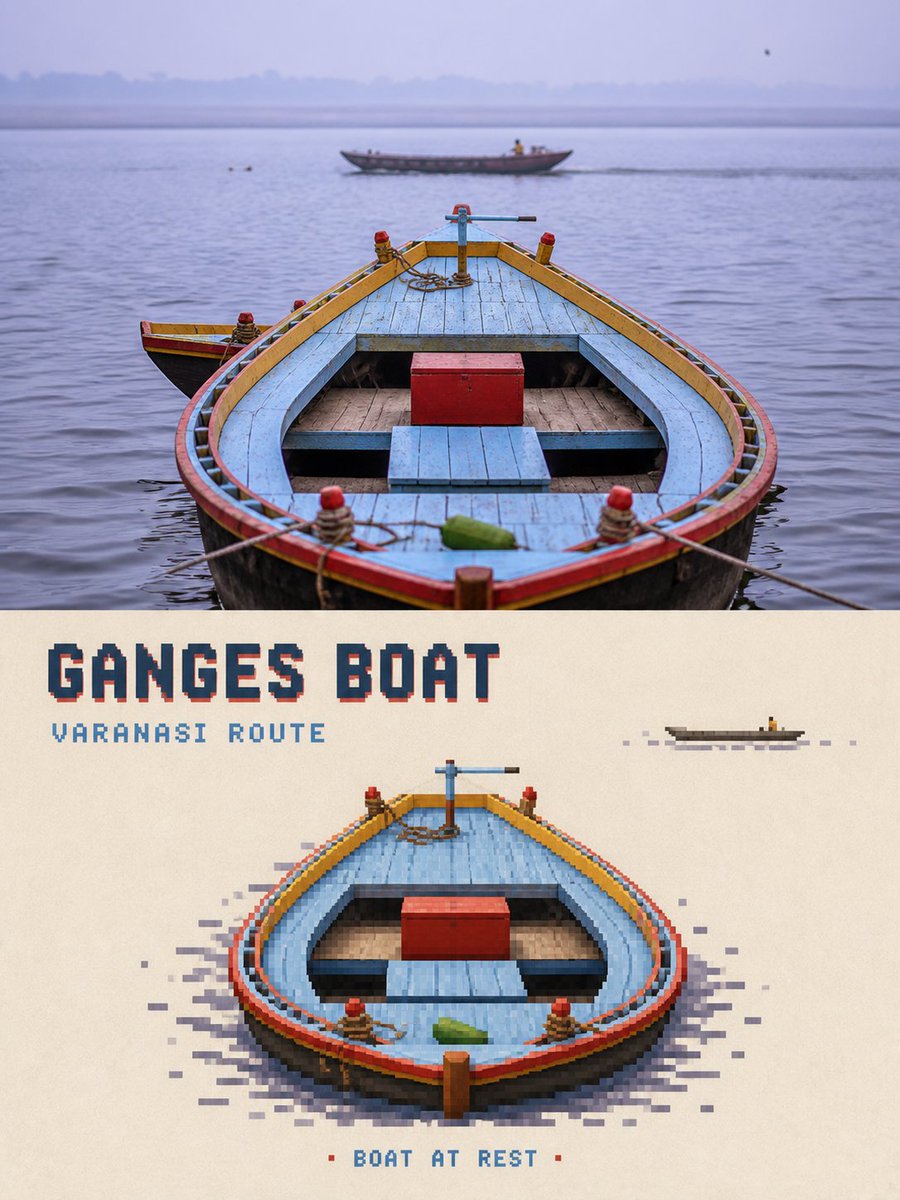
Pixel Art Travel Game Poster
A creative poster design that translates travel photographs into modular pixel art game assets, focusing on a single recognizable visual anchor.
This is a GPT Image 2 prompt case for Graphic & Poster. Use the copy-ready prompt below to generate similar visuals, and review Awesome GPT Image 2 Prompts attribution plus commercial-use rights before reuse.
Free 1K preview
Generate one preview image instantly, no sign-up required.
Free text preview doesn’t preserve reference-image consistency.
Prompt
Copy-ready prompt
Please transform each travel photo I upload into an individual high-end pixel game travel poster. No collage; one photo per final product.

Use a strict 3:4 vertical composition. Divide the frame into two areas of approximately 1:1 with a straight, clean horizontal boundary. Output only the poster face.

### Top Part: High-Fidelity Original Photography
Faithfully retain the original photo, preserving identities, structures, and lighting with minimal editorial grading and film grain. Do not illustrate the photo.

### Bottom Part: Subject-Refined Pixel Game Translation
Do not pixelate the whole photo. Identify a single visual subject worth exploring, such as: {argument name="visual anchor" default="a landmark building, ship, vehicle, person, gate, or bridge"}. Choose only one main visual anchor.

Reconstruct it into a mature travel game character, location, or interactive object. The subject should occupy 35-60% width and 25-45% height of the lower section.

### Environmental Simplification
Keep only 1-3 environment clues (e.g., a small stretch of road, a few trees, water ripples). Keep 50-65% of the lower area as continuous warm off-white paper.

### Pixel Medium
Use sharp square pixels to rebuild the subject. Use smaller, denser pixels for key recognizable details and medium pixels for the main volume. Gradually decrease pixel density for roads and vegetation. The subject should be relatively complete internally but fragmented at the edges along contours and paths.
Prompt variables
Editable argument placeholders found in the prompt, with their default values.
Best for
- - Graphic & Poster visual exploration
- - Image generation and reference-image edits
- - Reusable briefs that keep source attribution visible
Change these parts
- - Subject, product, character, or scene
- - Aspect ratio, camera, lighting, and background
- - Brand, text, color, and output constraints
Recommended model and settings
- - Model: gpt-image-2
- - Input mode: Image to Image
- - Aspect ratio: source
- - Commercial status: review original source
How to use this prompt
- 1. Copy the prompt and preserve its structure for the first test.
- 2. Replace the subject, context, and publishing channel.
- 3. Change one camera, lighting, or style variable per iteration.
- 4. Inspect the output, source, text, and rights before reuse.
Limitations, source, and reuse cautions
- - Generated output is an editable draft, not factual, legal, or rights evidence.
- - Review the linked source, people, brands, logos, text, and third-party media before commercial use.
More cases in this category
Prioritized by category, input mode compatibility, quality, and lower risk.
Reuse and source notes
Use this prompt safely after previewing the case.
- 1.Copy the prompt or open it directly in Dovoo with the generation button.
- 2.Adjust variables, aspect ratio, and reference images for your own use case.
- 3.Before publishing or paid usage, verify source rights, attribution requirements, and brand or likeness risks.
Can I use this prompt commercially?
Commercial-use status is allowed. Review the original source, license, brand constraints, and legal requirements before paid usage.
Where does this case come from?
This case is imported from Awesome GPT Image 2 Prompts; keep attribution visible and check the source URL before reuse.