IP
Generate

gpt-image-2 prompt example

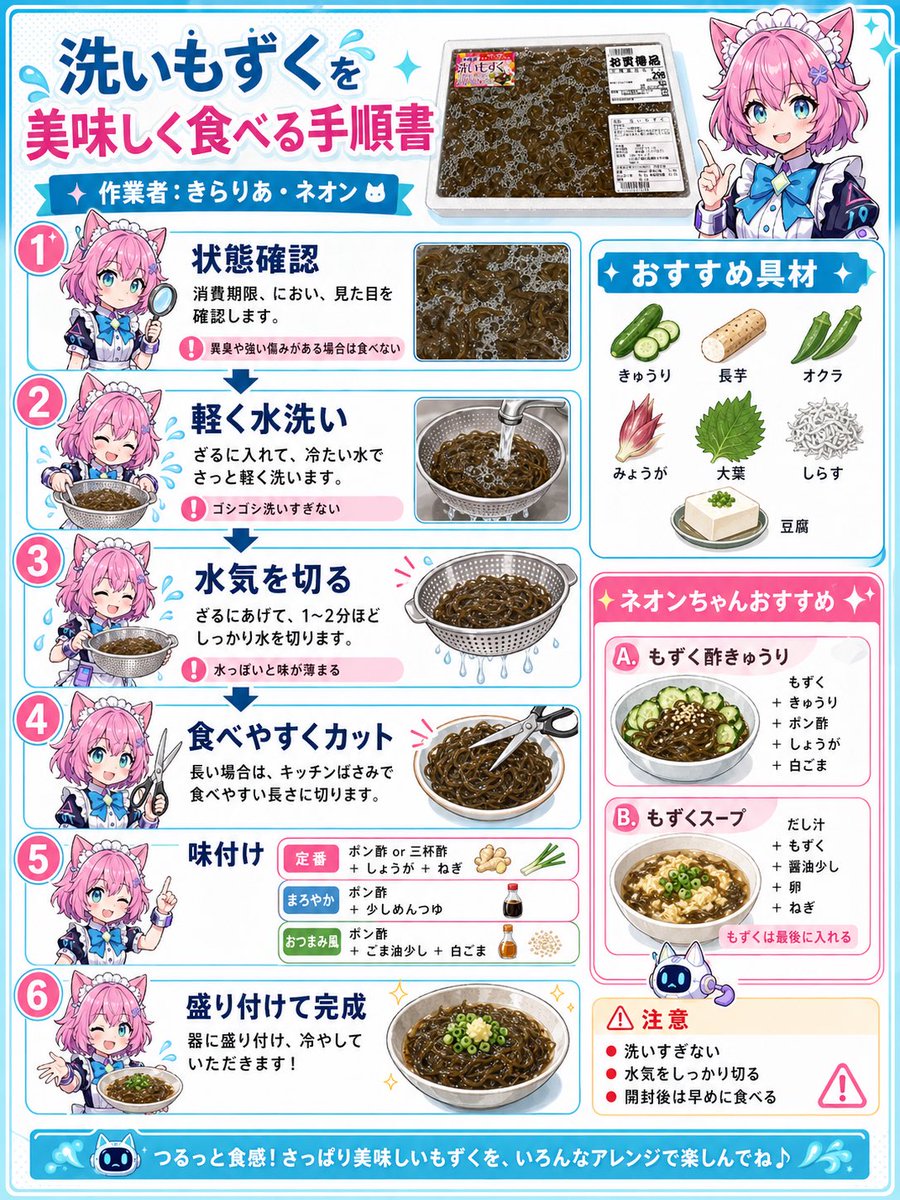
Cute Feng Shui Cloud Vegetable (mozuku) Making Guide Infographic

This prompt can transform a packaged water spinach reference photo into a brightly colored Japanese cooking step-by-step infographic poster, suitable for recipe guides or social media sharing.

Copy-ready prompt

Using the provided reference image of washed water spinach on its packaging, transform it into a cute Japanese recipe infographic poster teaching how to properly consume it. Ensure product recognition by displaying a photo of the packaging near the top and reuse the water spinach itself in small food/processing photos, but redesign all other elements with a bright, clean blue-pink editorial layout. Add a cheerful anime catgirl guide character with pink hair and cat ears who appears multiple times as an instructor. Create a striking Japanese title at the top: “洗いもずくを美味しく食べる手顺书” (Washing Water Spinach to Make It Delicious Handbook), and add a staff nameplate that reads “作业者:きらりあ・ネオン” (Worker: Kiraria Neon). Construct a 6-step vertical instruction flow on the left/center, connected using numbered circles from 1 to 6 and arrows. The 6 steps should be titled: 1 "Status Confirmation", 2 "Light Washing", 3 "Cutting Water", 4 "Cut with Kitchen Scissors", 5 "Adding Seasoning", 6 "Serving and Finishing". For each step, include a brief Japanese description and a supporting image/illustration showing the water spinach at that stage; specifically, include 1 image of packaging/close-up status confirmation, 1 image of rinsing in a strainer, 1 image of draining in a strainer, 1 image of cutting with kitchen scissors, 3 mini boxes for seasoning options below step 5, and 1 image of the finished dish served in a bowl below step 6. Add the title "おすすめtool" to the right panel to display 7 vignettes with labels: きゅうり, long taro, オクラ, みょうが, daye, しらす, and tofu. Add another recommendation panel on the right, titled "ネオンちゃんおすすめ", containing 2 cards marked A and B The menu cards: A "もずく酢きゅうり" and B "もずくスープ", each card comes with a picture of the bowl and a Japanese ingredient list. Add a "Note" box in the bottom right corner with three key points: "I don't want to wash it," "Cut the water vapor," and "Eat it as soon as you open it." Add a friendly Japanese footer banner at the bottom to encourage everyone to enjoy water spinach. The overall design is a highly readable supermarket flyer/cooking guide infographic, featuring rounded borders, glossy finishes, a clear hierarchical structure, and a vibrant, cute style.

Try this prompt

Prompt breakdown

Subject

Using the provided reference image of washed water spinach on its packaging, transform it into a cute Japanese recipe infographic poster teaching how to properly consume it.

Style and composition

Ensure product recognition by displaying a photo of the packaging near the top and reuse the water spinach itself in small food/processing photos, but redesign all other elements with a bright, clean blue-pink editorial layout.

Use case

Add a cheerful anime catgirl guide character with pink hair and cat ears who appears multiple times as an instructor.

Safety constraints

Create a striking Japanese title at the top: “洗いもずくを美味しく食べる手顺书” (Washing Water Spinach to Make It Delicious Handbook), and add a staff nameplate that reads “作业者:きらりあ・ネオン” (Worker: Kiraria Neon).

Related templates

Related examples

Shi Xiangyun Hanfu Story Poster Preview Image
Shi Xiangyun Hanfu Story Poster
source · GPT Image 2
Poster design

Objective: To create a gorgeous vertical Chinese-style romance poster/character infographic, featuring the main character as {argument name="character name" default="Shi Xiangyun"} The poster presents a full-body portrait of a young noblewoman in a spring garden, blending cinematic realism with exquisite illustration UI overlays. The canvas is a 2:3 vertical poster using warm-toned parchment and gold tones, featuring soft morning light, shallow depth of field, and high detail. The background is a blooming classical Chinese courtyard, including pavilions, stone paths, flowering trees, peonies, falling pink petals, and a dreamlike misty atmosphere. The main subject is a woman in full Hanfu (traditional Han clothing) standing on a circular, carved stone platform. She wears flowing, light-colored embroidered Hanfu, with a color scheme of {argument name="dress colors" default="Pale blue, pink, ivory white and soft cyan"} Layered, semi-transparent cuffs and long ribbons fluttered in the breeze, adorned with floral embroidery, a pink belt, tassel pendants, and embroidered shoes. Her hair was decorated with small flowers and hairpins. Her right hand extended towards the audience, holding a green floral porcelain wine cup; her left hand held a large bunch of pink peonies. Her posture was elegant, composed, and approachable, with her face softened or blurred. Left title bar: A textured parchment vertical bar was added to the left. The large black calligraphy title read "Shi Xiangyun". A smaller vertical subtitle read "Dream of the Red Chamber: Old Friends by the Pillow and Clouds". A red seal was added. Below were three stacked rectangular navigation tabs labeled: 1) "Bright and forthright" 2) "Drunkenly reclining among peonies" 3) "Youthful purity". Information cards: Eight vintage parchment story cards surrounded the main body, connected by fine gold geometric lines, circular number badges, semi-transparent crystal-like paper scraps, and faint constellation nodes. Each card includes a sepia miniature illustration and a Chinese title/text. Please use the following precise numbered titles: 01 "Old Images of the Shi Family Mansion, Xiangyun's First Arrival" 02 "Applause in the Grand View Garden" 03 "The Begonia Poetry Club's Brilliant Talent" 04 "The Luxue Hermitage, a Couplet of Unrestrained Spirit" 05 "Drunk on Peonies, a Spring Dream of Flowers" 06 "The Golden Kirin's Fate, a Subtle Echo" 07 "Old Friends' Laughter Like the Wind" 08 "Clouds Disperse, the Bright Echoes of Gaotang" Arrange cards 01, 02, 03, and 04 along the left/bottom left, and cards 05, 06, 07, and 08 along the right. Keep the text small, decorative, and secondary; prioritize the title and numbered badges. Bottom element: Add a gold plaque with an inscription at the platform base.{argument name="bottom quote" default="A cup of spring wine, and the fragrance of flowers all over."} At the bottom edge, add a thin gold timeline containing five labeled nodes: "First Arrival," "Poetry Society," "Collected Verses," "Drunken Retreat," and "Echoes." Visual Style: Elegant Chinese retro editorial design, *Dream of the Red Chamber* aesthetics, parchment texture, gold borders, ink-wash calligraphy font, tan story thumbnails, translucent collage fragments, romantic peonies, soft bokeh, high-end museum poster composition, highly detailed fabrics and embroidery, and cinematic lighting. Constraints: All text must be in Chinese as specified; no English text is allowed within the images; no watermarks, no logos, no additional cards or timeline nodes, and no modern objects are permitted.

Poster design
Lin Daiyu costume drama poster preview image
Lin Daiyu costume drama poster
source · GPT Image 2
Poster design

Objective: For{argument name="series title" default="Lin Daiyu"} Create a vertical, cinematic poster of a character from a Chinese period drama, blending realistic period drama style with traditional Chinese ink painting graphic design, and presenting the aesthetics of a literary suspense/poetry interface. Canvas: High-ratio 2:3 poster, using gray-green and dark brown tones, with an aged Xuan paper texture on the left edge. The background is a dark bamboo forest and a stone garden in the rain, accompanied by soft mist and falling petals. The entire composition is covered with delicate golden geometric star lines. Subject: A full-body portrait of a young noblewoman from the Qing Dynasty/classical Chinese literature background, standing in the center on a circular carved stone platform. She wears a light blue-green layered Hanfu, with semi-transparent gauze sleeves, embroidered patterns, long ribbons, and elegant blue shoes faintly visible. Her hairstyle is an exquisite bun, decorated with black hair ornaments, white flowers, and hanging silver tassels, exuding a scholarly and poetic temperament. The face is deliberately softened and blurred, while the details of the clothing remain clear. She extends one hand to the audience, holding an old, handwritten manuscript of poetry; her other hand, gathered around her sleeve, clutches a long tassel pendant adorned with jade beads. A blooming branch is added to the foreground, with petals scattered at her feet. Left title bar: The words "Lin Daiyu" in large, striking black Chinese characters are vertically arranged at the top left. Below, smaller text reads "Dream of the Red Chamber: Xiaoxiang Concubine." Faint background handwritten text and a red seal are added. Left side labels: Three small square labels are stacked vertically below the subtitle, labeled "Refined Talent," "Poetic Soul Burying Flowers," and "Delicate Willow in the Wind." Drama Card Layout: Eight retro drama cards surround the central figure, connected by fine gold thread, light-colored borders, corner decorations, and tiny nodes. Each card contains a circular number badge, a Chinese title, a small monochrome illustration resembling an old woodblock print, and two lines of short Chinese phrases. Four cards are arranged on the left and four on the right. The eight episode cards are as follows: 1. Top left card number 01, titled "Daiyu Enters the Mansion in Yangzhou's Old Dreams," depicting a scene of a riverboat/arrival. 2. Left card number 02, titled "Bamboo Shadows in the Xiaoxiang Pavilion's Chill," depicting a bamboo grove courtyard. 3. Bottom left card number 03, titled "The First Planting of Love in the Predestined Bond of Wood and Stone," depicting a scene of two young people sitting side by side. 4. Bottom left card number 04, titled "Reading the West Chamber Together, Hearts in Harmony," depicting a scene of two people reading together. 5. Top right card number 05, titled "The Begonia Poetry Club's Talent Amazes the Audience," depicting a scene of a poetry gathering at a table. 6. Right center card number 06, titled "The Burial of Flowers Becomes a Piece of Pure Earth," depicting a sorrowful scene of burying flowers. 7. Bottom right card number 07, titled "Burning Manuscripts to Sever Infatuation, Tears End, Soul Returns," depicting a woman by a desk or window. 8. Card number 08 in the bottom right corner, titled "The Poetic Soul Under the Cold Moon, Fragrant Through the Ages," showcases a commemorative scene under the moonlight. Bottom navigation: A thin gold timeline is placed at the bottom edge, containing 5 circular nodes and 5 labels: "Entering the Mansion," "Xiaoxiang," "Poetry Society," "Burying Flowers," and "Burning Manuscripts." Above the timeline, at the center of the stone base, a carved gold plaque is added, inscribed with "A scroll of poems, a courtyard full of fallen flowers." Visual style: A highly detailed, realistic fantasy poster with a Chinese ink painting atmosphere, an antique paper collage feel, an exquisite UI/infographic framework, delicate gold line outlining, weathered textures, cinematic lighting, shallow depth of field, an elegant and melancholic tone, soft mist, symmetrical balance, no modern objects, no watermarks, and no English characters in the image.

Poster design
Poster preview image of noblewomen in ancient China
Poster of a noblewoman in ancient China
source · GPT Image 2
Poster design

Objective: To create a vertical infographic for a Chinese historical romance character poster, depicting a noblewoman in a traditional Chinese garden, with the theme revolving around {argument name="character name" default="Xue Baochai"} This poster blends exquisite Qing Dynasty/Hanfu style, scrapbook textures, and numbered story illustrations. The canvas is a 2:3 vertical format with an antique parchment background and torn paper edges. It features brown ink calligraphy, delicate gold geometric lines, and overlapping translucent cracked glass polygons. The overall color scheme is a soft blend of beige, cream, gray-pink, sage green, dark ink, and aged gold. The central subject is a noblewoman dressed in full aristocratic attire, standing on a carved circular stone pedestal against a blurred backdrop of an ancient-style study/garden. The face is deliberately blurred, obscuring features, as if anonymizing the subject, while the rest of the portrait is highly detailed. She wears an exquisite cream-colored embroidered robe with layered wide sleeves, a peach-pink translucent overcoat, and sage green piping. The front and hem are adorned with peony embroidery. She wears embroidered shoes and a gold and beaded headdress with dangling beads. She holds a round fan in her left hand, the fan surface painted with peonies and vertical Chinese calligraphy; in her right hand, she holds a round gold pendant at her chest; tassels and beaded chains hang from her wrists. Overall posture: elegant, dignified, and slightly turned to the side, presenting the effect of a luxurious period drama character still. Main layout: On the far left, a large black vertical calligraphy piece is placed, the content of which is {argument name="main title" default="Xue Baochai"} Below is smaller vertical text.{argument name="subtitle" default="Dream of the Red Chamber: Lady Hengwu"} A red stamp is affixed next to the title. The small label on the left contains three stacked beige stamp-style labels with dark borders and Chinese text: 1) “Dignified and Gentle,” 2) “A Perfect Match,” 3) “Concealing Foolishness and Keeping a Simple Life.” Story Cards: Eight numbered illustrated cards are arranged around the central character, connected by fine gold thread and triangular geometric structures. Each card features a dark circular number badge, a Chinese title, a sepia-toned photographic illustration, and two lines of brief Chinese description. The eight cards are as follows: 1) Top left card, number 01, titled “The Xue Family Enters the Capital, Baochai Arrives,” showing the young girl arriving surrounded by her entourage. 2) Top right card, number 02, titled “The Fragrant Herbs in Hengwu Garden,” showing a garden pavilion scene. 3) Bottom right card, number 03, titled “The Tale of the Golden Lock and Jade,” showing a seated figure indoors with a blurred face. 4) Right center card, number 04, titled "The Cold Fragrance Pill: A Warm and Profound Heart," depicts a young girl writing or studying at a desk. 5) Bottom right card, number 05, titled "Poetry Club: Talents Unveiled," depicts a group of people sitting around a desk. 6) Left center card, number 06, titled "Butterflies Fluttering Among Flowers: Spring Shadows Swaying," depicts two young girls in a garden. 7) Bottom left card, number 07, titled "Bao, Dai, and Chai: A Balance of Emotion and Propriety," depicts a scene of conversation among three people. 8) Bottom left bottom card, number 08, titled "Golden Wedding: A Dream Awakens in the Red Chamber," depicts a wedding or formal gathering scene. Bottom title plate: A long, gold-edged plaque with a slogan is added to the base.{argument name="bottom quote" default="A round fan, half a lifetime of gold and jade"} Featuring black Chinese calligraphy. Bottom Timeline: At the bottom edge, add 5 milestone labels connected by a thin gold line with small dots: "Entering the Capital," "Hengwu," "Golden Lock," "Poetry Society," and "Wedding." Visual Style: Highly detailed, cinematic-quality period drama posters, collages of ancient Chinese books, exquisite feminine luxury, realistic fabric embroidery, peony motifs, shallow depth of field, soft warm lighting, museum-quality textures, aged paper grain, ink-wash details, gold-thread borders, and elegant editorial layout. Restrictions: All visible titles and labels must strictly use the specified Chinese characters. Maintain a central figure as the main subject and a full-body portrait. Includes 8 numbered illustrated cards, 3 left-side labels, and 5 bottom timeline milestones. Do not add additional numbered sections, modern items, logos, watermarks, or any English characters.

Poster design
Explosive food infographic composition preview image
Explosive food infographic composition
source · GPT Image 2
Infographic

Create a hyper-realistic vertical exploded infographic composition to showcase{argument name="food item" default="tacos"} The structure from top to bottom: Fresh lettuce (crisp green texture with natural wrinkles) → Tomato and salsa layer (juicy diced tomatoes and salsa mixture) → Melted cheese (smooth cheddar texture) → Meat filling (juicy seasoned meat details) → Taco crust (crispy golden crust texture). Perfect vertical alignment, rustic background, soft studio lighting, and realistic shadows beneath each floating element. Added clear infographic text labels with fine indicator lines, using the following exact labels: "Lettuce," "Salsa," "Cheese," "Meat," and "Shell." Ultra-fine food textures, high-end commercial aesthetics, 8K resolution.

Infographic
Prompt word preview image
Prompt words
source · GPT Image 2
GPT Image 2 Prompt

Create a high-end beauty editorial-style infographic based on uploaded portrait photos. Retain authentic personal identities and identifiable facial features. Maintain natural skin texture and realistic proportions. Style: [Replace style here] Layout: Luxury fashion magazine style

GPT Image 2 Prompt
Anime Mentor Whiteboard Infographic Preview Image
Anime Mentor Whiteboard Infographic
source · GPT Image 2
Infographic

Objective: To create a minimalist, anime-style classroom/office presentation scene, containing [images/features].{argument name="character name" default="A female business mentor"} Standing beside a large whiteboard, she explains an abstract data/AI workflow infographic. Canvas: 16:9 widescreen horizontal illustration, bright sunlight, soft pastel tones, clean lines, modern Japanese anime visual style, soft shadows, professional yet friendly atmosphere. Layout: The instructor stands in the left third of the frame, partially obscuring the whiteboard. She holds a dark tablet/laptop in front of her in one hand, and points a pen at the whiteboard in the other. A desk is positioned at the bottom foreground, with a laptop, a white mug, and printed charts on it. In the distance, a potted plant and a tall window are visible on the left. A light blue office chair is faintly visible in the lower right foreground. Character details: The instructor has long hair {argument name="hair color" default="gold"} She wore a white headscarf with a bow, a light green suit jacket, a white shirt, light-colored trousers, a black belt, and a small necklace. Her face was deliberately obscured by a solid beige rectangular mask in the center, revealing no facial features. Her posture was confident and instructive, facing the whiteboard. Whiteboard content: The whiteboard should precisely display two large rounded rectangular infographic panels. The left panel contains a 3D cube/module diagram composed of cyan, cream, and yellow cubes, with a small cube icon and three small colored dots near the top. A large double-headed horizontal arrow is placed between the two panels. The right panel contains five data visualization elements: a node network diagram with colored circles and connecting lines, an upward trend line chart, a vertical bar chart, a set of three horizontal slider controls, and a pie/ring chart. Chart colors should be cyan, soft yellow, gray, and cream. Avoid readable text on the whiteboard. Foreground Items: Includes 4 desktop items: an open laptop, a white coffee mug, a printed chart sheet, and a visible desktop edge. The whiteboard tray contains 5 small items: 3 colored markers, a dark chalkboard eraser, and a gray chalkboard eraser. Visual Style: Soft watercolor anime rendering with clean lines, warm sunlight streaming in from the left, light cream-colored walls, and subtle reflections on the whiteboard border, creating a clean and modern workspace. Keep the composition spacious and uncluttered. Constraints: No clear text, no logos, no watermarks, no extra characters, and a non-photorealistic style. The beige face-obscuring rectangle is retained as a deliberate visual element.

Infographic
AI Infrastructure Infographic Poster Preview Image
AI Infrastructure Infographic Poster
source · GPT Image 2
Poster design

Objective: To create a well-made vertical educational infographic, titled "..."{argument name="headline text" default="AI infrastructure"} The subtitle is{argument name="subtitle text" default="How Modern AI Systems Work"} This document provides an in-depth analysis of modern AI infrastructure, from data pipelines and GPU training clusters to inference services, batch processing, and key-value caches. Canvas: A portrait poster, 4:5 aspect ratio, with a deep blue, futuristic data center style. The background features a glowing blue/purple grid, complemented by illustrations of mountains, server racks, GPU chips, neon circuitry, slim, rounded panels, white and cyan fonts, and small orange numbered logos. The overall look should resemble a high-end technical poster, dense yet easy to read. Layout: A main heading is at the top left, followed by subheadings and slogans below, and decorative server racks and GPU chips at the top right. The content is divided into eight numbered main sections, with a "Key Concepts" section on the right and a flow footer at the bottom. Precise panel borders, icons, arrows, charts, tables, and microtabs are used. Sections and required content: 1. Data Pipeline: Showcasing five pipeline stages connected by arrows: raw data source, ingestion and cleaning, annotation/organization, word segmentation/chunking, and sharding and storage. The raw data source includes 5 key elements: web pages, documents, code, images, and logs. Ingestion and cleaning includes 3 key elements: filtering, deduplication, and normalization. Labeling/organization includes 3 key elements: quality checks, manual/heuristic methods, and dataset assembly. Tokenization/chunking includes 3 key elements: conversion to tokens, chunking into documents, and adding special tokens. Sharding and storage includes 3 key elements: splitting into shards, balanced partitioning, and optimization for parallel reads. Add explanatory text indicating that the data has been cleaned, deduplicated, organized, tokenized, and stored as shards for efficient reading by multiple worker nodes. 2. Storage and Orchestration Layer: Includes 3 vertical cards: Object Storage (with a cloud-to-database icon, labeled "S3 / GCS / Azure Blob or local object storage"); Metadata/Experiment Tracking (with a dashboard icon, key elements: "Running and Metrics", "Hyperparameters", "Lineage and Artifacts"); Monitoring and Logs (with charts/magnifying glass icons, key elements: "Metrics and Alerts", "Log Aggregation", "Tracking and Debugging"). Add a footer explanation: The control layer is responsible for coordinating computational tasks, tracking experiments, storing checkpoints, and monitoring utilization, failures, and costs. 3. Training Cluster Architecture: A central large architecture diagram, titled "Training Cluster Architecture." It shows four GPU/accelerator node boxes arranged in a 2x2 grid, connected by glowing high-speed network links labeled "High-Speed ​​Network InfiniBand / RoCE." Each node contains a CPU host (multi-core), RAM, GPU (e.g., 8x H100), and an NVMe local SSD. Dashed lines connect the nodes. Below are three smaller panels: Node Internals, Data Parallelism, and Distributed Training Parallelism (legend). The Node Internals panel should show the CPU connected to multiple GPUs via PCIe/NVLink/NVSwitch lines. The Distributed Training Parallelism legend should show four stages, labeled Stage 1, Stage 2, Stage 3, and Stage 4. 4. Training Steps: Create a training flow from left to right, containing six stages: Input Token, Forward Propagation, Loss Calculation, Backpropagation, Gradient Calculation, and Optimizer Update. Includes a stack of checkpoint icons, a "Model Accuracy" box (mentioning FP32, FP16/BF16, FP8), and an "Optimizer Status" box. It displays gradient accumulation arrows with the explanation: During training, the model predicts output, calculates loss, backpropagates gradients, and updates weights; this process is repeated billions of times. 5. Inference Service Pipeline: Creates a compact service flowchart with 6 stages at the top: User Requests, API Gateway, Tokenizer, Scheduler/Router, Model Server (GPU), and Streaming Output. The panel includes dynamic batching (3 lines of requests), a Model Server box (showing pre-filling and decoding loops), KV Cache in GPU memory, optional adapters, and a load balancer connecting 3 model replicas (labeled Model Replica 1, Model Replica 2, and Model Replica N). 6. Operations, Reliability, and Security: Includes 6 operations cards with icons: Auto-scaling/Scaling, Telemetry/Observability, Rate Limiting and Quotas, Security Filters/Guardrails, Version Control/Rollback, and Cost Monitoring. Add notes: Production-grade AI systems require robust operational tools to maintain reliability, security, and cost-effectiveness. 7. Training vs. Inference Comparison: Add a comparison table with 6 rows: Objective, Main Bottlenecks, Memory Concerns, Typical Metrics, Scaling Mode, and Elasticity Requirements. Label the two columns "Training" and "Inference (Service)" respectively. Training should describe learning model weights from data, distributed computing and data movement bandwidth, activation values/gradients/optimizer states, tokens per second or convergence speed, large batches of long tasks, and checkpoints/fault tolerance. Inference should describe user-generated useful responses, latency and throughput, model weights plus KV cache, latency and tokens per second, a large number of short requests, and high availability/graceful degradation. 8. Right-hand "Key Concepts" Sidebar: Create a tall right-hand sidebar titled "Key Concepts," containing 5 cards with letters: A. Batch Size, B. Sequence Length/Context Window, C. KV Cache, D. Throughput and Latency, E. Parameters/Weights/Activation Values. Card A should define the batch size and show a comparison between small and large batches (Token/person icons). Card B should show the cue word token and long context (token blocks labeled T1, T2, T3, T4, …, Tn). Card C should show the cue word token being input into a purple cylindrical KV cache, followed by new tokens being read from the cache. Card D should show two dashboards: throughput and latency. Card E should show weights and activation values ​​(blue and purple grids connected by multiplication). Add a "Prefilling vs. Decoding" tip at the bottom of the sidebar, explaining that prefilling processes complete cue words, while decoding generates tokens one by one using the KV cache. Footer: Add a bottom navigation bar in the sequence "Data → Training → Inference → Value," with a small circular rocket/compass icon on the left and a closing statement.{argument name="footer quote" default="Drive intelligent systems with data, computing power, and superior engineering capabilities."} Visual style: Dense corporate infographics, clean vector and semi-3D icons, glowing cyan outlines, subtle gradients, volumetric lighting, small schematics, micro-charts, and clean serif heading fonts paired with modern sans-serif labels. The color scheme should be {argument name="color palette" default="Deep navy blue, electric blue, cyan, violet, white, and a small amount of amber accents"} Constraints: Use 8 numbered main modules, 5 key concept cards, 4 GPU nodes, 6 training phases, 6 inference phases, 6 maintenance cards, and 6 rows of training vs. inference comparison tables. All visible text should be in English, watermarks and brand logos should be avoided, and high readability should be maintained within the dense layout.

Poster design
3D Infographic Preview Image of China's Divorce Data
3D Infographic of Chinese Divorce Data
source · GPT Image 2
Infographic

Objective: To create an elegant, edit-style 3D infographic with the theme of{argument name="headline topic" default="China's divorce population, 2020–2026"} The design employs Chinese fonts and a minimalist museum aesthetic. Canvas: 16:9 horizontal composition with a warm-toned off-white textured paper background, utilizing soft studio lighting, subtle shadows, and a soft cream background. Layout: A prominent black Chinese title, "2020–2026 China's Divorce Rates," is placed in the upper left. Below, a smaller subtitle, "Divorce Procedures Handled Nationwide," is added, accompanied by a thin horizontal line ending with a small orange dot. The main visual element is a dark charcoal gray oval/cylindrical display stand spanning the lower middle section, with a stage-like recessed oval opening at the top. On the front of the stand, the years are labeled from left to right: 2020, 2021, 2022, 2023, 2024, 2025, 2026. Chart elements: Seven vertical year positions are used. Five solid 3D cuboid bar charts and two dashed outline placeholder bars are displayed. The five solid bars represent: a tall, ochre-gold bar from 2020, labeled "433.9"; a shorter, grey-coral bar from 2021, labeled "283.9" with a small label "2021 Low"; a soft sage-green bar from 2022, labeled "287.9"; a taller salmon-pink bar from 2023, labeled "360.53" with a small label "2023 Rebound"; and a beige stone-textured bar from 2024, labeled "351.3". Two future placeholders are dashed, transparent bars for 2025 and 2026, each with a "To be updated" label below. Add small black dots and guide lines above each value. Decorative details: Add two miniature figures to reflect proportion: one standing on the left edge of the display, near a simple railing and sparse, delicate branches/trees; the other standing on the right, near the future data bars. Add a large, flat, golden sun ring in the upper right corner. Place a tall, cream-colored rectangular board at the right rear of the booth, with a thin, black vertical line in front of it. In the lower left corner, place a wooden semicircle, a slanted piece of paper with small orange dots, a light green cube, and a miniature beige line chart card affixed to the front of the booth. Text and Legend: Add an orange dot in the lower left corner, followed by "Unit: 10,000 pairs". All visible text should be in Chinese, using a clear black font, without additional labels. Visual Style: Refined data visualization poster, tactile paper texture, 3D clay/paper-cut style, ochre, coral, sage green, and beige color palette, high-end magazine infographics, ample white space, realistic soft shadows, and precise alignment. Constraints: Strictly adhere to the above 7 year positions, as well as 5 solid bars and 2 dashed future bars. Do not add watermarks, logos, additional charts, or extra figures.

Infographic
Creamy-colored Chinese divorce data chart preview image
Creamy-colored Chinese divorce data chart
source · GPT Image 2
GPT Image 2 Prompt

Objective: Create a cream-themed, editable data visualization poster with the theme of {argument name="headline text" default="Number of divorces in China, 2020–2026"} This presentation uses a miniature 3D bar chart installation to display the number of divorces in China from 2020 to 2026. The canvas is a widescreen 16:9 composition with a warm ivory paper background featuring delicate textures, soft studio lighting, and ample white space, creating a sophisticated magazine-quality infographic. The layout features a prominent black serif Chinese title on the left, divided into two lines: "2020–2026" and "Number of Divorces in China." Below this is a subtitle, "Divorce Procedures Handled Nationwide According to Law," accompanied by a thin horizontal line ending with a small orange dot. An orange dot and the label "Unit: 10,000 Couples" are added to the lower left corner. The main chart is located in the lower center, placed on a matte black oval/cylindrical base, presented from a micro-perspective. Year labels are printed on the front edge of the base. Data and chart elements: Seven year positions are used, labeled 2020, 2021, 2022, 2023, 2024, 2025, and 2026. The chart displays five solid 3D bar charts and two placeholder bars for future forecasts. The five solid bars are: a tall, gold bar for 2020, labeled "433.9"; a shorter, terracotta-red bar for 2021, labeled "283.9" with a beige label "2021 Low"; a soft sage-green bar for 2022, labeled "287.9"; a salmon-pink bar for 2023, labeled "360.53" with a pink label "2023 Rebound"; and a beige bar for 2024, labeled "351.3". The two placeholder bars for 2025 and 2026 are displayed as transparent rectangular bars with dashed outlines. Each bar has a dashed guide line connecting it to a hanging label that reads "To be updated". Black dots are used above the bar charts, and thin guide lines connect the numerical labels and annotations. Decorative scene details: Miniature figures are added to emphasize proportion: one figure stands on the left edge of the base, near a delicate, leafless decorative tree and railing; another figure stands on the right, near a future placeholder pillar. In front of the base is a small piece of paper with a simple line drawing and orange dots, a small pale green cube, and a semi-circular wooden decoration behind the paper. On the far right, a tall beige rectangular panel is added with two thin black vertical bars and a large gold sun-shaped ring above. Visual style: A soft cream aesthetic, tactile paper and clay textures, using soft tones of black, ivory, ochre, terracotta, sage green, salmon pink, beige, and warm wood tones. Titles use an elegant serif font, while numbers and small labels use a clean sans-serif font. Realistic soft shadows, miniature scale, and high-end editorial data visualizations contribute to a sophisticated and refined style. Constraints: Ensure all visible Chinese text is completely identical to the specified content, use the specified 7 year labels and 5 numerical values, and do not add any additional bar charts, legends, logos, watermarks, or irrelevant text.

GPT Image 2 Prompt
Grok AI-edited infographic poster preview image
Grok AI Editable Infographic Poster
source · GPT Image 2
Poster design

Search about{argument name="topic" default="Grok AI"} Detailed information about the model, including its development history, underlying architecture, technological capabilities, training methods, practical applications, cultural impact, major breakthroughs, points of contention, well-known model versions, and little-known facts. Then, create a dramatic, editable infographic poster, referencing the style of {argument name="style" default="National Geographic Special Report"} — But the theme is groundbreaking artificial intelligence. Grok's most powerful and recognizable visual presentation is a full-bleed, atmospheric main visual that runs from top to bottom of the poster, using dramatic lighting and color tones in deep black, electric blue, chrome silver, and cosmic neon hues to match Grok's rebellious and futuristic identity. Oversized, bold "GROK" dominates the top of the poster in a stylish sci-fi font inspired by space technology and cyberpunk interfaces. Text and graphic panels float naturally above the image as editorial overlays, rather than traditional magazine layout frames. Content must include: release year and creator/company (xAI / Elon Musk), model architecture and parameter size, training data size and computing infrastructure, key capabilities and benchmark performance, integration with X (Twitter), adoption statistics and market impact, release milestones, notable public demos, major achievements, cultural significance, and three little-known facts. A technical specifications panel on the side showcases the architecture, multimodal capabilities, inference functionality, context windows, API ecosystem, and computing power. The bottom displays a timeline of Grok's major breakthroughs and releases. Content should mention real-time internet integration, its humor-driven personality, open-source initiatives, and competition with other cutting-edge AI models. The color scheme and atmosphere are entirely derived from Grok's own visual identity system—cinematic, avant-garde, intelligent, futuristic, and slightly rebellious. There are no white backgrounds, no magazine grids, and no boxed sections. All elements are organically superimposed on the full-bleed main visual image. The aspect ratio is 4:5. The content is dense, the texture rich, and the image quality cinematic; it's instantly recognizable as Grok.

Poster design
Poster preview image of miniature model of electronic components based on Chinese poetry
Poster featuring miniature models of electronic components based on Chinese poetry
source · GPT Image 2
Poster design

Objective: To create a vertical poster about Chinese education, combining miniature electronic components similar to LEGO with information about poetry.{argument name="poem title" default="Qinyuanchun Changsha"} This design combines study notes with infographics. Canvas: 3:4 vertical poster, warm beige background, advanced editing layout. The left side features a simple information panel; the right and lower areas showcase a realistic miniature scene, with electronic hardware components arranged to form a miniature industrial city. Layout: The top left corner features a striking deep navy blue calligraphy title, with the first line reading "Qinyuanchun" and the second line reading "Changsha," accompanied by a small, vertical red seal engraved with "Mao Zedong." Below the title is a subtitle: "5 Key Points Related to This Article." Below the subtitle, create 5 stacked knowledge cards, each containing a navy blue numbered square, a small icon, a bold title, and two lines of brief Chinese explanation. The 5 cards must be strictly labeled as: 01 Writing Background, 02 Poetic Genre, 03 Theme, 04 Artistic Features, 05 Historical Significance. Use delicate dividing lines and subtle circuitry decorations near the subtitle. Miniature Electronic Model: On the right, a highly detailed desktop scene is built using electronic components, resembling a LEGO building: white wall sockets, circuit breakers with red toggle switches, relays, terminal blocks, capacitors, metal rails, copper pipes, black cables, a transparent fuse box, a gray platform, and miniature bolts. A prominent wooden sign is mounted above the circuit components in the upper right corner, stating…{argument name="main sign text" default="Serving the People"} Add a large wall socket to the right edge and another socket module to the upper left. Place 10 miniature worker models in blue uniforms and yellow hard hats around the mechanical device, distributed near the platform, relay tower, and copper pipe path. Add small model trees along the edges to make the electronic components look more like a miniature city. Other visible signage: Add two smaller wooden signs to the lower half of the model. One sign in the lower left foreground reads "Orange Isle" with a small arrow. Another sign in the lower right foreground contains a few lines of short vertical Chinese characters, hinting at notes related to poetry; keep the text clear but as a secondary element. Visual style: A combination of photorealistic macro photography and infographic design, shallow depth of field, warm studio lighting, clear focus on the central electronic components, and a softly blurred background that presents realistic plastic, ceramic, copper, and metallic textures. Color scheme: Creamy beige, deep navy blue, copper orange, electronic white, metallic gray, red switch accents, and small blue and yellow worker models. Constraints: Use Chinese accurately in the designated locations, keep the left-side infographic concise and easy to read, strictly retain 5 knowledge cards and 10 worker models, avoid random additional titles or watermarks, and make the electronic components look like LEGO with modular fun, while maintaining their recognizability as real electronic hardware.

Poster design
Prompt: Generate a high-information 16:9 landscape poster titled "Swimwear Selection Guide | Swimwear Styles". The overall style is a high-end swimwear preview image.
Prompt: Generate a 16:9 horizontal poster with high information content titled "Swimwear Selection Guide | Swimwear Styles". The overall style is high-end swimwear.
source · GPT Image 2
Poster design

Generate a 16:9 horizontal poster with high information density titled "Swimwear Buying Guide | Swimwear Styles". The overall style should be a high-end swimwear brand lookbook + professional swimwear buying infographic + practical guide for summer water activities. It should possess the following qualities: a premium brand feel, strong communicative power, high information density, clear and readable buying reference value, professionalism, practicality, credibility, a stylish editorial feel, and a product guide aesthetic that combines quality and functionality.

Poster design
Cute Feng Shui Cloud Vegetable (mozuku) Making Guide Infographic for GPT Image 2 | Image Prompt Gallery