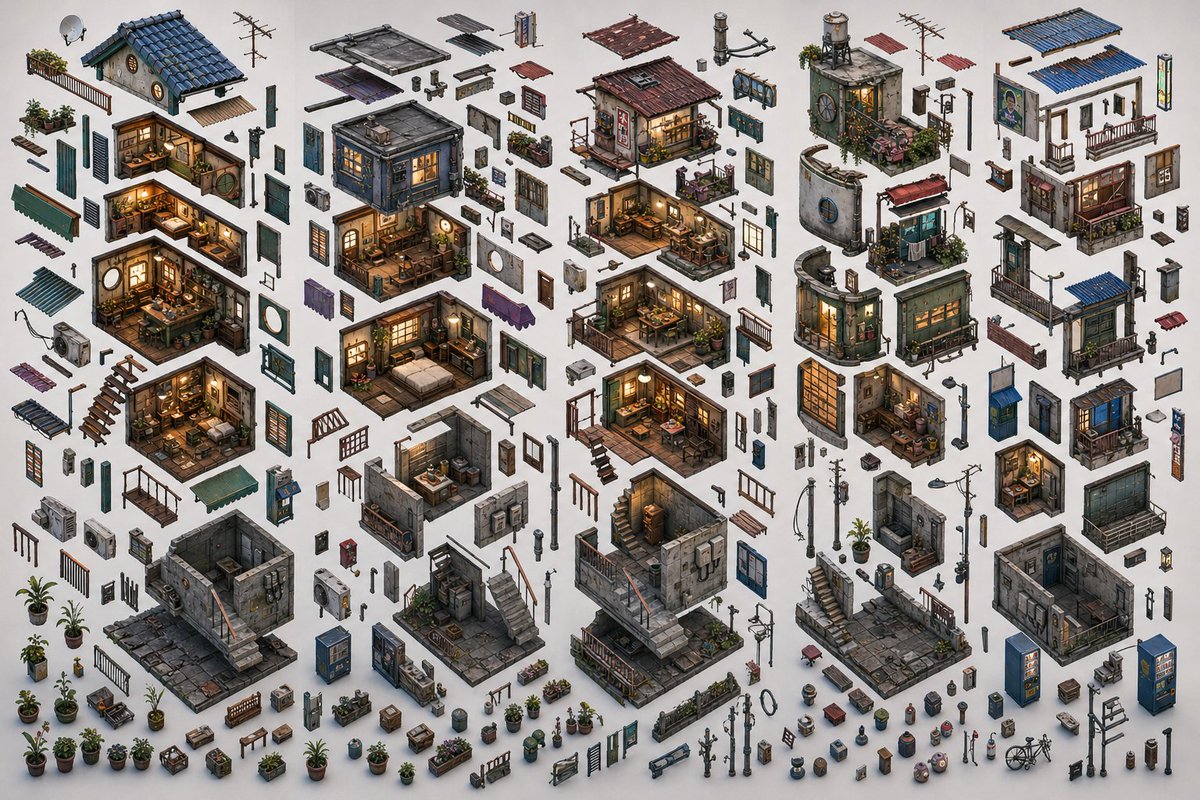
Isometric Exploded Urban Asset Sheet
A detailed isometric environment sheet of modular retro urban buildings and interiors, ideal for concept art, game asset design, and architectural worldbuilding.
This is a GPT Image 2 prompt case for Anime & Game. Use the copy-ready prompt below to generate similar visuals, and review Awesome GPT Image 2 Prompts attribution plus commercial-use rights before reuse.
Free 1K preview
Generate one preview image instantly, no sign-up required.
Prompt
Copy-ready prompt
A massive isometric exploded-view environment sheet showing a dense collection of modular retro urban buildings and room cutaways on a clean white background, rendered like a highly detailed game asset breakdown or architectural kitbash catalog. The image contains 20 main assembled structures or room modules, each separated into floating parts: 1 small gabled house with blue roof, 1 dark blue square building, 1 small rust-red house, 1 cylindrical weathered tower building, 1 white two-story house with blue roofs, 1 warm wood-paneled corner room, 1 compact study or office room, 1 bedroom, 1 dining room with balcony, 1 café or kitchen room, 1 narrow storefront room, 1 small lit alcove room, 1 large concrete stairwell block, 1 small tiled washroom, 1 medium concrete stair-and-landing block, 1 larger concrete stair platform block, 1 narrow concrete corridor or service block, 1 large empty concrete room, and 1 blue vending machine pair area. Surrounding all modules are hundreds of separated components arranged neatly in exploded fashion: roof panels, corrugated awnings, wall segments, doors, shutters, windows, stair flights, railings, balconies, signboards, pipes, antennas, utility poles, lamps, vents, meters, tanks, planters, flower boxes, benches, crates, air conditioners, cabinets, fences, street barriers, buckets, jars, utility boxes, and small street props. The style is painterly but precise, with cozy amber interior lighting contrasting against worn concrete, oxidized metal, chipped paint, rust-red and deep blue roofs, teal-green trim, and aged urban textures. Emphasize miniature diorama realism, isometric perspective, exploded assembly presentation, many floating parts evenly spaced around each structure, highly legible silhouette separation, soft studio shadowing, extremely intricate detail, concept-art polish, and the feeling of a comprehensive environment asset sheet for a side-street neighborhood in {argument name="city style" default="a nostalgic Japanese retro urban district"}. Include exactly 20 major modules, with the lower edge lined by many small props and potted plants, and keep the overall composition balanced across the full canvas. Use a crisp white background, no framing, no people, no vehicles except 1 bicycle, and no text labels.Prompt variables
Editable argument placeholders found in the prompt, with their default values.
Best for
- - Anime & Game visual exploration
- - Image generation and reference-image edits
- - Reusable briefs that keep source attribution visible
Change these parts
- - Subject, product, character, or scene
- - Aspect ratio, camera, lighting, and background
- - Brand, text, color, and output constraints
Recommended model and settings
- - Model: gpt-image-2
- - Input mode: Text to Image
- - Aspect ratio: source
- - Commercial status: review original source
How to use this prompt
- 1. Copy the prompt and preserve its structure for the first test.
- 2. Replace the subject, context, and publishing channel.
- 3. Change one camera, lighting, or style variable per iteration.
- 4. Inspect the output, source, text, and rights before reuse.
Limitations, source, and reuse cautions
- - Generated output is an editable draft, not factual, legal, or rights evidence.
- - Review the linked source, people, brands, logos, text, and third-party media before commercial use.
More cases in this category
Prioritized by category, input mode compatibility, quality, and lower risk.
Reuse and source notes
Use this prompt safely after previewing the case.
- 1.Copy the prompt or open it directly in Dovoo with the generation button.
- 2.Adjust variables, aspect ratio, and reference images for your own use case.
- 3.Before publishing or paid usage, verify source rights, attribution requirements, and brand or likeness risks.
Can I use this prompt commercially?
Commercial-use status is allowed. Review the original source, license, brand constraints, and legal requirements before paid usage.
Where does this case come from?
This case is imported from Awesome GPT Image 2 Prompts; keep attribution visible and check the source URL before reuse.