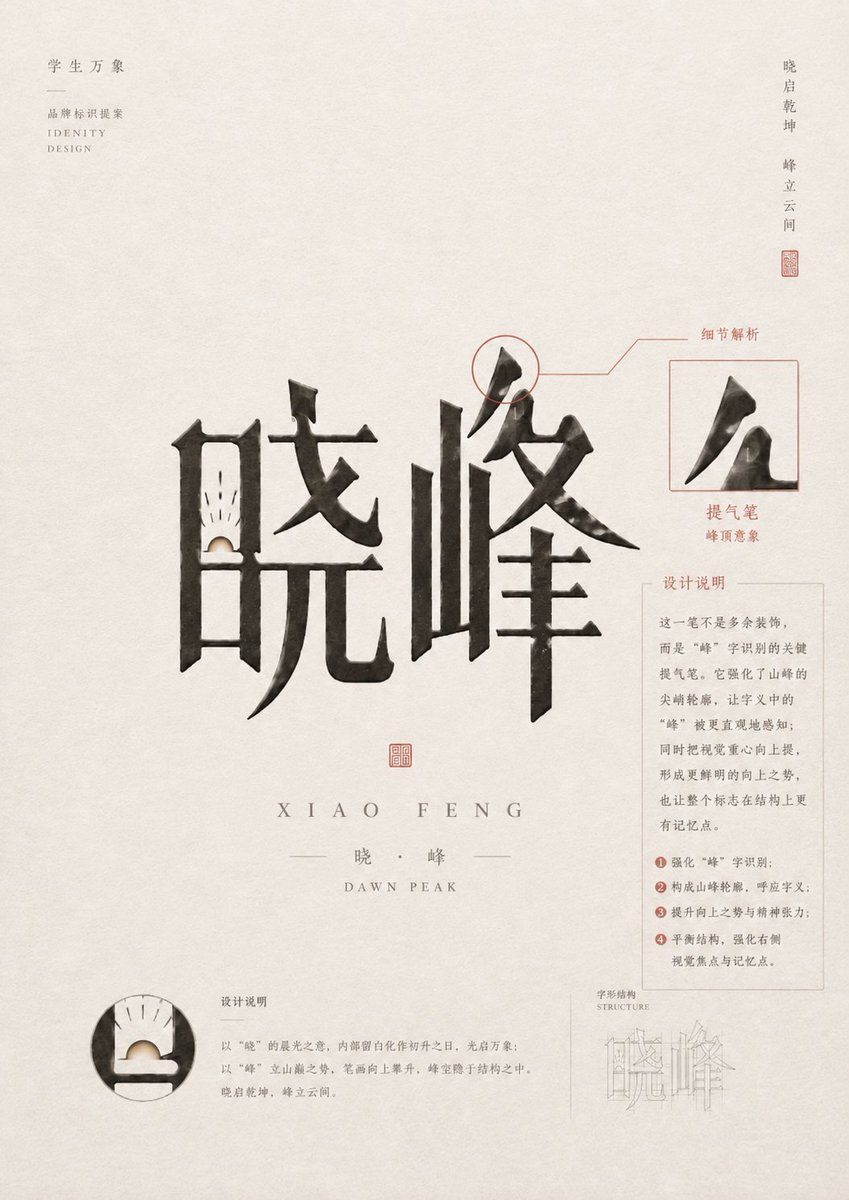
Chinese Calligraphy Identity Poster
Generates an elegant rice-paper brand identity poster featuring a Chinese calligraphic wordmark with seals, magnified stroke analysis, and design explanation modules.
This is a GPT Image 2 prompt case for Graphic & Poster. Use the copy-ready prompt below to generate similar visuals, and review Awesome GPT Image 2 Prompts attribution plus commercial-use rights before reuse.
Free 1K preview
Generate one preview image instantly, no sign-up required.
Prompt
Copy-ready prompt
Objective: Create a sophisticated Chinese-style visual design showcase poster for a calligraphy logotype, centered around two large black ink calligraphy characters {argument name="main Chinese logotype" default="Xiaofeng"}, employing an elegant brand case study layout and descriptive annotation graphics.

Canvas: A vertical poster with a 3:4 aspect ratio, featuring a warm, off-white Xuan paper background with fine fiber texture and a light beige aged effect, with ample negative space, presenting a minimalist, high-end editorial style.

Main Composition: Position the massive black calligraphy logotype slightly left of center, occupying the middle of the page. The brushstrokes should be expressive, angular, and architectural, showcasing dry brush gradients, rough ink edges, sharp hook endings, and subtle white space within the strokes. Add a red square seal near the center below the logotype.

Text Hierarchy: Below the main logotype, set a wide-spaced Pinyin {argument name="romanized name" default="XIAO FENG"}, followed by a thin horizontal line, flanked by smaller Chinese names on either side, and then small, uppercase English text {argument name="English subtitle" default="DAWN PEAK"} below. Maintain a refined layout, wide letter spacing, and a subtle gray tone.

Top-Left Identifier Area: Add a small, vertically aligned brand title in the top-left corner, containing Chinese and English lines. Include 4 lines of visible text: “Student Wanshiang,” a short horizontal line, “Brand Identity Proposal,” and “IDENTITY DESIGN.” Use tiny gray serif or Song typeface.

Top-Right Motto Area: Add a narrow, vertical Chinese phrase {argument name="vertical motto" default="XIAO FENG"} in the top-right corner, accompanied by a small red seal.

Right-Side Annotation System: Create 3 analytical elements to the right of the logotype. First, highlight the top stroke of the second character with a thin red circle, connecting it to the label “Detail Analysis” with a red guide line. Second, a red-outlined square illustration shows a magnified detail of that stroke, labeled “Qi Pen” and subtext “Peak Imagery.” Third, below that, place a rectangular explanation card with a light-colored border, titled “Design Explanation,” containing a compact Chinese paragraph and 4 points numbered with red circles.

Bottom-Left Detail Annotation: Add 1 circular magnified illustration showcasing the internal stroke details of the lower-left corner of the first character, with fine black construction lines and light semi-circular highlights. To its right, place a small title “Design Explanation” and a tiny gray Chinese explanatory text.

Bottom-Right Structural Annotation: Add 1 elegant technical construction diagram labeled “Character Structure,” followed by “STRUCTURE” in English, showcasing fine-line geometric guides and a low-opacity logotype outline.

Visual Style: High-end Chinese brand presentation, academic visual design proposal, restrained red annotation lines, gray micro-typography, black ink calligraphy, delicate seal red accents, refined grid-like explanatory details, and the serene negative space of a museum catalog.

Constraints: Utilize 2 primary Chinese calligraphy characters, 2 red seals, 3 right-side analytical elements, 1 bottom-left circular illustration, and 1 bottom-right structural diagram. All annotations should be refined and accurate, avoiding modern UI styles, vibrant colors, clutter, and preserving the poster’s elegant negative space.
Prompt variables
Editable argument placeholders found in the prompt, with their default values.
Best for
- - Graphic & Poster visual exploration
- - Image generation and reference-image edits
- - Reusable briefs that keep source attribution visible
Change these parts
- - Subject, product, character, or scene
- - Aspect ratio, camera, lighting, and background
- - Brand, text, color, and output constraints
Recommended model and settings
- - Model: gpt-image-2
- - Input mode: Text to Image
- - Aspect ratio: source
- - Commercial status: review original source
How to use this prompt
- 1. Copy the prompt and preserve its structure for the first test.
- 2. Replace the subject, context, and publishing channel.
- 3. Change one camera, lighting, or style variable per iteration.
- 4. Inspect the output, source, text, and rights before reuse.
Limitations, source, and reuse cautions
- - Generated output is an editable draft, not factual, legal, or rights evidence.
- - Review the linked source, people, brands, logos, text, and third-party media before commercial use.
More cases in this category
Prioritized by category, input mode compatibility, quality, and lower risk.

Reuse and source notes
Use this prompt safely after previewing the case.
- 1.Copy the prompt or open it directly in Dovoo with the generation button.
- 2.Adjust variables, aspect ratio, and reference images for your own use case.
- 3.Before publishing or paid usage, verify source rights, attribution requirements, and brand or likeness risks.
Can I use this prompt commercially?
Commercial-use status is allowed. Review the original source, license, brand constraints, and legal requirements before paid usage.
Where does this case come from?
This case is imported from Awesome GPT Image 2 Prompts; keep attribution visible and check the source URL before reuse.