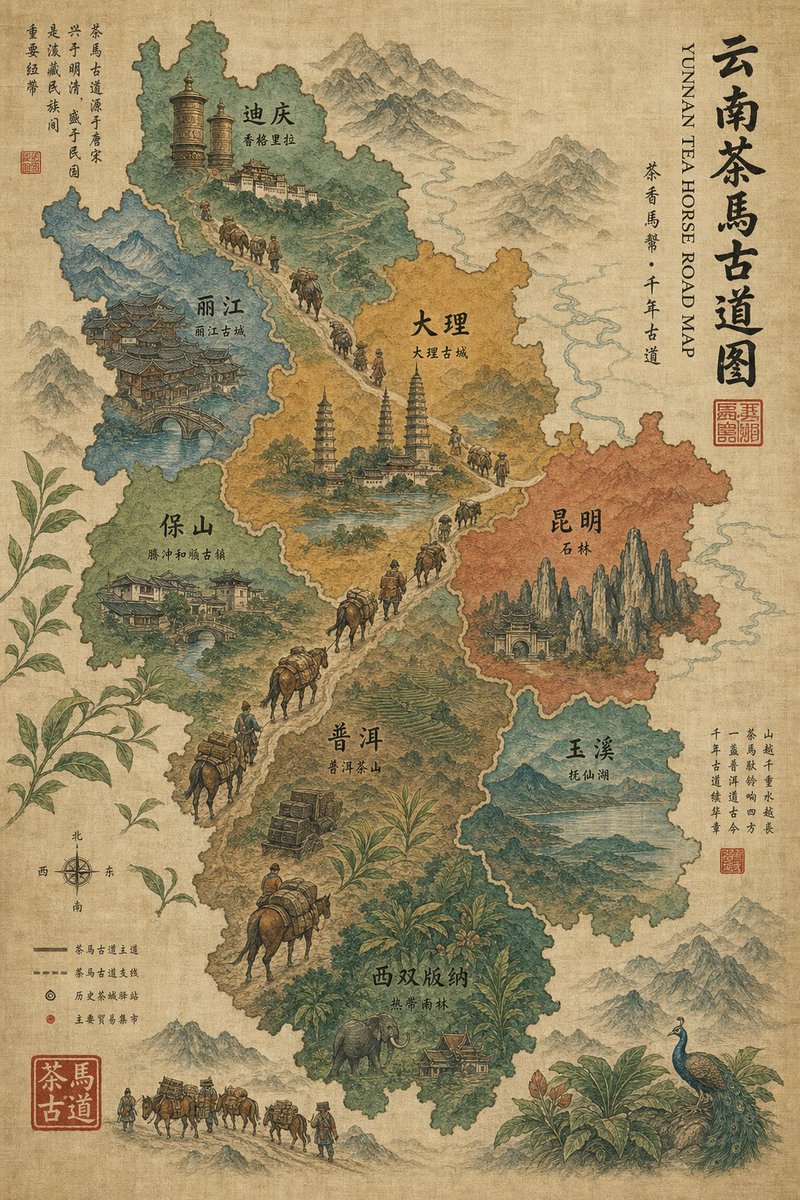
Vintage Yunnan Tea Horse Road Map
A detailed antique-style illustrated map of Yunnan’s Tea Horse Road for historical posters, travel art, or cultural editorial design.
This is a GPT Image 2 prompt case for Illustration & Art. Use the copy-ready prompt below to generate similar visuals, and review Awesome GPT Image 2 Prompts attribution plus commercial-use rights before reuse.
Free 1K preview
Generate one preview image instantly, no sign-up required.
Prompt
Copy-ready prompt
Objective: Create a retro-style Chinese travel map themed around {argument name="region title" default="Yunnan Tea Horse Road Map"}, presented as a hand-drawn parchment map depicting the ancient caravan routes through Yunnan.

Canvas: 2:3 vertical poster, with a background of aged Xuan paper featuring worn textures, subtle stains, ink wash borders, and soft mineral pigments. The overall look should blend the style of Qing Dynasty travel scrolls with that of a fantastical historical map.

Layout: Use the outline of Yunnan Province as a large, irregular central shape, divided into 8 shaded areas with soft ink wash outlines. A winding beige caravan trail enters from the lower left corner, passes through the center, and exits near the upper center, connecting all major sites. Add faint monochrome mountains, rivers, clouds, and blank parchment space around the province.

Title and Side Text: Place a large vertical black calligraphy title “云南茶马古道图” (Yunnan Tea Horse Road Map) on the right edge, accompanied by a smaller vertical English subtitle “YUNNAN TEA HORSE ROAD MAP”. Add small vertical Chinese calligraphy annotations in the upper left and lower right corners, and stamp two red square seals near the title and annotations.

Map Areas: Include 8 labeled areas, each with a large Chinese place name and a smaller descriptive subtitle: 1) Northwest green area, “迪庆” (Diqing), featuring Tibetan Buddhist temples and two pagodas; 2) West blue area, “丽江” (Lijiang), featuring an ancient town, tiled roofs, and an arch bridge; 3) Central gold area, “大理” (Dali), featuring the Three Pagodas by the lake; 4) East orange area, “昆明” (Kunming), featuring the Stone Forest peaks and city gates; 5) Southwest light green area, “保山” (Baoshan), featuring a market town and a bridge; 6) South-central earthy green area, “普洱” (Pu'er), featuring terraced tea plantations and tea transport boxes; 7) Southeast turquoise area, “玉溪” (Yuxi), featuring the scenery of Fuxian Lake; 8) Far south dark green area, “西双版纳” (Xishuangbanna), featuring tropical tea forests, elephants, and Dai architecture.

Route Details: Display 3 route styles in a small legend in the lower left corner: the main Tea Horse Road as a solid dark line, branch routes as dashed lines, and major trading posts as red dots. Add a compass rose labeled with east, south, west, and north above the legend.

Caravan Elements: Depict 6 clearly visible caravans along the route: 1) a group of people and pack animals departing from the lower left corner; 2) a group near Pu'er, with two pack horses and a horseman; 3) a group in the middle of the route, with three pack animals climbing towards Dali; 4) a group passing the Three Pagodas of Dali; 5) a group entering the mountainous area of Diqing; 6) a small distant caravan near the top of the route. Use brown horses and mules carrying stacked tea packages, accompanied by several travelers wearing long robes.

Decorative Elements: Add 4 main plant/animal decorations outside or near the map: 1) a tea branch on the left side; 2) a cluster of tea bushes at the bottom center; 3) tropical broad leaves and flowers in the lower right corner; 4) a blue-green peacock standing in the lower right corner. Add a red seal with the text “茶马古道” (Tea Horse Road) in the lower left corner.

Visual Style: Fine black ink wash lines, watercolor rendering, antique map illustration, Chinese landscape painting, misty mountains, delicate river lines, traditional calligraphy, warm sepia parchment background, and soft shades of cyan, ochre, jade green, blue, and rust. Maintain rich detail in the image, but ensure overall harmony and a sense of age.

Restrictions: Maintain a vertical poster composition, use clear handwritten calligraphy for Chinese labels, avoid modern roads, cars, buildings, icons, bright digital colors, photorealistic depictions, or simple vector graphics. No watermarks.
Prompt variables
Editable argument placeholders found in the prompt, with their default values.
Best for
- - Illustration & Art visual exploration
- - Image generation and reference-image edits
- - Reusable briefs that keep source attribution visible
Change these parts
- - Subject, product, character, or scene
- - Aspect ratio, camera, lighting, and background
- - Brand, text, color, and output constraints
Recommended model and settings
- - Model: gpt-image-2
- - Input mode: Text to Image
- - Aspect ratio: source
- - Commercial status: review original source
How to use this prompt
- 1. Copy the prompt and preserve its structure for the first test.
- 2. Replace the subject, context, and publishing channel.
- 3. Change one camera, lighting, or style variable per iteration.
- 4. Inspect the output, source, text, and rights before reuse.
Limitations, source, and reuse cautions
- - Generated output is an editable draft, not factual, legal, or rights evidence.
- - Review the linked source, people, brands, logos, text, and third-party media before commercial use.
More cases in this category
Prioritized by category, input mode compatibility, quality, and lower risk.


Reuse and source notes
Use this prompt safely after previewing the case.
- 1.Copy the prompt or open it directly in Dovoo with the generation button.
- 2.Adjust variables, aspect ratio, and reference images for your own use case.
- 3.Before publishing or paid usage, verify source rights, attribution requirements, and brand or likeness risks.
Can I use this prompt commercially?
Commercial-use status is allowed. Review the original source, license, brand constraints, and legal requirements before paid usage.
Where does this case come from?
This case is imported from Awesome GPT Image 2 Prompts; keep attribution visible and check the source URL before reuse.