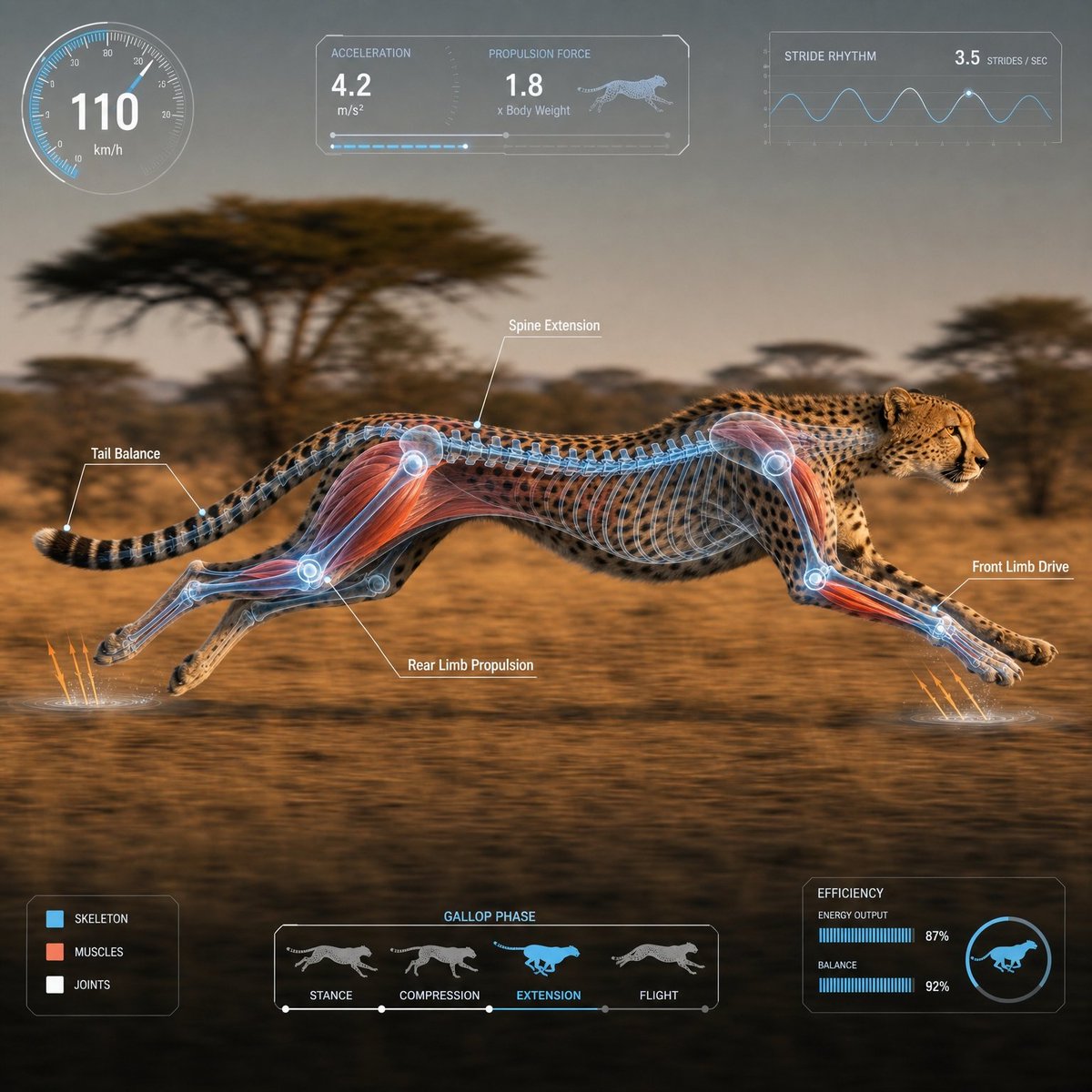
Scientific Animal Motion Analysis HUD
A highly detailed technical prompt for generating photorealistic animal motion studies featuring transparent anatomical overlays and scientific HUD elements.
This is a GPT Image 2 prompt case for Other Inspiration. Use the copy-ready prompt below to generate similar visuals, and review Awesome GPT Image 2 Prompts attribution plus commercial-use rights before reuse.
Free 1K preview
Generate one preview image instantly, no sign-up required.
Prompt
Copy-ready prompt
1:1 square composition. Suited for video material. Please provide a photorealistic depiction of a {argument name="animal name" default="cheetah"} moving in its natural habitat, captured in a high-speed tracking shot from the side.
The camera is a medium-long shot, pulled back sufficiently. The composition ensures the entire body is completely within the frame, with no clipping of major parts like the head, torso, legs, wings, fins, or tail. The subject is placed in the center safety zone, within 60-70% of the horizontal width, leaving margins on all sides. A lateral silhouette moving from left to right. The background has a light horizontal motion blur, while the subject is in sharp focus.
Accurately overlay a transparent 3D skeleton or appropriate anatomical layer on the body, emphasizing muscles, joints, the extension of the spine and trunk, and propulsive parts like legs, wings, fins, and tail. Semi-transparent blue/white base with red or orange accents on key areas.
Display a fixed-layout semi-transparent HUD at the edge of the screen. The UI should not obscure the subject and must have the same placement every time.
Top Left: Circular speedometer
Top Center: Acceleration/Force/Propulsion panel
Top Right: Stride/Flap/Swimming rhythm graph
Bottom Left: Muscle/Skeletal/Joint legend
Bottom Center: Motion phase timeline
Bottom Right: Small energy efficiency/balance chart
Maximum of 4 annotations. Short English labels only. Clean, sci-fi documentary-style UI in white, cyan, and light blue. Numbers are for reference; avoid long text or dense UI. Cinematic natural lighting, high definition, photorealistic, organized scientific documentary style.
Avoid: Close-ups, body clipping, limbs out of frame, multiple animals, extra legs, distorted joints, human-like skeleton, unreadable text, crowded UI, giant graphs, UI hiding the subject, excessive light effects.
Prompt variables
Editable argument placeholders found in the prompt, with their default values.
Best for
- - Other Inspiration visual exploration
- - Image generation and reference-image edits
- - Reusable briefs that keep source attribution visible
Change these parts
- - Subject, product, character, or scene
- - Aspect ratio, camera, lighting, and background
- - Brand, text, color, and output constraints
Recommended model and settings
- - Model: gpt-image-2
- - Input mode: Text to Image
- - Aspect ratio: source
- - Commercial status: review original source
How to use this prompt
- 1. Copy the prompt and preserve its structure for the first test.
- 2. Replace the subject, context, and publishing channel.
- 3. Change one camera, lighting, or style variable per iteration.
- 4. Inspect the output, source, text, and rights before reuse.
Limitations, source, and reuse cautions
- - Generated output is an editable draft, not factual, legal, or rights evidence.
- - Review the linked source, people, brands, logos, text, and third-party media before commercial use.
More cases in this category
Prioritized by category, input mode compatibility, quality, and lower risk.
Reuse and source notes
Use this prompt safely after previewing the case.
- 1.Copy the prompt or open it directly in Dovoo with the generation button.
- 2.Adjust variables, aspect ratio, and reference images for your own use case.
- 3.Before publishing or paid usage, verify source rights, attribution requirements, and brand or likeness risks.
Can I use this prompt commercially?
Commercial-use status is allowed. Review the original source, license, brand constraints, and legal requirements before paid usage.
Where does this case come from?
This case is imported from Awesome GPT Image 2 Prompts; keep attribution visible and check the source URL before reuse.