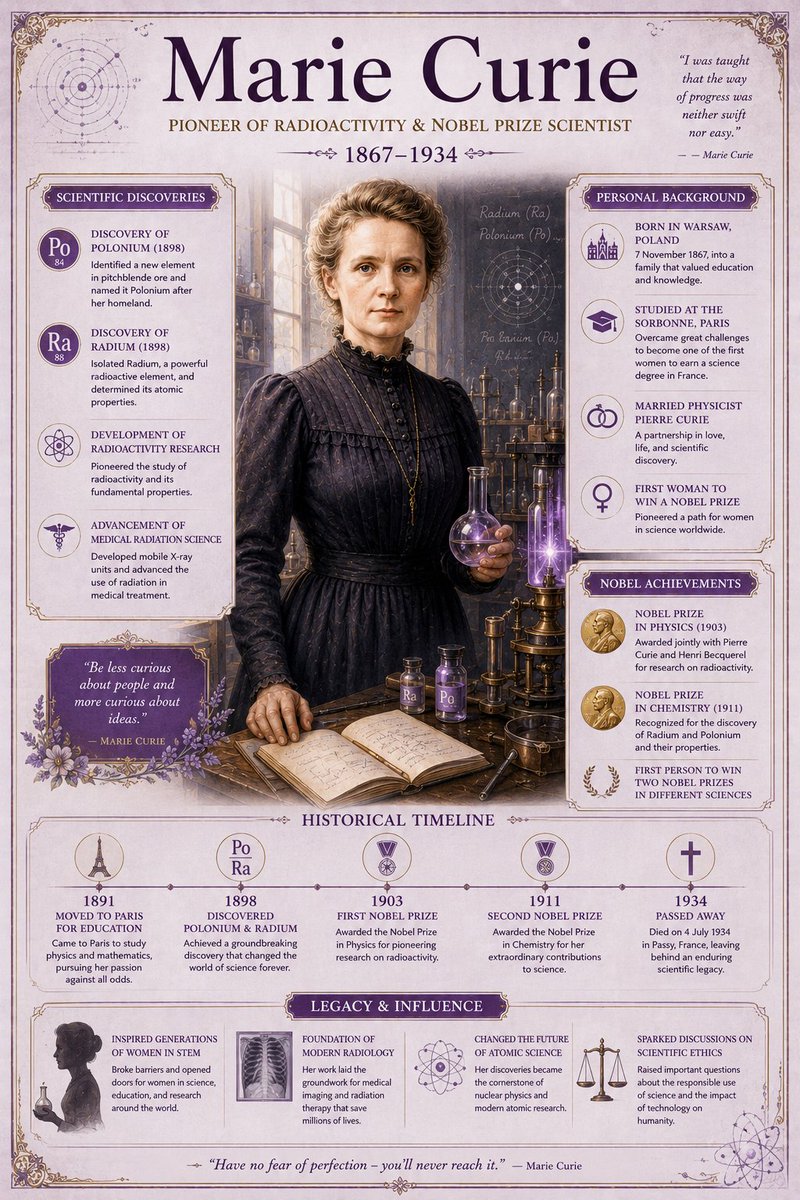
Vintage Encyclopedia Scientific Infographic
Design a sophisticated, educational infographic in a historical encyclopedia style, complete with portraits, scientific timelines, and decorative borders.
This is a GPT Image 2 prompt case for 平面海报. Use the copy-ready prompt below to generate similar visuals, and review Awesome GPT Image 2 Prompts attribution plus commercial-use rights before reuse.
Prompt
Copy-ready prompt
High-quality retro encyclopedia-style educational infographics:{argument name="subject" default="Marie Curie's scientific legacy"} Create a sophisticated vertical infographic with the aesthetic appeal of a historical encyclopedia.{argument name="person" default="Marie Curie (1867–1934)"} The theme should be to echo another infographic with a matching visual style, while providing a fresh composition and different layout elements. Main title "{argument name="title" default="Marie Curie"} Subtitle: Pioneers of Radioactivity Research and Nobel Prize-Winning Scientists Visual Center: An elegant oil painting-style portrait depicts Marie Curie standing in an early 20th-century laboratory, surrounded by glowing scientific instruments, notebooks, and glass beakers, with a faint, purplish-blue radioactive effect. Information Section: Scientific Discoveries: Discovery of polonium (1898) Discovery of radium Development of radioactivity research Advances in medical radiology Personal Background: Born in Warsaw, Poland Studied at the Sorbonne University in Paris Married to physicist Pierre Curie First woman to win a Nobel Prize Nobel Prize Achievements: Nobel Prize in Physics (1903) Nobel Prize in Chemistry (1911) First person to win a Nobel Prize in two different scientific fields Historical Timeline: 1891 → Moved to Paris for studies 1898 → Discovery of polonium and radium 1903 → First Nobel Prize 1911 → Second Nobel Prize 1934 → Death Legacy and Impact: Inspired STEM The female successors in the field, the cornerstones of modern radiology, changed the future of atomic science and sparked discussions about scientific ethics and radiation safety. Design style: Retro academic encyclopedia layout; soft pale purple background (#F0E8F5); elegant purple accents (#7B5BA8); historically elegant serif font; decorative scientific borders and delicate floral embellishments; soft antique texture and paper grain; pale purple information card layout with thin gold or dark purple borders; composition: large portrait slightly tilted to one side; alternating information panels; vertical timeline with glowing date markers; decorative scientific charts in the background; balanced and symmetrical composition, suitable for display alongside another infographic; art direction: highly detailed digital illustrations; editorial infographic style; high-quality educational poster; elegant museum-grade design; respect for history; soft cinematic lighting effects; exquisite Victorian scientific atmosphere.Prompt variables
Editable argument placeholders found in the prompt, with their default values.
More cases in this category
Prioritized by category, input mode compatibility, quality, and lower risk.


Reuse and source notes
Use this prompt safely after previewing the case.
- 1.Copy the prompt or open it directly in Dovoo with the generation button.
- 2.Adjust variables, aspect ratio, and reference images for your own use case.
- 3.Before publishing or paid usage, verify source rights, attribution requirements, and brand or likeness risks.
Can I use this prompt commercially?
Commercial-use status is allowed. Review the original source, license, brand constraints, and legal requirements before paid usage.
Where does this case come from?
This case is imported from Awesome GPT Image 2 Prompts; keep attribution visible and check the source URL before reuse.