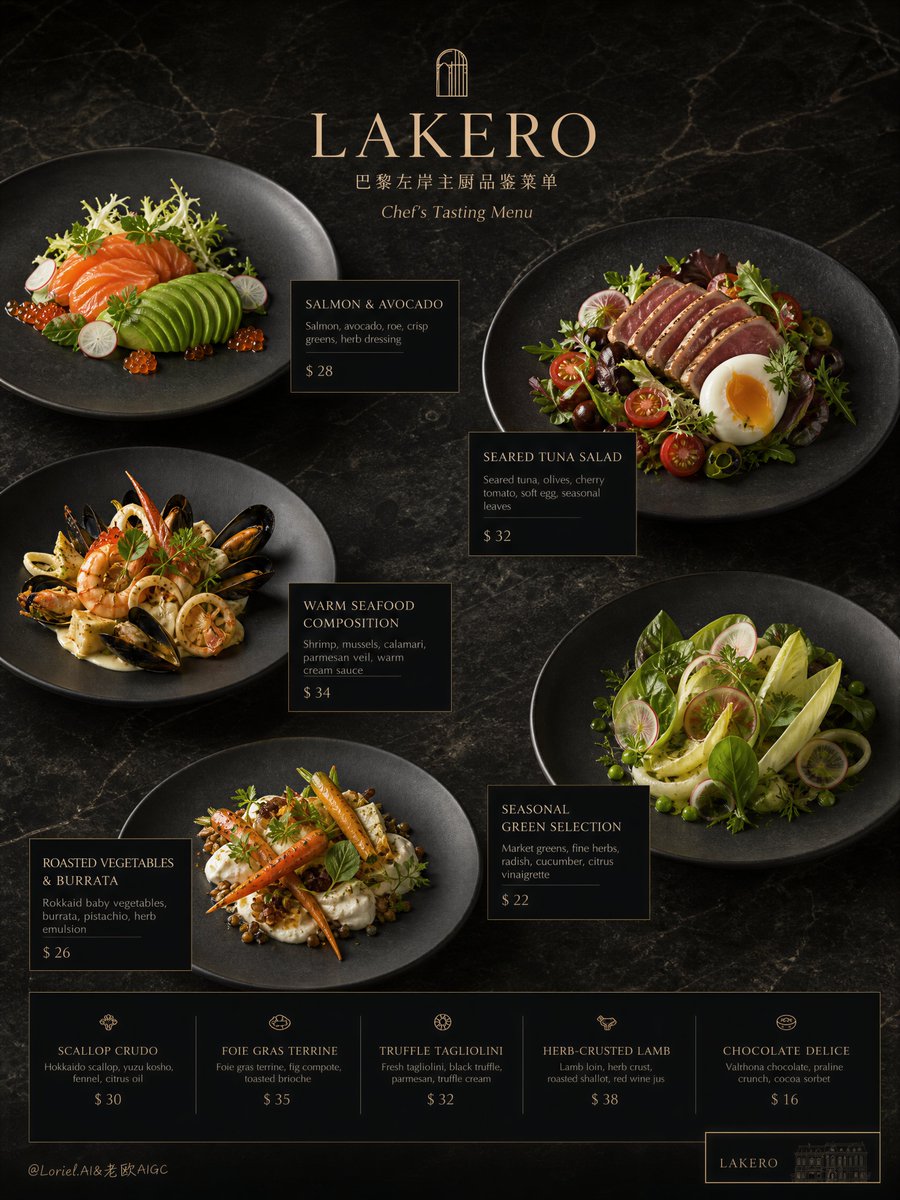
Premium Restaurant Campaign Poster
A highly detailed prompt for creating a Michelin-inspired French fine dining menu poster with a luxury editorial aesthetic.
This is a GPT Image 2 prompt case for Food & Beverage. Use the copy-ready prompt below to generate similar visuals, and review Awesome GPT Image 2 Prompts attribution plus commercial-use rights before reuse.
Free 1K preview
Generate one preview image instantly, no sign-up required.
Free text preview doesn’t preserve reference-image consistency.
Prompt
Copy-ready prompt
Create an ultra-high-end restaurant poster for LAKERO as part of a series inspired by Michelin-starred chefs on the Left Bank of Paris, but re-imagined as a refined multi-course menu poster composition. Fully maintain the existing LAKERO brand world: contemporary French fine dining, the sophistication of the Left Bank of Paris, a chef-driven tasting menu identity, serene luxury, editorial restraint, and high-end culinary realism. The image must feel like a high-end restaurant menu poster, not a casual food collage, with strong spatial order, elegant black information blocks, and a luxurious menu item atmosphere. Employ a vertical poster composition inspired by high-end multi-course menu layouts. Arrange multiple LAKERO dishes on the poster in a carefully balanced, staggered composition, viewed from a slightly elevated front-top angle. Plates should be distributed purposefully across the page, allowing for breathing room, asymmetrical harmony, and a strong editorial hierarchy. The overall structure should include: several hero dishes placed in the upper and mid-composition, several black rectangular information panels near each featured plate, and a wide bottom information band containing additional menu items listed in a row. The layout must feel clean, graphic, highly controlled, and undeniably high-end. The background should be a luxurious dark stone or smoked marble surface with subtle organic texture, a soft matte finish, and refined tonal variations. It must feel architectural, expensive, and quietly dramatic, as the perfect foundation for the presentation of dishes and typography. No casual restaurant environment, no cluttered tables, no diners, no decorative props unrelated to the cuisine. Feature three to five signature LAKERO dishes as the primary visual subjects, each presented on elegant matte black or deep charcoal ceramic plates. These dishes must belong to the same Michelin-inspired French tasting menu world: refined composed salads, delicate seafood courses, modern French vegetable arrangements, chef-driven composed appetizers, or elegant light main course combinations. Plating must feel highly intentional, modern, restrained, and chef-created. Each dish must be rendered with exceptional realism: minute moisture on green vegetables, natural sheen on seafood or protein, fine texture in vegetables, silky sauce details, delicate garnish placement, clean plate edges, and Michelin-level culinary precision. Food must look expensive, fresh, balanced, and highly appetizing, never rustic or casual. Suggested dish language for featured plates: Refined Salmon & Avocado Composition with Roe and Crisp Greens; Precisely Cut and Elegantly Garnished Tuna or Grilled Fish Salad; Warm Seafood Composition with Mussels, Shrimp, and a Delicate Cream Sauce; and other contemporary French salads or tasting menu dishes consistent with the LAKERO brand style. All dishes should remain modern, elegant, and sensually Parisian. Typography and information architecture are critical. Place elegant black information cards next to or overlapping the plates, each containing the dish name, a short English description, and a price line. Cards must feel like part of a graphic design system, not cheap menu labels. Use beautifully edited typography with a clear hierarchy, calm spacing, and luxurious printing specifications. In the top or upper-mid area, include the restaurant branding: the primary English title “LAKERO”; a small Chinese subtitle “Chef’s Tasting Menu, Left Bank of Paris”; and an optional small accompanying English line “Chef’s Tasting Menu”. Title treatment should feel understated, elegant, and consistent with the existing LAKERO family, not loud or oversized. Create a custom LAKERO logo consistent with the series: minimalist, architectural, timeless, Parisian, editorial, and internationally high-end. The logo can appear near the title area or be subtly integrated into one of the menu information areas. For each black information card, use English dish names and English description text as the primary system. Example direction: “Salmon & Avocado,” “Seared Tuna Salad,” “Warm Seafood Composition,” “Seasonal Green Selection.” Descriptions should read like concise, high-end menu copy, such as: “Salmon, avocado, roe, crisp greens, herb dressing,” “Seared tuna, olives, cherry tomato, soft egg, seasonal leaves,” “Shrimp, mussels, calamari, parmesan veil, warm cream sauce.” Include an elegant price symbol in a high-end menu style. At the bottom of the poster, create a full-width black menu band divided into sections, each listing additional dish names, short English descriptions, and prices in a clean, edited layout. This bottom band must feel graphic, luxurious, and structurally important. Lighting should be soft, cinematic, and high-end: soft top light, quiet side shadows, subtle highlights on plate edges, natural sheen on ingredients, soft reflections in sauces, and a fine tonal fade across the stone background. The atmosphere must feel intimate, expensive, and edited, like an advertisement for a Michelin-starred restaurant for a luxury culinary magazine. The color palette should remain within the original LAKERO family world: warm blacks, deep charcoals, limestone, soft ivory, sage green, olive, butter cream, seafood coral tones, subtle toasted hues, and restrained champagne highlights. The tones must remain sophisticated and appetite-driven, without excessive saturation or bright commercial styles. The overall tone must be: Parisian, chef-driven, menu editorial, Michelin-inspired, refined, gourmet, quiet, architectural, luxurious, and highly curated. Rendering style: hyperrealistic food photography, Parisian Left Bank restaurant menu poster, multiple black ceramic plated dishes, dark marble background, elegant black editorial information cards, custom LAKERO logo, refined menu typography, soft cinematic luxurious lighting, Michelin-level food styling, high-end event quality, 8k, world-class commercial quality. Negative prompts: cheap menu items, casual cafe atmosphere, rustic tavern clutter, alcohol-centric hero objects, dominant wine bottles, bright commercial food advertising, crowded cutlery, messy plating, cartoon food, fast-food styling, generic logos, loud typography, flat lighting, noisy composition, low-end booklet design, excessive props, ingredients that look plastic, weak brand identity.
Best for
- - Food & Beverage visual exploration
- - Image generation and reference-image edits
- - Reusable briefs that keep source attribution visible
Change these parts
- - Subject, product, character, or scene
- - Aspect ratio, camera, lighting, and background
- - Brand, text, color, and output constraints
Recommended model and settings
- - Model: gpt-image-2
- - Input mode: Image to Image
- - Aspect ratio: source
- - Commercial status: review original source
How to use this prompt
- 1. Copy the prompt and preserve its structure for the first test.
- 2. Replace the subject, context, and publishing channel.
- 3. Change one camera, lighting, or style variable per iteration.
- 4. Inspect the output, source, text, and rights before reuse.
Limitations, source, and reuse cautions
- - Generated output is an editable draft, not factual, legal, or rights evidence.
- - Review the linked source, people, brands, logos, text, and third-party media before commercial use.
More cases in this category
Prioritized by category, input mode compatibility, quality, and lower risk.
Reuse and source notes
Use this prompt safely after previewing the case.
- 1.Copy the prompt or open it directly in Dovoo with the generation button.
- 2.Adjust variables, aspect ratio, and reference images for your own use case.
- 3.Before publishing or paid usage, verify source rights, attribution requirements, and brand or likeness risks.
Can I use this prompt commercially?
Commercial-use status is allowed. Review the original source, license, brand constraints, and legal requirements before paid usage.
Where does this case come from?
This case is imported from Awesome GPT Image 2 Prompts; keep attribution visible and check the source URL before reuse.