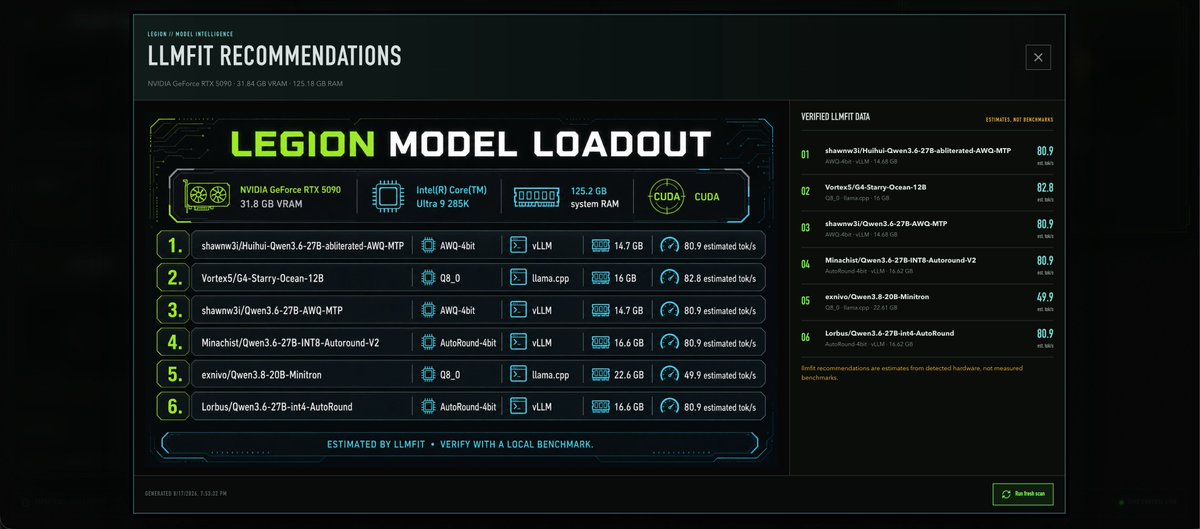
Cyberpunk LLMFit Model Dashboard
Generates a dark sci-fi dashboard infographic showing local hardware and six recommended LLM model loadouts for a machine-learning control panel.
This is a GPT Image 2 prompt case for Graphic & Poster. Use the copy-ready prompt below to generate similar visuals, and review Awesome GPT Image 2 Prompts attribution plus commercial-use rights before reuse.
Free 1K preview
Generate one preview image instantly, no sign-up required.
Prompt
Copy-ready prompt
Goal: Create a dark futuristic dashboard infographic for local AI model recommendations titled {argument name="headline text" default="LLMFIT RECOMMENDATIONS"}, with a large central panel reading {argument name="main title" default="LEGION MODEL LOADOUT"}. The design should look like a cyberpunk hardware-analysis UI generated on demand for a local machine, not a marketing poster.

Canvas: Wide 21:9 landscape image, approximately 1200x560, black and deep teal background with subtle glow, thin cyan grid lines, faint circuit traces, and a bordered application-window frame. Add a small close-box icon in the top right of the window. Use sharp sci-fi typography, condensed uppercase headings, neon lime accents, cyan outlines, and small amber annotation text.

Top header: At upper left, small label "LEGION / MODEL INTELLIGENCE" above the headline. Under the headline, show hardware summary text: {argument name="hardware summary" default="NVIDIA GeForce RTX 5090 · 31.84 GB VRAM · 125.18 GB RAM"}.

Main layout: Split the dashboard into two main columns. The left column takes about 70% width and contains the primary loadout card. The right column takes about 30% width and contains a compact verified-data list.

Left primary card: Create a large neon-framed panel with the big title "LEGION MODEL LOADOUT" in lime green and white. Beneath it, show exactly 4 hardware capability badges in a single row: 1) NVIDIA GeForce RTX 5090, 31.8 GB VRAM with a GPU fan icon; 2) Intel(R) Core(TM) Ultra 9 285K with a CPU chip icon; 3) 125.2 GB system RAM with a memory module icon; 4) CUDA with a circular CUDA icon. Use lime for the GPU badge and cyan for the others.

Loadout table: Below the badges, show exactly 6 ranked recommendation rows with large lime row numbers in rounded boxes and thin cyan separators. Each row should include model name, quantization, runtime, memory, and estimated speed. The 6 rows are: 1) "shawnw3j/Huihui-Qwen3.6-27B-abliterated-AWQ-MTP", quantization "AWQ-4bit", runtime "vLLM", memory "14.7 GB", speed "80.9 estimated tok/s"; 2) "Vortex5/G4-Starry-Ocean-12B", quantization "Q8_0", runtime "llama.cpp", memory "16 GB", speed "82.8 estimated tok/s"; 3) "shawnw3j/Qwen3.6-27B-AWQ-MTP", quantization "AWQ-4bit", runtime "vLLM", memory "14.7 GB", speed "80.9 estimated tok/s"; 4) "Minachist/Qwen3.6-27B-INT8-Autoround-V2", quantization "AutoRound-4bit", runtime "vLLM", memory "16.6 GB", speed "80.9 estimated tok/s"; 5) "exnivo/Qwen3.8-20B-Minitron", quantization "Q8_0", runtime "llama.cpp", memory "22.6 GB", speed "49.9 estimated tok/s"; 6) "Lorbus/Qwen3.6-27B-int4-AutoRound", quantization "AutoRound-4bit", runtime "vLLM", memory "16.6 GB", speed "80.9 estimated tok/s". Add tiny icons for chip, terminal/runtime, memory, and speedometer in the metric columns.

Footer strip in the main card: Centered text in cyan: "ESTIMATED BY LLMFIT · VERIFY WITH A LOCAL BENCHMARK." Add angular brackets and thin decorative circuit segments around it.

Right sidebar: Header "VERIFIED LLMFIT DATA" on the left and small amber text "ESTIMATES, NOT BENCHMARKS" on the right. Show exactly 6 compact verified-data rows matching the 6 recommendations, numbered 01 through 06 in lime. Each row should show a shortened model name, a small second line with quant/runtime/memory, and a large right-aligned score: 80.9, 82.8, 80.9, 80.9, 49.9, 80.9. At the bottom, add a small amber note: "llmfit recommendations are estimates from detected hardware, not measured benchmarks."

Bottom window bar: Add tiny timestamp text at bottom left, "GENERATED 8/17/2026, 7:35:32 PM". Add a small rectangular neon green button at bottom right labeled {argument name="button label" default="Refresh scan"} with a refresh icon.

Visual constraints: Keep all text in English, crisp and legible, with no extra rows beyond the specified 6 recommendations and no extra hardware badges beyond the specified 4. Use a dark transparent-glass UI style, subtle bloom, no people, no logos other than the textual hardware/model labels, and no watermark.
Prompt variables
Editable argument placeholders found in the prompt, with their default values.
Best for
- - Graphic & Poster visual exploration
- - Image generation and reference-image edits
- - Reusable briefs that keep source attribution visible
Change these parts
- - Subject, product, character, or scene
- - Aspect ratio, camera, lighting, and background
- - Brand, text, color, and output constraints
Recommended model and settings
- - Model: gpt-image-2
- - Input mode: Text to Image
- - Aspect ratio: source
- - Commercial status: review original source
How to use this prompt
- 1. Copy the prompt and preserve its structure for the first test.
- 2. Replace the subject, context, and publishing channel.
- 3. Change one camera, lighting, or style variable per iteration.
- 4. Inspect the output, source, text, and rights before reuse.
Limitations, source, and reuse cautions
- - Generated output is an editable draft, not factual, legal, or rights evidence.
- - Review the linked source, people, brands, logos, text, and third-party media before commercial use.
More cases in this category
Prioritized by category, input mode compatibility, quality, and lower risk.
Reuse and source notes
Use this prompt safely after previewing the case.
- 1.Copy the prompt or open it directly in Dovoo with the generation button.
- 2.Adjust variables, aspect ratio, and reference images for your own use case.
- 3.Before publishing or paid usage, verify source rights, attribution requirements, and brand or likeness risks.
Can I use this prompt commercially?
Commercial-use status is allowed. Review the original source, license, brand constraints, and legal requirements before paid usage.
Where does this case come from?
This case is imported from Awesome GPT Image 2 Prompts; keep attribution visible and check the source URL before reuse.