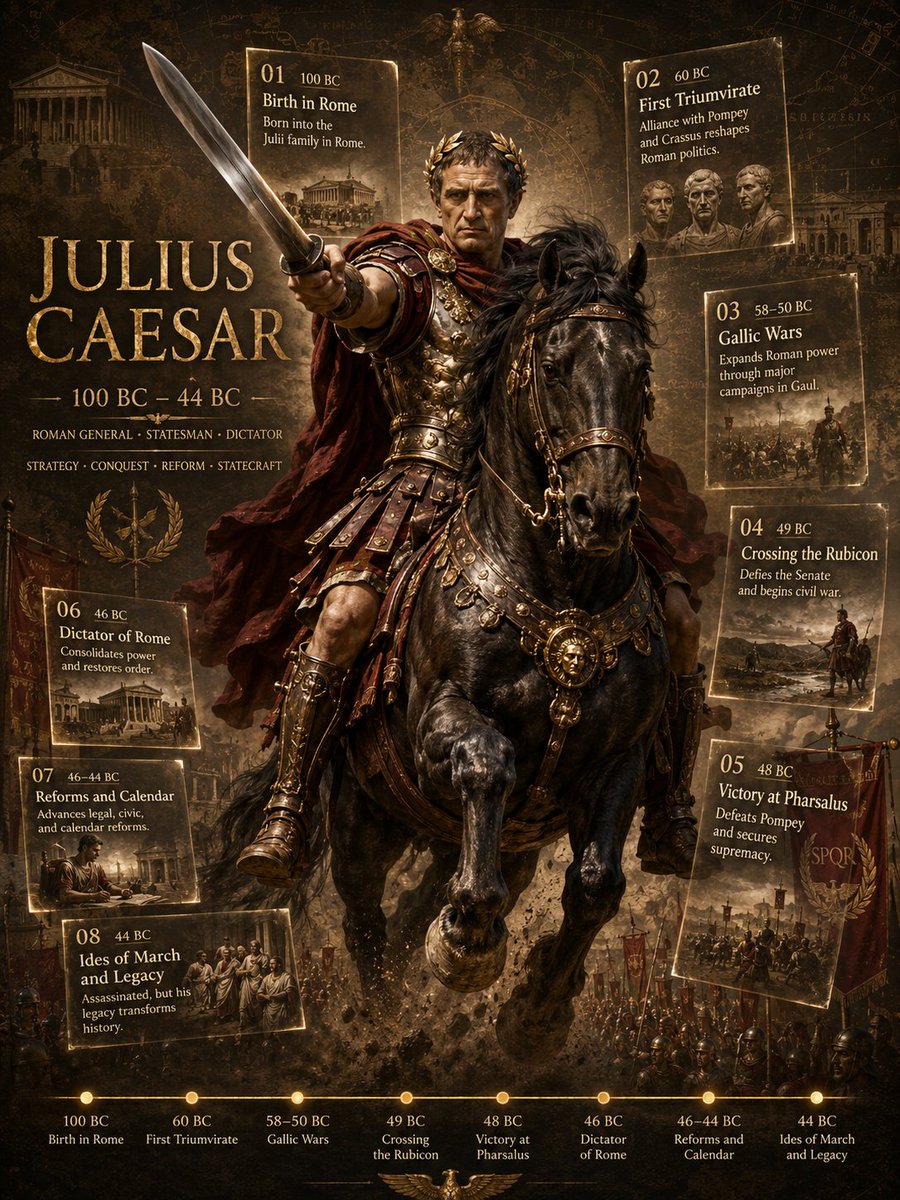
Julius Caesar Epic Timeline Poster
A cinematic ancient Roman biography poster featuring Julius Caesar on horseback with eight historical event cards and a bottom timeline.
This is a GPT Image 2 prompt case for 平面海报. Use the copy-ready prompt below to generate similar visuals, and review Awesome GPT Image 2 Prompts attribution plus commercial-use rights before reuse.
Prompt
Copy-ready prompt
Objective: For{argument name="subject figure" default="Julius Caesar"} Create a highly dramatic, cinematic historical biographical poster, showcasing Julius Caesar as a Roman general, politician, and dictator in an epic, ancient war infographic style. Canvas: Vertical 3:4. The poster uses deep sepia and black tones, paired with antique gold typography and parchment textures. The background incorporates blurred Roman maps, charts, constellations, and architectural sketches. High-contrast lighting, a smoky battlefield atmosphere, rough dust, embers, and opulent metallic highlights. Subject: The central composition shows Julius Caesar leaping forward on a powerful black warhorse. He wears exquisite Roman armor with gold details, leather tunics, and bronze greaves, a red cloak flowing behind him, and a laurel wreath on his head. His right arm, with strong perspective, points a Roman short sword at the viewer. The horse is adorned with ornate gold-plated harnesses, medals, and a leather belt, with dramatic highlights. The rider's face is deliberately obscured by a plain, light brown rectangle devoid of facial features. Behind him are Roman soldiers, flags, banners, and battlefield silhouettes. Main text: On the left is a large, antique-style serif gold title that reads, "{argument name="headline text" default="JULIUS CAESAR"} Below are arranged in order: “100 BC – 44 BC”, “ROMAN GENERAL · STATESMAN · DICTATOR”, and “STRATEGY · CONQUEST · REFORM · STATECRAFT”. A golden Roman eagle and laurel wreath is added below the text. Event Cards: Contains 8 glowing parchment-style historical event cards, numbered 01 to 08, each with a small tan illustration and a gold border. They are arranged around the central rider: two on the top, three on the right, and three on the left/lower left. The 8 cards contain the following information: 01 — “100 BC” — “Born in Rome” — “Born into the Roman Julius family.” 02 — “60 BC” — “The First Triumvirate” — “Allied with Pompey and Crassus, reshaping Roman politics.” 03 — 58–50 BC — Gallo-Gaul Wars — "Expanding Roman power through major battles in Gaul." 04 — 49 BC — Crossing the Rubicon — "Defying the Senate and starting the civil war." 05 — 48 BC — Victory at the Battle of Pharsalus — "Defeating Pompey and establishing dominance." 06 — 46 BC — "The Roman Dictator" — "Consolidating power and restoring order." 07 — 46–44 BC — "Reforms and the Calendar" — "Promoting reforms in law, citizenship, and the calendar." 08 — 44 BC — "March 15th and the Legacy" — "Assassinated, but his legacy changed history." Bottom Timeline: Add 8 gold dots connected by thin horizontal lines to the bottom edge. Labeled from left to right: “100 BC: Birth in Rome,” “60 BC: First Triumvirate,” “58–50 BC: Gallo-Gaul Wars,” “49 BC: Crossing the Rubicon,” “48 BC: Victory at the Battle of Pharsalus,” “46 BC: Roman Dictator,” “46–44 BC: Reforms and Calendar,” “44 BC: March 15th and Legacy.” Visual Style: Ultra-detailed digital painting, epic historical fantasy realism, museum-quality military portraits, ornate Roman Empire design, dramatic chiaroscuro, gilded serif typography, aged manuscript overlay effect, movie poster lighting, sharp central figures, and slightly blurred backgrounds. Borders, text, timelines, and decorative symbols use…{argument name="accent color" default="Antique gold"} Constraints: Ensure all text is legible and spelled correctly. Use 8 event cards and 8 timeline points. No modern objects, symbols, watermarks, or additional characters may be added to the foreground, except for the mounted commander and background troops. Maintain a deep, ancient Roman atmosphere; bright modern colors are prohibited.Prompt variables
Editable argument placeholders found in the prompt, with their default values.
More cases in this category
Prioritized by category, input mode compatibility, quality, and lower risk.

Reuse and source notes
Use this prompt safely after previewing the case.
- 1.Copy the prompt or open it directly in Dovoo with the generation button.
- 2.Adjust variables, aspect ratio, and reference images for your own use case.
- 3.Before publishing or paid usage, verify source rights, attribution requirements, and brand or likeness risks.
Can I use this prompt commercially?
Commercial-use status is allowed. Review the original source, license, brand constraints, and legal requirements before paid usage.
Where does this case come from?
This case is imported from Awesome GPT Image 2 Prompts; keep attribution visible and check the source URL before reuse.