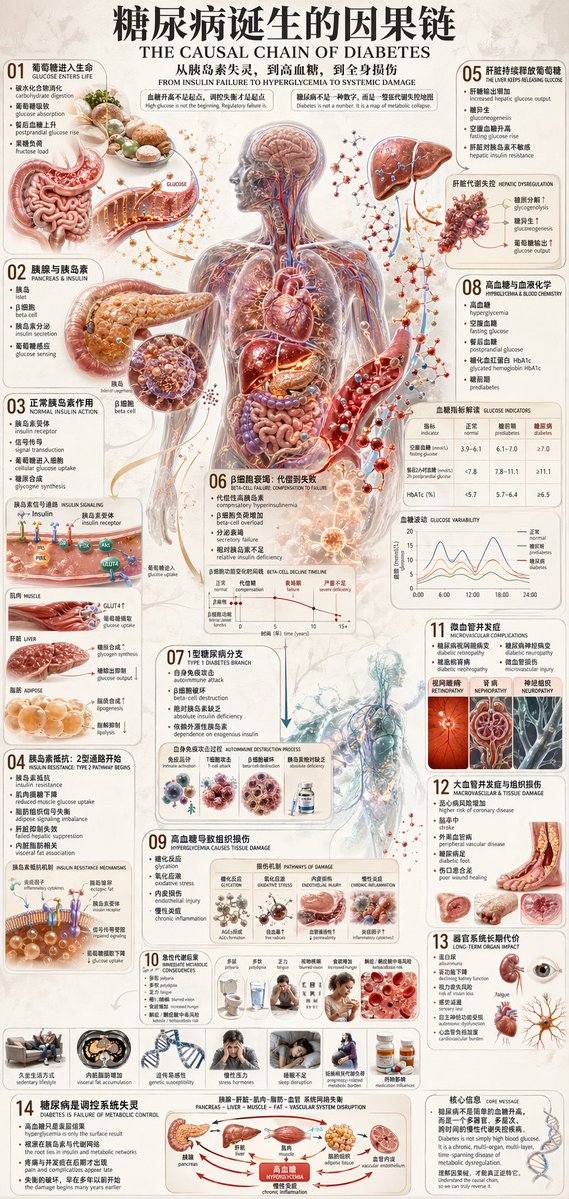
Diabetes Causal Chain Infographic
A dense bilingual medical poster explaining the full progression of diabetes from glucose intake and insulin dysfunction to systemic complications, suitable for educational or editorial health visuals.
This is a GPT Image 2 prompt case for 平面海报. Use the copy-ready prompt below to generate similar visuals, and review Awesome GPT Image 2 Prompts attribution plus commercial-use rights before reuse.
Prompt
Copy-ready prompt
{
  "type": "Medical Infographic Poster",
  "topic": "Cause and effect chain of diabetes",
  "language": "Chinese with English subtitle",
  "style": "High-detail biomedical illustrations, editorial infographics, warm beige parchment background, realistic anatomical structures combined with 3D cross-sectional organ and molecular diagrams.",
  "format": "Vertical poster",
  "title": {
    "main": "The causal chain of diabetes",
    "subtitle": "THE CAUSAL CHAIN OF DIABETES",
    "tagline": "From insulin failure to hyperglycemia to systemic damage"
  },
  "central_visual": {
    "description": "A large, semi-transparent full-body anatomical diagram is displayed in the center, showing the brain, blood vessels, lungs, heart, liver, pancreas, stomach, intestines, kidneys, and surrounding glucose and insulin signal transduction patterns.",
    "emphasis": "The metabolic pathway originates in the pancreas and liver, and spreads to multiple organs via the bloodstream."
  },
  "layout": {
    "sections": [
      {
        "title": "01 Glucose enters life",
        "position": "top-left",
        "count": 1,
        "labels": [
          "GLUCOSE ENTERS LIFE"
        ]
      },
      {
        "title": "02 Pancreas and Insulin",
        "position": "upper-left",
        "count": 1,
        "labels": [
          "PANCREAS & INSULIN"
        ]
      },
      {
        "title": "03 Normal Insulin Function",
        "position": "left-mid",
        "count": 1,
        "labels": [
          "NORMAL INSULIN ACTION"
        ]
      },
      {
        "title": "04 Insulin Resistance: Type 2 Pathway Initiation",
        "position": "lower-left",
        "count": 1,
        "labels": [
          "TYPE 2 PATHWAY BEGINS"
        ]
      },
      {
        "title": "05 The liver continuously releases glucose",
        "position": "top-right",
        "count": 1,
        "labels": [
          "LIVER KEEPS RELEASING GLUCOSE"
        ]
      },
      {
        "title": "06 β-cell exhaustion: from compensation to runaway",
        "position": "center-lower",
        "count": 1,
        "labels": [
          "BETA CELL FAILURE: COMPENSATION TO FAILURE"
        ]
      },
      {
        "title": "07 Type 1 Diabetes Branch",
        "position": "lower-left-center",
        "count": 1,
        "labels": [
          "TYPE 1 DIABETES BRANCH"
        ]
      },
      {
        "title": "08 High blood sugar and blood chemistry",
        "position": "upper-right-mid",
        "count": 1,
        "labels": [
          "HYPERGLYCEMIA & BLOOD CHEMISTRY"
        ]
      },
      {
        "title": "09 High blood sugar causes tissue damage",
        "position": "lower-mid-left",
        "count": 1,
        "labels": [
          "HYPERGLYCEMIA CAUSES TISSUE DAMAGE"
        ]
      },
      {
        "title": "10 Acute metabolic consequences",
        "position": "bottom-mid-left",
        "count": 1,
        "labels": [
          "IMMEDIATE METABOLIC CONSEQUENCES"
        ]
      },
      {
        "title": "11 Microvascular complications",
        "position": "mid-right-lower",
        "count": 1,
        "labels": [
          "MICROVASCULAR COMPLICATIONS"
        ]
      },
      {
        "title": "12 Major Vascular Complications and Tissue Damage",
        "position": "lower-right",
        "count": 1,
        "labels": [
          "MACROVASCULAR & TISSUE DAMAGE"
        ]
      },
      {
        "title": "13. Long-term costs to organ systems",
        "position": "bottom-right",
        "count": 1,
        "labels": [
          "LONG-TERM ORGAN IMPACT"
        ]
      },
      {
        "title": "14. Diabetes is a result of a malfunctioning regulatory system.",
        "position": "bottom-left-wide",
        "count": 1,
        "labels": [
          "DIABETES IS FAILURE OF METABOLIC REGULATION"
        ]
      }
    ],
    "connectors": "All sections are connected by arrows, branching flowcharts, circular labels, and cause-and-effect diagrams, extending downwards and horizontally across the page."
  },
  "illustrations": {
    "organs_count": 12,
    "organs": [
      "Cross-section of the digestive tract (including the stomach and intestines)",
      "Pancreas close-up",
      "Microscopic illustration of pancreatic islets",
      "Muscle tissue illustration",
      "Liver close-up",
      "Human central brain",
      "Chest cavity and heart",
      "Abdominal intestines",
      "Retinal/fundus images",
      "kidney images",
      "Images of nerves/neuropathy",
      "Damage to blood vessels in the foot and lower leg"
    ]
  },
  "small_panels": {
    "count": 6,
    "items": [
      "Glucose and fructose intake scenarios (including fruits and sweets)",
      "Insulin receptor signal transduction map (including GLUT4 transport)",
      "Diagram of insulin resistance membrane structure",
      "β-cell decay timeline chart",
      "24-hour glucose fluctuation line graph",
      "AGEs/Oxidative Stress/Inflammatory Tissue Damage Sequence"
    ]
  },
  "photo_style_insets": {
    "count": 8,
    "items": [
      "sedentary lifestyle scenarios",
      "Abdominal scan images of visceral fat",
      "Blood glucose test strips or blood glucose measuring tools",
      "Obese/Back Fat Human Photos",
      "Sleep disorders and fatigue",
      "Medicine vials or insulin vials",
      "Photographs of eyes with retinal disease",
      "Photo of diabetic foot ulcer"
    ]
  },
  "color_palette": {
    "background": "old paper, beige",
    "primary": "Dark brown typography",
    "accent": "Red blood vessels and glucose granules",
    "secondary": "Orange pancreas and liver hue",
    "tertiary": "Blue signal molecules and cool-toned anatomical highlights"
  },
  "typography": {
    "headline": "Large, bold, serif-style Chinese title with a centered English subtitle below.",
    "section_numbers": "Large double-digit dark blocks from 01 to 14",
    "body_text": "Compactly arranged bilingual explanatory text, with bullet points and microlabels."
  },
  "composition": "This science poster boasts extremely high information density, with balanced left and right sidebars, a centrally located human figure, multiple magnifying organ cross-sections, and floating molecular chains around it—an educational design with magazine-quality features.",
  "rendering": "Ultra-detailed, clear, print-quality posters; realistic anatomy; elegant infographic spacing; delicate parchment texture; soft vignetting; high resolution."
}
More cases in this category
Prioritized by category, input mode compatibility, quality, and lower risk.





Reuse and source notes
Use this prompt safely after previewing the case.
- 1.Copy the prompt or open it directly in Dovoo with the generation button.
- 2.Adjust variables, aspect ratio, and reference images for your own use case.
- 3.Before publishing or paid usage, verify source rights, attribution requirements, and brand or likeness risks.
Can I use this prompt commercially?
Commercial-use status is allowed. Review the original source, license, brand constraints, and legal requirements before paid usage.
Where does this case come from?
This case is imported from Awesome GPT Image 2 Prompts; keep attribution visible and check the source URL before reuse.