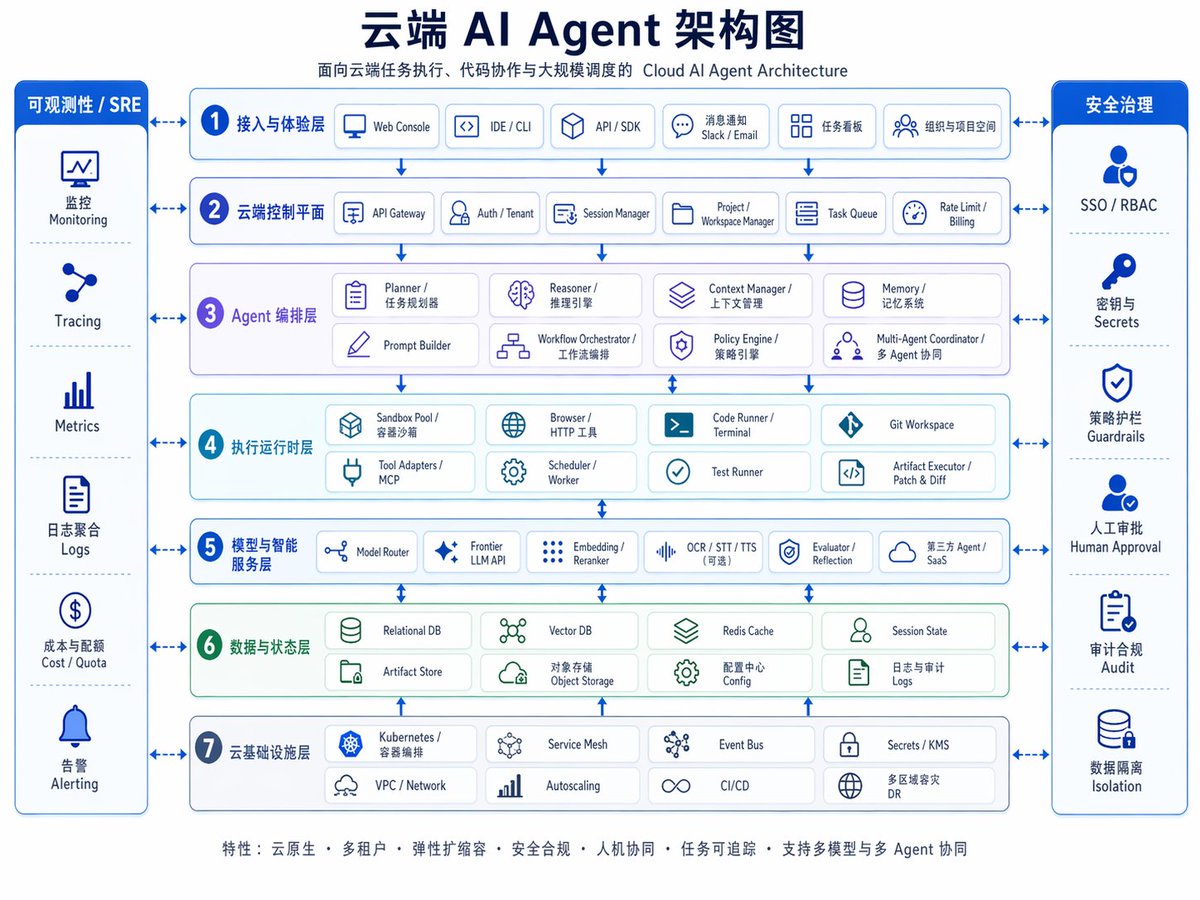
Cloud AI Agent Architecture Diagram
A polished bilingual enterprise infographic showing a layered cloud AI agent architecture, suitable for presentations, product explainers, and technical marketing.
This is a GPT Image 2 prompt case for Graphic & Poster. Use the copy-ready prompt below to generate similar visuals, and review Awesome GPT Image 2 Prompts attribution plus commercial-use rights before reuse.
Free 1K preview
Generate one preview image instantly, no sign-up required.
Prompt
Copy-ready prompt
{
  "type": "enterprise cloud AI architecture infographic",
  "style": "clean corporate vector diagram, white background, blue and teal palette, rounded rectangles, thin blue outlines, subtle shadows, Chinese-first bilingual labels with smaller English subtitles, symmetrical layout, presentation-slide quality",
  "canvas": {
    "aspect_ratio": "4:3",
    "resolution": "1024x768"
  },
  "title_block": {
    "headline": "{argument name=\"headline text\" default=\"Cloud AI Agent Architecture Diagram\"}",
    "subtitle": "Cloud AI Agent Architecture for Cloud Task Execution, Code Collaboration & Large-Scale Scheduling",
    "position": "top center"
  },
  "layout": {
    "center": {
      "type": "stacked architecture layers",
      "count": 7,
      "numbered": true,
      "layers": [
        {
          "index": 1,
          "title": "Access & Experience Layer",
          "english": "access and experience layer",
          "count": 5,
          "items": [
            "Web Console",
            "IDE / CLI",
            "API / SDK",
            "Message Notifications Slack / Email",
            "Task Kanban Organization & Project Space"
          ]
        },
        {
          "index": 2,
          "title": "Cloud Control Plane",
          "english": "cloud control plane",
          "count": 6,
          "items": [
            "API Gateway",
            "Auth / Tenant",
            "Session Manager",
            "Project / Workspace Manager",
            "Task Queue",
            "Rate Limit / Billing"
          ]
        },
        {
          "index": 3,
          "title": "Agent Orchestration Layer",
          "english": "agent orchestration layer",
          "count": 8,
          "items": [
            "Planner / Task Planner",
            "Reasoner / Inference Engine",
            "Context Manager / Context Management",
            "Memory / Memory System",
            "Prompt Builder",
            "Workflow Orchestrator / Workflow Orchestration",
            "Policy Engine / Policy Engine",
            "Multi-Agent Coordinator / Multi-Agent Coordination"
          ]
        },
        {
          "index": 4,
          "title": "Execution Runtime Layer",
          "english": "execution runtime layer",
          "count": 8,
          "items": [
            "Sandbox Pool / Container Sandbox",
            "Browser / HTTP Tool",
            "Code Runner / Terminal",
            "Git Workspace",
            "Tool Adapters / MCP",
            "Scheduler / Worker",
            "Test Runner",
            "Artifact Executor / Patch & Diff"
          ]
        },
        {
          "index": 5,
          "title": "Model & Intelligent Service Layer",
          "english": "model and intelligence services layer",
          "count": 6,
          "items": [
            "Model Router",
            "Frontier LLM API",
            "Embedding / Reranker",
            "OCR / STT / TTS (Optional)",
            "Evaluator / Reflection",
            "Third-party Agent / SaaS"
          ]
        },
        {
          "index": 6,
          "title": "Data and State Layer",
          "english": "data and state layer",
          "count": 8,
          "items": [
            "Relational DB",
            "Vector DB",
            "Redis Cache",
            "Session State",
            "Artifact Store",
            "Object Storage",
            "Configuration Center Config",
            "Logs and Audit Logs"
          ]
        },
        {
          "index": 7,
          "title": "Cloud Infrastructure Layer",
          "english": "cloud infrastructure layer",
          "count": 8,
          "items": [
            "Kubernetes / Container Orchestration",
            "Service Mesh",
            "Event Bus",
            "Secrets / KMS",
            "VPC / Network",
            "Autoscaling",
            "CI/CD",
            "Multi-Region Disaster Recovery DR"
          ]
        }
      ]
    },
    "left_sidebar": {
      "title": "Observability / SRE",
      "position": "left",
      "count": 6,
      "items": [
        "Monitoring",
        "Tracing",
        "Metrics",
        "Log Aggregation Logs",
        "Cost / Quota",
        "Alerting"
      ]
    },
    "right_sidebar": {
      "title": "Security Governance",
      "position": "right",
      "count": 6,
      "items": [
        "SSO / RBAC",
        "Keys & Secrets",
        "Policy Guardrails",
        "Human Approval",
        "Audit Compliance",
        "Data Isolation"
      ]
    },
    "connectors": "bidirectional blue arrows linking both sidebars to every central layer, plus vertical arrows between each architecture layer"
  },
  "visual_details": {
    "icons": "simple blue line icons in every box, one icon per module",
    "boxes": "rounded white cards with pale blue or pale green tinted section backgrounds",
    "section_colors": {
      "layers_1_2_5_7": "light blue",
      "layer_3": "light lavender",
      "layer_4": "light cyan",
      "layer_6": "light green",
      "sidebars": "deep royal blue headers with white text"
    },
    "typography": "bold dark navy Chinese headline, smaller gray-blue subtitle, medium-weight Chinese section labels, compact bilingual item labels"
  },
  "footer": {
    "position": "bottom center",
    "text": "{argument name=\"footer text\" default=\"Features: Cloud Native • Multi-tenancy • Elastic Scalability • Security & Compliance • Human-Machine Collaboration • Task Traceability • Support for Multi-Model & Multi-Agent Collaboration\"}"
  },
  "quality": "crisp infographic, balanced spacing, high legibility, polished enterprise architecture slide suitable for keynote, documentation, and product marketing"
}
Prompt variables
Editable argument placeholders found in the prompt, with their default values.
Best for
- - Graphic & Poster visual exploration
- - Image generation and reference-image edits
- - Reusable briefs that keep source attribution visible
Change these parts
- - Subject, product, character, or scene
- - Aspect ratio, camera, lighting, and background
- - Brand, text, color, and output constraints
Recommended model and settings
- - Model: gpt-image-2
- - Input mode: Text to Image
- - Aspect ratio: source
- - Commercial status: review original source
How to use this prompt
- 1. Copy the prompt and preserve its structure for the first test.
- 2. Replace the subject, context, and publishing channel.
- 3. Change one camera, lighting, or style variable per iteration.
- 4. Inspect the output, source, text, and rights before reuse.
Limitations, source, and reuse cautions
- - Generated output is an editable draft, not factual, legal, or rights evidence.
- - Review the linked source, people, brands, logos, text, and third-party media before commercial use.
More cases in this category
Prioritized by category, input mode compatibility, quality, and lower risk.



Reuse and source notes
Use this prompt safely after previewing the case.
- 1.Copy the prompt or open it directly in Dovoo with the generation button.
- 2.Adjust variables, aspect ratio, and reference images for your own use case.
- 3.Before publishing or paid usage, verify source rights, attribution requirements, and brand or likeness risks.
Can I use this prompt commercially?
Commercial-use status is allowed. Review the original source, license, brand constraints, and legal requirements before paid usage.
Where does this case come from?
This case is imported from Awesome GPT Image 2 Prompts; keep attribution visible and check the source URL before reuse.