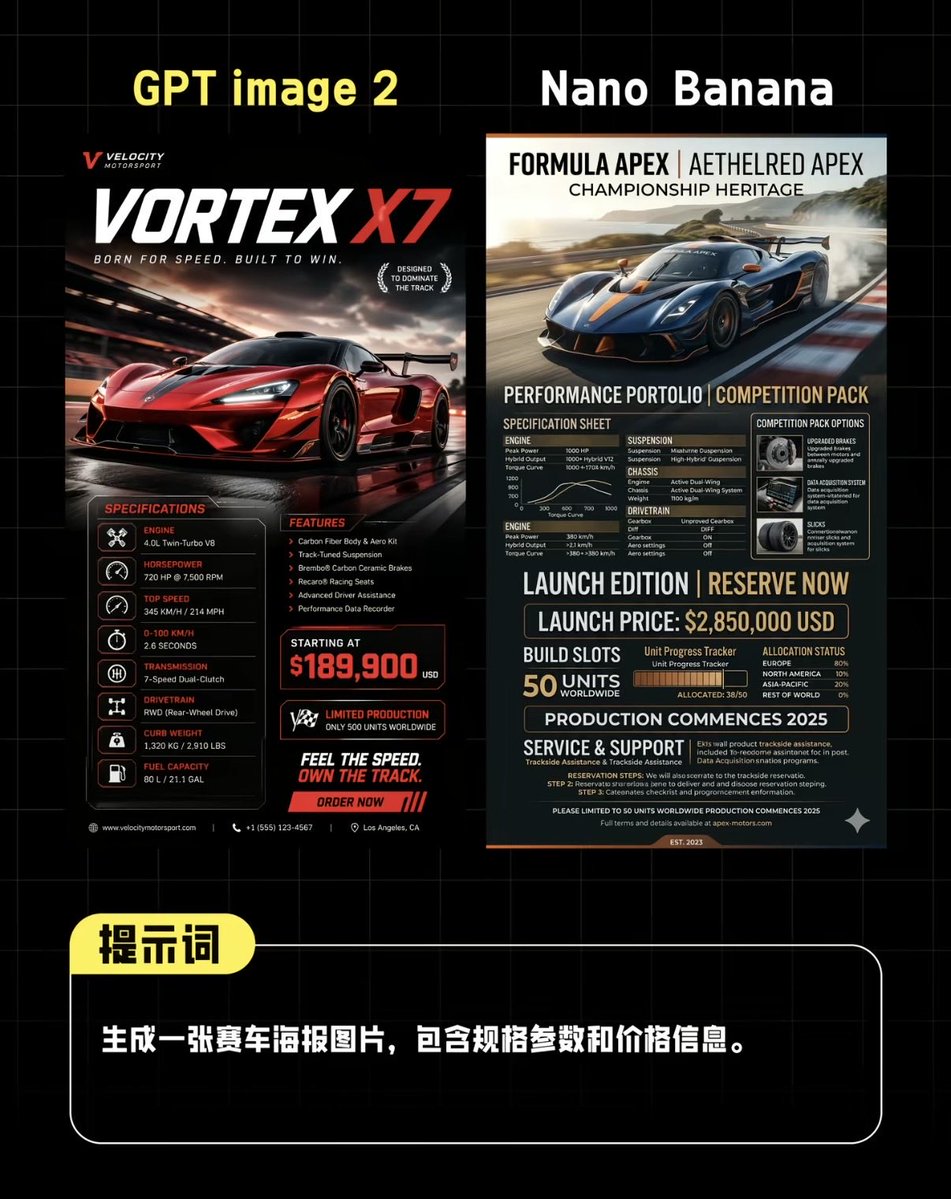
AI Supercar Poster Comparison
A social-media style side-by-side comparison image showing two different AI-generated racing poster designs above a Chinese prompt box, useful for benchmarking image models.
This is a GPT Image 2 prompt case for Graphic & Poster. Use the copy-ready prompt below to generate similar visuals, and review Awesome GPT Image 2 Prompts attribution plus commercial-use rights before reuse.
Free 1K preview
Generate one preview image instantly, no sign-up required.
Prompt
Copy-ready prompt
Create a side-by-side comparison image on a black background with a light gray grid, in a style similar to benchmark posts on Chinese social media, for comparing two AI-generated supercar posters. Place 2 large headings at the top: “GPT image 2” in bold yellow text on the left, and “Nano Banana” in bold white text on the right. Below them, centered, display 2 different vertical racing car poster designs side-by-side with a narrow gap in between. The left poster should be presented in a high-end racing car advertisement style, using a black, red, and white color scheme, depicting a bright red supercar speeding on a wet track at dusk, with cinematic reflections, motion blur, and strong lighting effects. Add a small brand logo in the upper left corner, a large title “VORTEX X7” with “X7” in bright red, and subtitles such as “BORN FOR SPEED. BUILT TO WIN.” Add 2 laurel leaf-like badges to the right of the title area. In the lower half, include 3 content blocks: on the left, a “SPECIFICATIONS” column with 7 lines of lists containing icon symbols and labels, covering engine, horsepower, top speed, acceleration, transmission, drive system, curb weight, and compactly listing fuel capacity (if applicable) on the last line; in the middle, a “FEATURES” column with 5 key points; and a bold “PRICE” block displaying “STARTING AT” and a prominent red price displayed as {argument name="price" default="$189,900"}. Add 1 limited edition badge, 1 slogan block reading “FEEL THE SPEED. OWN THE TRACK.”, and 1 red call-to-action bar reading “ORDER NOW”. Use tiny footer details and micro-text in a contact information style along the bottom edge. The right poster should look more editorial and technical, using navy blue, charcoal gray, beige, and orange accents, depicting a deep blue supercar drifting on a track with smoke and landscape in the background. At the top, use a high-end magazine-style header with 3 stacked titles: “FORMULA APEX | AETHELRED APEX”, “CHAMPIONSHIP HERITAGE”, and a performance subtitle. In the lower half, create a dense specification sheet layout with 8 main sections: “SPECIFICATION SHEET”, “COMPETITION PACK OPTIONS”, “ENGINE”, “SUSPENSION”, “CHASSIS”, “DRIVETRAIN”, “LAUNCH EDITION | RESERVE NOW”, and “SERVICE & SUPPORT”. Include a small performance chart, a boxed options panel with 3 icon cards, a line displaying the launch price as {argument name="launch price" default="$2,850,000 USD"}, an area displaying a production quota of 50 units globally, a segmented bar for allocation or progress tracking, a line stating that production begins on {argument name="production year" default="2025"}, and dense, detailed technical specifications text. Below the two posters, add a rounded black prompt box with a white border spanning most of the width. Overlay a yellow rounded label in the upper left corner containing the Chinese characters “Prompt”. Inside the box, place a line of bold white Chinese text: {argument name="prompt text" default="Generate a racing car poster image, including specifications and pricing information."}. The overall composition should be a sophisticated social media AI image comparison screenshot, with sharp typography, high contrast, neat alignment, and realistic poster mock-up proportions.Prompt variables
Editable argument placeholders found in the prompt, with their default values.
Best for
- - Graphic & Poster visual exploration
- - Image generation and reference-image edits
- - Reusable briefs that keep source attribution visible
Change these parts
- - Subject, product, character, or scene
- - Aspect ratio, camera, lighting, and background
- - Brand, text, color, and output constraints
Recommended model and settings
- - Model: gpt-image-2
- - Input mode: Text to Image
- - Aspect ratio: source
- - Commercial status: review original source
How to use this prompt
- 1. Copy the prompt and preserve its structure for the first test.
- 2. Replace the subject, context, and publishing channel.
- 3. Change one camera, lighting, or style variable per iteration.
- 4. Inspect the output, source, text, and rights before reuse.
Limitations, source, and reuse cautions
- - Generated output is an editable draft, not factual, legal, or rights evidence.
- - Review the linked source, people, brands, logos, text, and third-party media before commercial use.
More cases in this category
Prioritized by category, input mode compatibility, quality, and lower risk.
Reuse and source notes
Use this prompt safely after previewing the case.
- 1.Copy the prompt or open it directly in Dovoo with the generation button.
- 2.Adjust variables, aspect ratio, and reference images for your own use case.
- 3.Before publishing or paid usage, verify source rights, attribution requirements, and brand or likeness risks.
Can I use this prompt commercially?
Commercial-use status is allowed. Review the original source, license, brand constraints, and legal requirements before paid usage.
Where does this case come from?
This case is imported from Awesome GPT Image 2 Prompts; keep attribution visible and check the source URL before reuse.