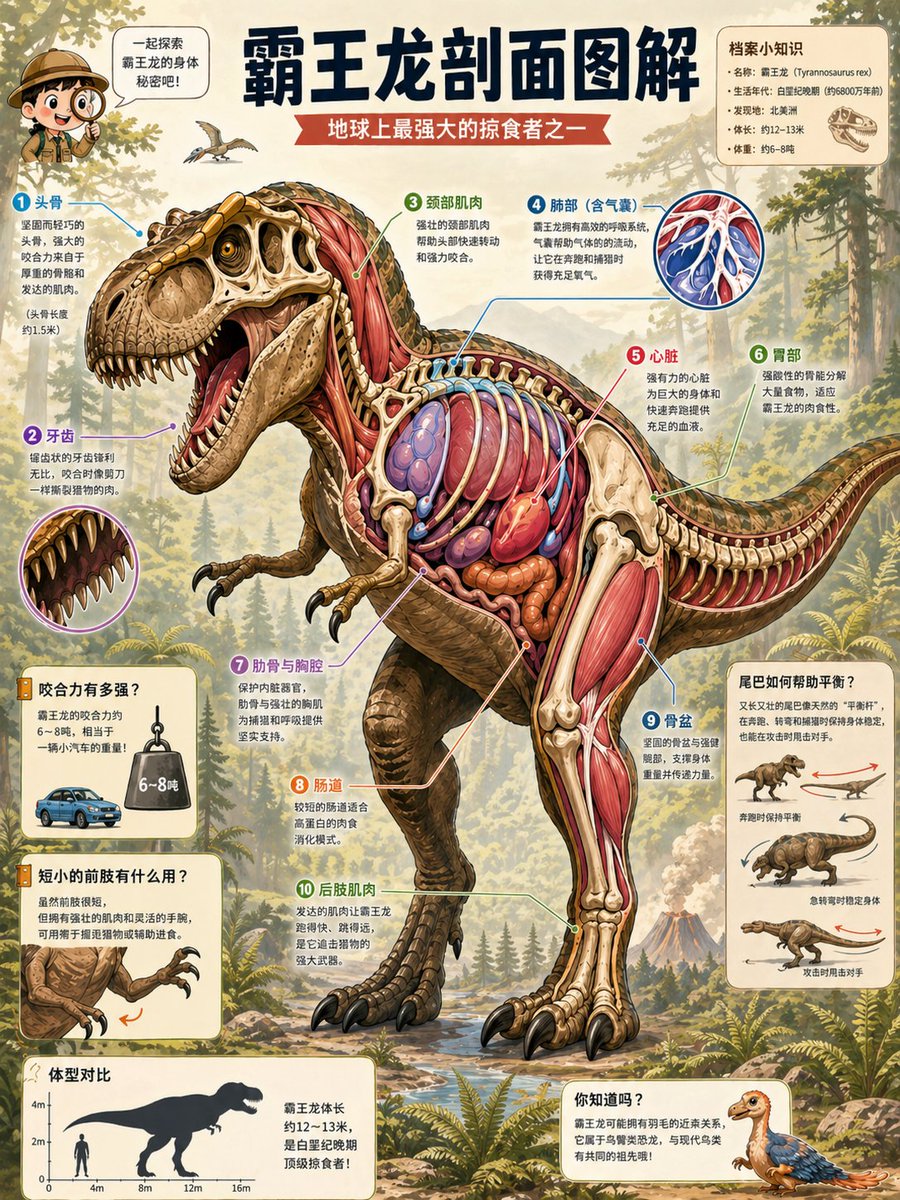
T. Rex Cutaway Encyclopedia Poster
Generates a detailed Chinese educational cutaway diagram of a Tyrannosaurus rex with labeled anatomy, facts, and side explanation cards for science publishing.
This is a gpt-image-2 prompt case for 平面海报. Use the copy-ready prompt below to generate similar visuals, and review Awesome Seedance 2.0 Video Prompts attribution plus commercial-use rights before reuse.
Prompt
Copy-ready prompt
{"type":"Published-level Educational Science Encyclopedia Sectional Poster","language":"Simplified Chinese Tags and Descriptions","main_title":}{argument name="headline text" default="Tyrannosaurus Rex cross-section diagram"} ","subtitle":"{argument name="subtitle text" default="One of the most powerful predators on Earth"} ","subject":{"species":"{argument name="dinosaur species" default="Tyrannosaurus rex"} ","pose":"A large, roaring, side-view dinosaur, walking from left to right, mouth wide open, tail outstretched for balance, one hind leg forward, tiny forelimbs raised,""style":"Highly detailed semi-realistic scientific illustrations, retro natural history encyclopedia style, richly rendered watercolor and gouache textures, clear ink lines, warm parchment background,""cutaway":"The left half shows the external scaly skin and skull; the right side and center of the body are anatomically processed, exposing the bones, red muscles, ribs, lungs, heart, intestines, stomach, tendons, and the spatially coherent cross-section of the leg muscle layers,""skin_color":"{argument name="skin color" default="Olive brown with ochre scales and dark stripes."} ","anatomy_colors":"Ivory skeleton, deep red and pink muscles, blue-purple lungs, bright red heart, orange-brown digestive organs"},"layout":{"composition":"Vertical poster layout, dinosaur in the center, numbered arrows radiating around the body, rounded cream-colored cards with embedded small illustrations, background is a forest and volcanic landscape","background":"Mesozoic forest, including conifers, ferns, rocky streams, hazy mountains, distant volcanoes, small flying pterosaurs, warm sunshine, educational museum poster atmosphere","top_left_mascot":"Small explorer children's character with a speech bubble:\"Let's explore the secrets of the Tyrannosaurus Rex's body together!"","top_right_fact_card":{"title":"Archival Facts","count":4,"items":["Name: Tyrannosaurus Rex","Life Period: Late Cretaceous (approximately 68 million years ago)","Location: North America","Length: Approximately 12–13"} "Meters", "Weight: Approximately 6–8 tons"],"note": "Draw a small Tyrannosaurus Rex skull icon next to the fact"},"main_numbered_anatomy_callouts":{"count":10,"items":[{"number":1,"label":"Skull","description":"Huge skull, powerful jaw, thick bones and strong jaw muscles"},{"number":2,"label":"Teeth","description":"Large, conical, serrated teeth, with a close-up circular illustration of an open mouth"},{"number":3,"label":"Neck muscles","description":"Thick neck muscles connecting the skull to the torso"},{"number":4,"label":"Lungs (including air sacs)","description":"Blue respiratory system, with a circular illustration showing branching air sacs and blood vessels"},{"number":5,"label":"Heart", description":"Large red heart within the ribcage"},{"number":6,"label":"Stomach","description":"Stomach and digestive cavity behind the ribs"},{"number":7,"label":"Ribs and thoracic cavity","description":"Archive ivory ribs surrounding the lungs and organs"},{"number":8,"label":"Intestines","description":"Orange intestines coiled around the abdomen"},{"number":9,"label":"Pelvis","description":"Large hip bones supporting the hind limbs and tail"},{"number":10,"label":"Hhind limb muscles","description":"Strong red thigh and calf muscles attached to the long leg bones"}]},"side_information_cards":{"count":5,"cards":[{"position":"lower left upper","title":"How strong is the bite force?"}} {"visuals":"A small blue car is hanging with a weight marked 6-8 tons","purpose":"Explaining the bite force comparison"},{"position":"lower left middle","title":"What is the use of the short forelimbs?",visuals":"Close-up of the small forelimbs with claws and orange movement arrows","purpose":"Explaining the possible functions of the short forelimbs"},{"position":"lower left bottom","title":"Size comparison","visuals":"A silhouette comparison of humans and Tyrannosaurus Rex, vertical scale up to 4 meters, horizontal scale up to 16 meters","purpose":"Showing the size comparison and body length of about 12-13 meters"},{"position":"right middle","title":"How does the tail help with balance?", ...right middle","title":"How does the tail help with balance?",visuals":"Close-up of the small forelimbs with claws and orange movement arrows","purpose":"Explaining the possible functions of the short {"count":3,"visuals":["Small dinosaur with red horizontal balancing arrows","Illustration of tail-bearing walking with blue arrows","Illustration of running posture with red arrows"],"purpose":"Explaining the balancing function of the tail and running stability"},{"position":"lower right","title":"Did you know? ","visuals":"Illustrations of small feathered juvenile dinosaurs","purpose":"Fun trivia cards about feathers and close relatives"}]},"typography":"Bold dark navy blue Chinese title at the top, red ribbon subtitle, clear printed Chinese text, color-coded numbered circles, thin colored guide lines, rounded cream-colored annotation cards with subtle shadows","rendering_requirements":"Ensure clear and layered anatomical structures, including accurate internal structures, maintain color consistency and clear labels, high-resolution printable poster, no photorealistic rendering, no 3D rendering, no modern UI elements"}Prompt variables
Editable argument placeholders found in the prompt, with their default values.
More cases in this category
Prioritized by category, input mode compatibility, quality, and lower risk.




Reuse and source notes
Use this prompt safely after previewing the case.
- 1.Copy the prompt or open it directly in Dovoo with the generation button.
- 2.Adjust variables, aspect ratio, and reference images for your own use case.
- 3.Before publishing or paid usage, verify source rights, attribution requirements, and brand or likeness risks.
Can I use this prompt commercially?
Commercial-use status is restricted. Review the original source, license, brand constraints, and legal requirements before paid usage.
Where does this case come from?
This case is imported from Awesome Seedance 2.0 Video Prompts; keep attribution visible and check the source URL before reuse.