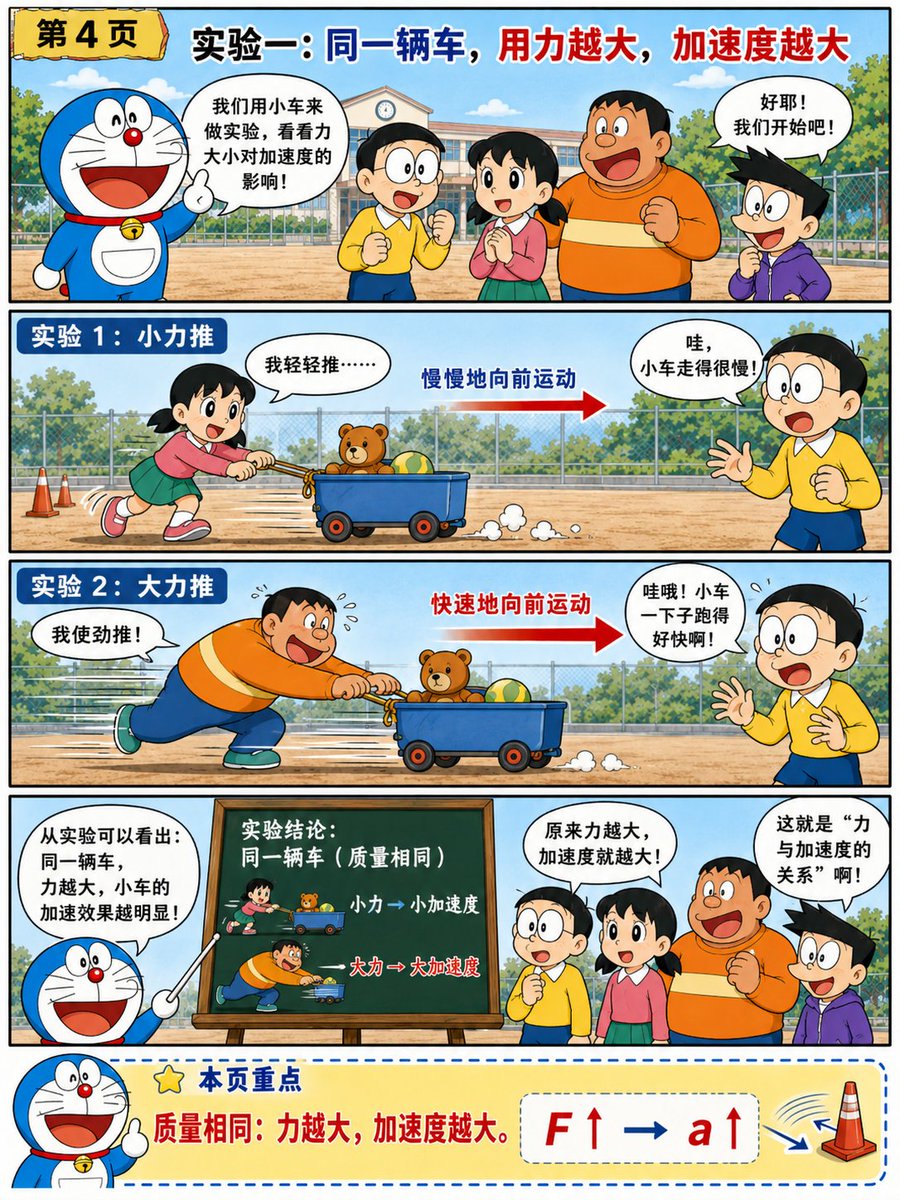
Doraemon-style Newton's Second Law comics
A structured prompt is used to generate brightly colored Chinese science comic pages that explain force and acceleration through experiments with toy cars.
Prompt
Copy-ready prompt
Objective: To create a vibrant, colorful science comic strip that teaches Newton's Second Law through a classroom experiment inspired by Doraemon, employing a cheerful Japanese children's comic aesthetic and accompanied by clear Chinese explanatory text. Canvas: A 3:4 portrait page with a thick black border, precisely divided into 5 horizontal sections: 1 header story panel, 2 experiment panels, 1 conclusion panel, and 1 bottom summary bar. Use bright base colors and clean ink lines. The background is a school playground, including blue sky, trees, fences, and school buildings. Layout and Text Content: A yellow torn paper label in the upper left corner contains the following information:{argument name="page label" default="Page 4"} The top heading is in bold Chinese and contains the following content:{argument name="main headline" default="Experiment 1: For the same car, the greater the force applied, the greater the acceleration."} The text highlights various sections, including: "The same vehicle" in blue, and "The greater the force, the greater the acceleration" in red. Section 1, the introduction panel: On the left is a blue Doraemon character, resembling a classic round-headed cartoon cat, smiling and raising one finger, wearing a red collar and bell. Four children stand in the middle/right: a boy in a yellow shirt (face deliberately blurred/blank), a girl in a pink top and green skirt, a muscular boy in an orange sweater, and a boy with spiky hair in a purple hoodie. A dialogue bubble: Doraemon says, "Let's use the vehicle to conduct an experiment and see how the force affects acceleration!" The spiky-haired boy says, "Yay! Let's begin!" Section 2, the experiment panel, labeled "Experiment 1: Small Push" within a blue rounded rectangle: A school scene where a girl is pulling a blue cart from left to right with a rope/handle. The cart contains two clearly visible items: a teddy bear and a striped ball. A small amount of dust effect is added behind the wheels. A red arrow points to the right, accompanied by the blue text "Move forward slowly." A speech bubble: a girl says, "I push gently..." and a boy with a blurred face on the right says, "Wow, the car is moving very slowly!" Section 3, Experiment cell, labeled "Experiment 2: Push Hard": A burly boy in an orange sweater pushes the same blue cart forcefully from left to right, leaning forward, with speed lines, sweat beads, and a stronger sense of movement. The cart also contains two clearly visible items: a teddy bear and a striped ball. A larger red arrow points to the right, accompanied by the red text "Move forward quickly." A speech bubble: the burly boy says, "I push hard!" and a boy with a blurred face on the right says, "Wow! The cart is moving so fast!" Section 4, Conclusion cell: On the left, a blue Doraemon points with a pointer and says, "The experiment shows that for the same cart, the greater the force, the more obvious the acceleration effect!" In the center is a green blackboard on a wooden easel. The blackboard is titled "Experimental Conclusion: Same Car (Same Mass)" and displays two sets of miniature illustrations for comparison: a small force push is accompanied by the text "Small force → Small acceleration," and a large force push is accompanied by the text "Large force → Large acceleration." Four children stand on the right: a boy in a yellow shirt with blurred faces, a girl in a pink shirt and green skirt, a muscular boy in an orange shirt, and a boy with spiky hair in a purple shirt. Speech bubbles read, "So, the greater the force, the greater the acceleration!" and "This is the relationship between force and acceleration!" In section 5, the bottom summary bar is a pale yellow rounded rectangle with a blue dotted border. On the left, a blue Doraemon smiles, raising a finger next to a star icon. The large blue title reads {argument name="summary heading" default="This page highlights"} The main clause in red is {argument name="summary sentence" default="For the same mass: the greater the force, the greater the acceleration."} The right side displays a formula card with the bold red and blue symbol "F↑ → a↑", along with an orange traffic cone icon with an arc-shaped trajectory. Visual style: A refined Japanese manga layout mimicking Ohmsha's style of science books: thick black panel lines, clean cel color scheme, expressive cartoon faces, easy-to-read bold Chinese typography, speech bubbles with black outlines, and a friendly elementary science teaching tone. Constraints: Maintain precise 5 horizontal areas, precise 4 children in group scenes, precise 2 items inside the car in each experiment cell, and ensure the yellow-shirted boy's face remains intentionally blurred/blank wherever it appears. Avoid photorealism, extra panels, watermarks, and ensure all text is clearly legible.Prompt variables
Editable argument placeholders found in the prompt, with their default values.
Variable
page label
Default
Page 4
Variable
main headline
Default
Experiment 1: For the same car, the greater the force applied, the greater the acceleration.
Variable
summary heading
Default
This page highlights
Variable
summary sentence
Default
For the same mass: the greater the force, the greater the acceleration.
More cases in this category
Prioritized by category, input mode compatibility, quality, and lower risk.

"Sunset Rendezvous" Animation Storyboard
text to imageunknown

Trading Card Battle Animation Storyboard
text to imageunknown

Q-version comic of a sports meet on a rainy day
text to imageunknown

Exquisite pen and ink comic style
text to imageunknown

Anime storyboard generation
text to imageunknown

Software analogy comic illustration
text to imageunknown
Reuse and source notes
Use this prompt safely after previewing the case.
- 1.Copy the prompt or open it directly in Dovoo with the generation button.
- 2.Adjust variables, aspect ratio, and reference images for your own use case.
- 3.Before publishing or paid usage, verify source rights, attribution requirements, and brand or likeness risks.
Can I use this prompt commercially?
Commercial-use status is unknown. Review the original source, license, brand constraints, and legal requirements before paid usage.
Where does this case come from?
This case is imported from YouMind OpenLab awesome-gpt-image-2; keep attribution visible and check the source URL before reuse.