LEO Rocket Delta-V Infographic
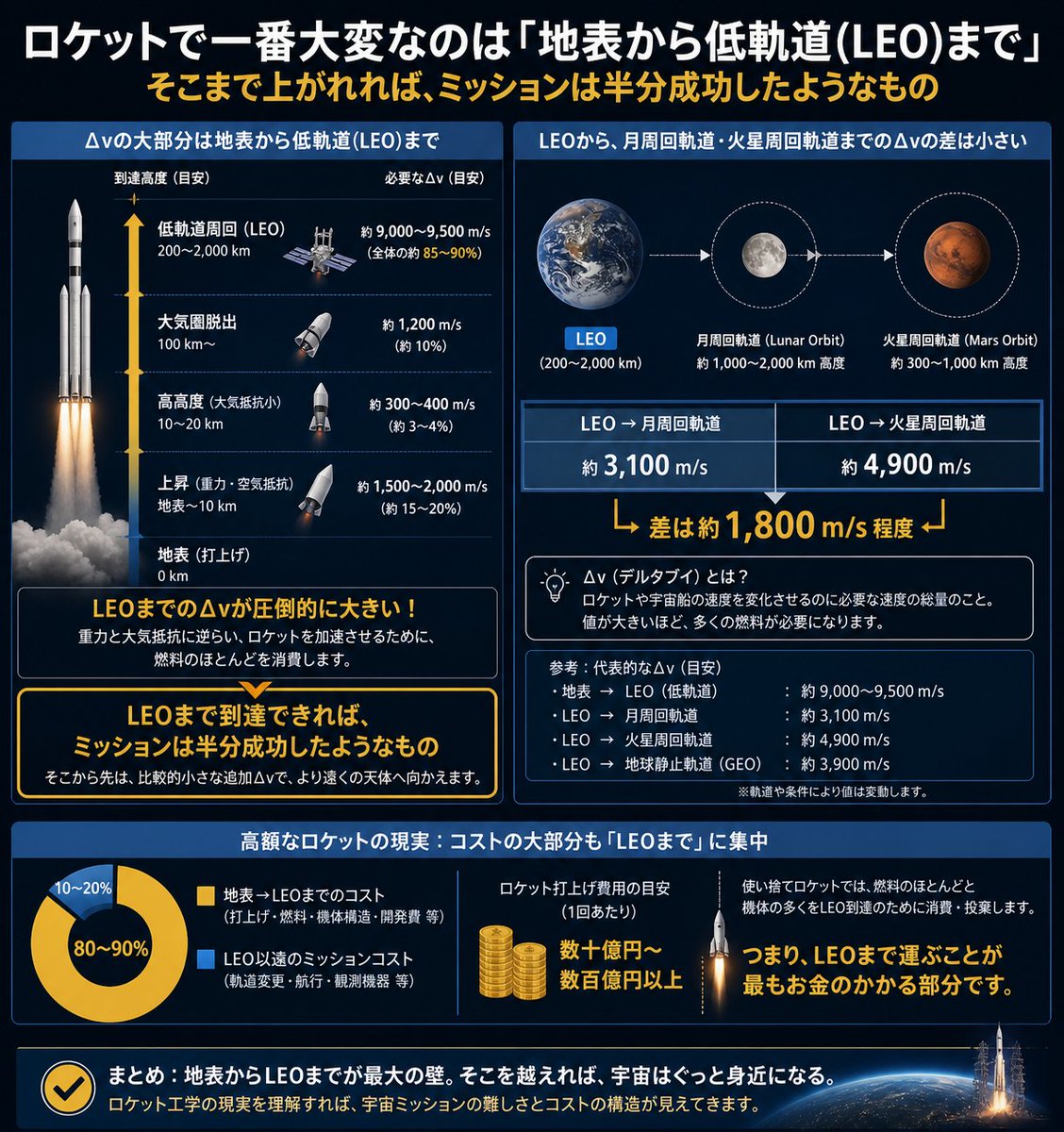
Generates a Japanese engineering infographic explaining why reaching low Earth orbit is the hardest and most expensive part of a rocket mission.
This is a gpt-image-2 prompt case for 平面海报. Use the copy-ready prompt below to generate similar visuals, and review Awesome Seedance 2.0 Video Prompts attribution plus commercial-use rights before reuse.
Prompt
Copy-ready prompt
{
"type": "Japanese rocket engineering information diagram",
"format": "Single square educational infographic, 1:1 aspect ratio",
"theme": "Based on fundamental rocket engineering, this explains the most challenging part of a rocket mission: reaching low Earth orbit from the Earth's surface.",
"language": "Japanese",
"visual style": "The deep navy blue infographics, reminiscent of space technology, feature bright blue chapter titles, yellow-orange highlights, white Japanese font, concise engineering diagrams, realistic 3D rocket and planet renderings, high contrast, and sophisticated social media science education design.",
"headline": "{argument name=\"headline text\" default=\"The most difficult step in rocket launch: from the Earth's surface to low Earth orbit (LEO).\"}",
"subtitle": "{argument name=\"subtitle text\" default=\"If we can get there, the mission will be half successful.\"}",
"canvas": {
"background": "Deep navy blue gradient with subtle grid lines and a space-age halo effect.",
"border": "The entire infographic is surrounded by a thin blue border.",
"layout": "The top panel has a header, two large panels side-by-side above, a wide cost panel in the middle, and a summary banner at the bottom."
},
"layout": {
"sections count": 5,
"sections": [
{
"title": "Most of Δv is consumed during the journey from the Earth's surface to low Earth orbit (LEO).",
"position": "Top left",
"content type": "A chart comparing vertical height to Delta-V, accompanied by a rocket launch illustration.",
"main visual": "On the far left, a large, black-and-white heavy rocket launches into the sky, accompanied by bright orange flames and smoke.",
"chart columns": [
"Altitude reached (for reference)",
"Required Δv (reference)"
],
"altitude stages count": 4,
"altitude stages": [
{
"label": "Low Earth Orbit (LEO)",
"altitude": "200〜2,000 km",
"delta v": "Approximately 9,000–9,500 m/s (approximately 85–90% of the total)",
"icon": "small satellite"
},
{
"label": "De-atmosphere",
"altitude": "Over 100 km",
"delta v": "Approximately 1,200 m/s (approximately 10%)",
"icon": "Small tilting rocket"
},
{
"label": "High altitude (low atmospheric drag)",
"altitude": "10〜20 km",
"delta v": "Approximately 300–400 m/s (approximately 3–4%)",
"icon": "small rocket"
},
{
"label": "Ascent (gravity and air resistance)",
"altitude": "Surface ~ 10 km",
"delta v": "Approximately 1,500–2,000 m/s (approximately 15–20%)",
"icon": "Small rocket nose up"
}
],
"callouts count": 2,
"callouts": [
{
"text": "The Δv required to reach LEO is extremely large!",
"style": "Yellow title within dark border"
},
{
"text": "If we can reach LEO, the mission will be half successful.",
"style": "Large orange border with downward arrow"
}
]
},
{
"title": "The Δv difference from LEO to lunar or Mars orbit is small.",
"position": "Top right",
"content type": "Space orbit comparison chart and delta-v table",
"celestial bodies count": 3,
"celestial bodies": [
{
"label": "LEO",
"description": "Earth with a blue atmosphere, in a dashed circular orbit, marked 200–2,000 km."
},
{
"label": "Lunar Orbit",
"description": "A gray moon in a dashed orbit, marked at an altitude of approximately 1,000–2,000 km."
},
{
"label": "Mars Orbit",
"description": "Orange Mars in a dashed orbit, marked at an altitude of approximately 300–1,000 km."
}
],
"trajectory arrows count": 2,
"trajectory arrows": [
"Earth/LEO to the Moon",
"From the Moon to Mars"
],
"comparison boxes count": 2,
"comparison boxes": [
{
"label": "LEO → Lunar Orbit",
"value": "Approximately 3,100 m/s"
},
{
"label": "LEO → Mars orbit",
"value": "Approximately 4,900 m/s"
}
],
"highlight": "The difference is only about 1,800 m/s",
"definition box": {
"title": "What is Δv (Delta-v)?",
"text": "This refers to the total velocity required to change the speed of a rocket or spacecraft. The higher the value, the more fuel is needed.",
"icon": "Light bulb"
},
"reference list count": 4,
"reference list": [
"Surface to LEO (Low Earth Orbit): Approximately 9,000–9,500 m/s",
"LEO → Lunar orbit: Approximately 3,100 m/s",
"LEO → Mars orbit: approximately 4,900 m/s",
"LEO → Geostationary Orbit (GEO): Approximately 3,900 m/s"
],
"footnote": "* Values may vary depending on fuel efficiency and conditions."
},
{
"title": "The reality of expensive rockets: most of the cost is concentrated on \"reaching LEO\".",
"position": "Full width in the middle",
"content type": "Cost Composition Panel",
"subcomponents count": 4,
"subcomponents": [
{
"type": "pie chart",
"label": "80〜90%",
"secondary label": "10〜20%",
"colors": "Yellow and blue"
},
{
"type": "legend",
"items count": 2,
"items": [
"Surface to LEO Costs (launch, fuel, airframe structure, R&D expenses, etc.)",
"Costs beyond LEO (orbit changes, navigation, observation instruments, etc.)"
]
},
{
"type": "Coin stack illustration",
"label": "Rocket launch cost reference (single launch)",
"value": "Billions to tens of billions of yen or more"
},
{
"type": "Small rocket launch icon and description",
"text": "In expendable rockets, most of the fuel and structural components are consumed or jettisoned during the journey to LEO. In other words, transporting the rocket to LEO is the most expensive part."
}
]
},
{
"title": "In summary: The greatest barrier is from the Earth's surface to LEO. Once crossed, the universe will become within reach.",
"position": "Bottom full width",
"content type": "Summary Banner",
"icon": "The large yellow checkmark inside the circle on the left",
"background visual": "A curved horizon and a small rocket launch on the right.",
"body text": "Understanding the realities of rocket engineering allows us to see the challenges and cost structure of space missions."
},
{
"title": "Overall visual decoration",
"position": "Throughout the entire map",
"content type": "Decorative technical elements",
"items count": 5,
"items": [
"Blue panel title",
"Orange arrow",
"fine dividing line",
"Small spacecraft icon",
"Glowing yellow accent text"
]
}
]
},
"typography": {
"headline": "Large, bold, white Japanese sans-serif font containing LEO phrases.",
"subtitle": "Bold yellow Japanese sans-serif font",
"body": "Compact and concise white Japanese text",
"numbers": "Large, bold white and yellow numbers used for delta-v values"
},
"color palette": {
"primary background": "{argument name=\"background color\" default=\"Deep Navy Blue\"}",
"accent": "{argument name=\"accent color\" default=\"Golden orange\"}",
"secondary": "Electric Blue",
"text": "White"
},
"rendering instructions": "Create a clear, information-dense Japanese infographic suitable for X/Twitter. Keep all tags sharp and legible, panels neatly aligned, and designated Japanese text preserved. Combine realistic rocket/planet illustrations with flat UI-style charts, and avoid clutter outside of structured panels."
}Prompt variables
Editable argument placeholders found in the prompt, with their default values.
More cases in this category
Prioritized by category, input mode compatibility, quality, and lower risk.




Reuse and source notes
Use this prompt safely after previewing the case.
- 1.Copy the prompt or open it directly in Dovoo with the generation button.
- 2.Adjust variables, aspect ratio, and reference images for your own use case.
- 3.Before publishing or paid usage, verify source rights, attribution requirements, and brand or likeness risks.
Can I use this prompt commercially?
Commercial-use status is restricted. Review the original source, license, brand constraints, and legal requirements before paid usage.
Where does this case come from?
This case is imported from Awesome Seedance 2.0 Video Prompts; keep attribution visible and check the source URL before reuse.