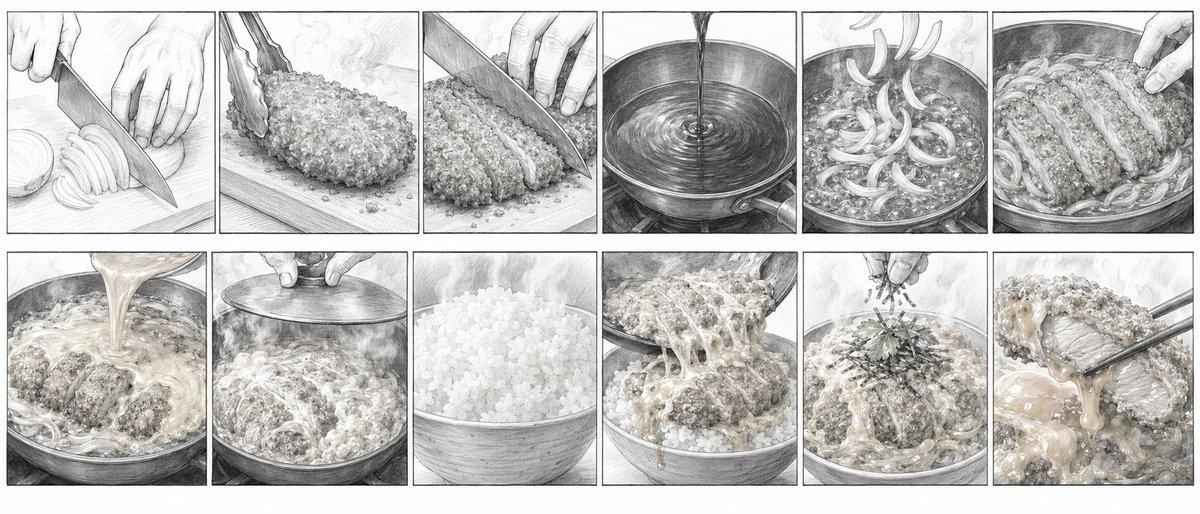
Katsudon Cooking Storyboard
A detailed 12-panel manga-style recipe storyboard showing the full cooking process for katsudon from onion slicing to serving.
This is a GPT Image 2 prompt case for Anime & Game. Use the copy-ready prompt below to generate similar visuals, and review Awesome GPT Image 2 Prompts attribution plus commercial-use rights before reuse.
Free 1K preview
Generate one preview image instantly, no sign-up required.
Prompt
Copy-ready prompt
Goal: Create a monochrome cooking storyboard illustration showing the preparation and serving of a Japanese-style katsudon rice bowl, drawn like a detailed manga storyboard or recipe process sheet.

Canvas: Wide horizontal aspect ratio, about 2.4:1, white background, arranged as exactly 12 rectangular panels in a clean grid: 6 panels across the top row and 6 panels across the bottom row. Thin black borders separate every panel. No captions, no speech bubbles, no logos, no watermark.

Visual style: Highly detailed pencil sketch and light watercolor-wash look, mostly grayscale with subtle warm beige tones in the egg sauce and fried cutlet. Fine crosshatching, visible paper texture, realistic hand-drawn food textures, steam, highlights on oil and sauce, cinematic close-up framing in every panel.

Subject: A step-by-step cooking sequence for {argument name="dish name" default="katsudon"}, featuring sliced onion, breaded pork cutlet, simmering egg sauce, rice, and garnish. Use realistic adult hands when hands appear, cropped close to the food.

Panel layout and exact panel count: Show exactly 12 panels, ordered left to right, top row then bottom row:
1. Close-up of hands slicing a pale onion into thin crescent slices on a cutting board with a large kitchen knife.
2. Close-up of a breaded pork cutlet on a cutting board, held with tongs, covered in coarse crispy crumbs.
3. Close-up of the fried cutlet being cut into thick strips with a knife, fingers holding it steady.
4. Top-down close-up of clear liquid or broth being poured into a round metal pan, creating circular ripples.
5. Close-up of sliced onions simmering in bubbling broth in the pan, steam rising.
6. Close-up of the sliced cutlet being placed on top of the onions in the pan by hand.
7. Close-up of beaten egg mixture being poured over the cutlet and onions, creamy ribbons spreading through the pan.
8. Close-up of a metal lid covering the pan while steam surrounds the edges.
9. Close-up of a large bowl filled with fluffy white rice, rice grains clearly defined.
10. Close-up of the cooked cutlet, onion, and soft egg mixture being slid from the pan onto the rice bowl, strands of egg stretching.
11. Close-up of the finished bowl being sprinkled with thin dark seaweed strips and green garnish on top, steam rising.
12. Close-up serving shot of chopsticks lifting one saucy slice of cutlet with soft egg dripping, the rice bowl visible underneath.

Composition constraints: Keep each panel tightly framed and food-focused; maintain consistent lighting and hand-drawn pencil shading across all panels; make the sequence readable as a recipe storyboard; do not add text labels, numbers, extra panels, utensils not described, or colorful modern graphics.
Prompt variables
Editable argument placeholders found in the prompt, with their default values.
Best for
- - Anime & Game visual exploration
- - Image generation and reference-image edits
- - Reusable briefs that keep source attribution visible
Change these parts
- - Subject, product, character, or scene
- - Aspect ratio, camera, lighting, and background
- - Brand, text, color, and output constraints
Recommended model and settings
- - Model: gpt-image-2
- - Input mode: Text to Image
- - Aspect ratio: source
- - Commercial status: review original source
How to use this prompt
- 1. Copy the prompt and preserve its structure for the first test.
- 2. Replace the subject, context, and publishing channel.
- 3. Change one camera, lighting, or style variable per iteration.
- 4. Inspect the output, source, text, and rights before reuse.
Limitations, source, and reuse cautions
- - Generated output is an editable draft, not factual, legal, or rights evidence.
- - Review the linked source, people, brands, logos, text, and third-party media before commercial use.
More cases in this category
Prioritized by category, input mode compatibility, quality, and lower risk.

Reuse and source notes
Use this prompt safely after previewing the case.
- 1.Copy the prompt or open it directly in Dovoo with the generation button.
- 2.Adjust variables, aspect ratio, and reference images for your own use case.
- 3.Before publishing or paid usage, verify source rights, attribution requirements, and brand or likeness risks.
Can I use this prompt commercially?
Commercial-use status is allowed. Review the original source, license, brand constraints, and legal requirements before paid usage.
Where does this case come from?
This case is imported from Awesome GPT Image 2 Prompts; keep attribution visible and check the source URL before reuse.