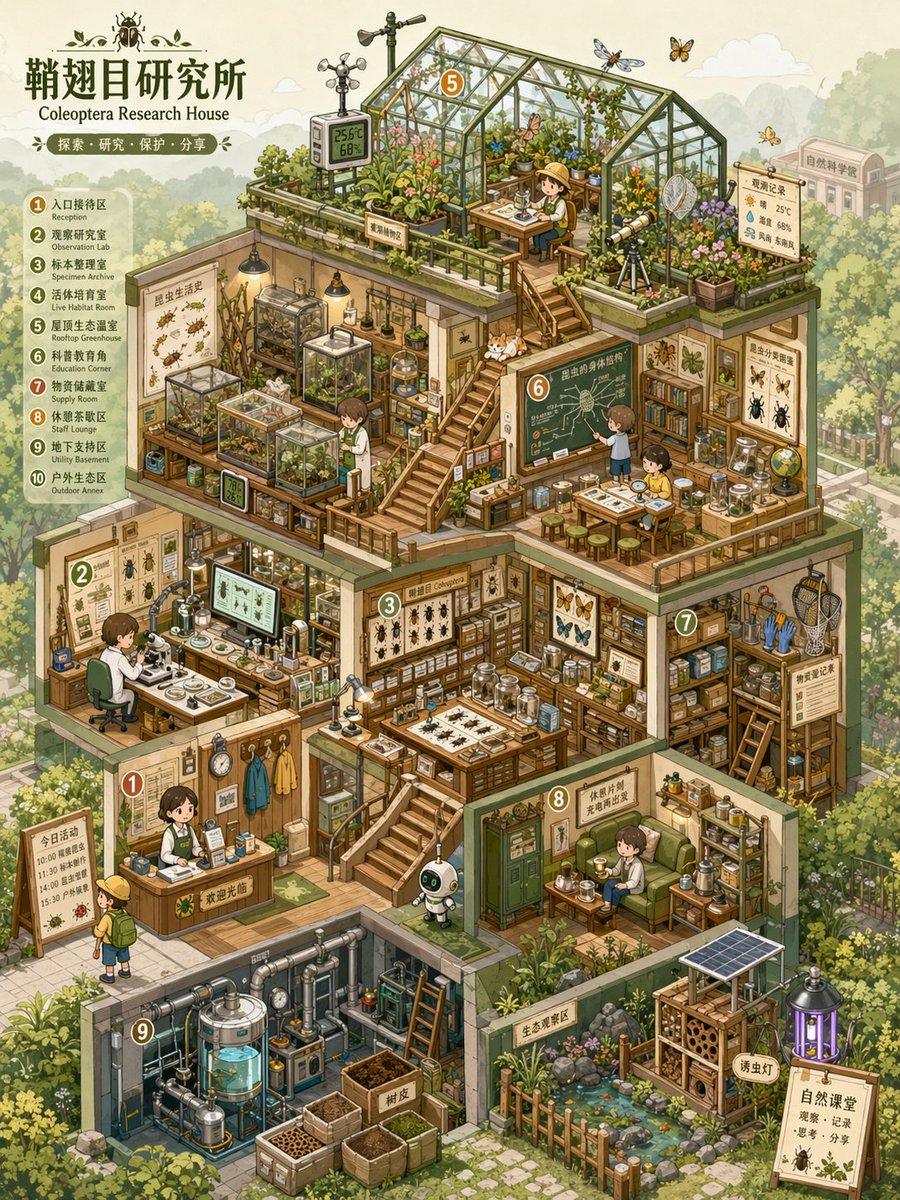
Isometric Micro-World Cross-Section Archive
A professional and highly detailed instruction prompt for generating isometric, cross-section views of miniature thematic worlds with high information density.
This is a GPT Image 2 prompt case for Illustration & Art. Use the copy-ready prompt below to generate similar visuals, and review Awesome GPT Image 2 Prompts attribution plus commercial-use rights before reuse.
Free 1K preview
Generate one preview image instantly, no sign-up required.
Prompt
Copy-ready prompt
Please create a high-completion, high-information-density visual map of an 'Isometric Micro-World Archive' suitable for serialized publishing based on the [Theme].

This is not a regular room illustration or a simple architectural drawing, but a thematic space overview combining 'isometric perspective + architectural cross-section structure + multi-layer functional space + high-density thematic props + miniature model feel + game scene concept art feel.' The image should look like an opened miniature world, a business simulation game scene, a dollhouse model, or a world-building concept map, allowing viewers to understand the overall structure at a glance while repeatedly observing the small details within.

[Basic Settings]
Theme: [Theme, e.g., Insect Research Institute / Future Survival Base / Magic Potion Workshop / AI Automation Company / Plant Factory / Children's Learning Center / Space Supply Station]
Space Name / Brand Name: [Brand name or space name, can be empty]
Worldview Direction: [Reality / Sci-Fi / Fairy Tale / Magic / Post-Apocalyptic / Museum / Laboratory / Business Simulation / Campus / Natural Ecology]
Building Type: [Cottage / Base / Factory / Lab / Shop / Museum / Underground Space / Spaceship / Multi-layer Studio]
Core Function: [What this space is mainly used for, e.g., research, production, display, life, training, trading, learning, maintenance, planting]
Main Color: [Main color, e.g., light blue, mint green, cream yellow, pink, orange-green, purple-blue, white-blue tech color]
Auxiliary Color: [Auxiliary color, can be empty]
Accent Color: [Accent color, can be empty]
Aspect Ratio: [1:1 / 3:4 / 4:5 / 9:16]
Information Density: [Medium-high / High / Ultra-high]
Overall Vibe: [Healing, cute, precise, childlike, popular science, futuristic, retro, refreshing, sense of exploration]

If some fields are not filled, please automatically derive them reasonably based on the [Theme]; do not leave the screen blank. All content must be generated uniformly around the theme, avoiding irrelevant elements.

[Visual Structure]
Adopt a clear isometric perspective / axonometric view, where the main subject is an opened multi-layer thematic building or functional base. Viewers can simultaneously see the front, side, top, and internal space of the building. The entire building is located at the center of the screen, occupying most of the area, with the background environment moderately faded to highlight the subject.

The interior of the building needs to be divided into multiple functional areas, each with a clear purpose, rather than randomly piled decorations. It can include:
1. Main work area / Core operation area
2. Display area / Collection area / Specimen area
3. Research area / Lab area / Control area
4. Storage area / Shelving area / Supply area
5. Living area / Rest area / Small residential area
6. Energy area / Machine area / Piping area
7. Planting area / Cultivation area / Ecological area
8. Entrance area / Transport area / Maintenance area
9. Spatial connection structures like stairs, platforms, corridors, railings, ladders, etc.

Clear spatial relationships must be formed between various areas through stairs, corridors, platforms, pipes, bridges, or cables, making the image look like a real, functioning miniature system.

[Props and Details]
Generate a large number of relevant props based on the [Theme] and distribute them in different functional areas. Props need to be specific, identifiable, and thematically related, not just vague decorations. Each small object should be as clear and readable as a game asset, with a feel of being clickable, interactive, and collectable.

Types of props can include:
- Thematic equipment: machines, instruments, tools, consoles, containers, screens, workbenches
- Lifestyle objects: tables/chairs, bookshelves, beds, cups, boxes, cabinets, lamps
- Display objects: specimens, models, posters, signboards, glass cabinets, display racks
- Connection structures: pipes, wires, ladders, stairs, conveyor belts, slide rails, platforms
- Ecological elements: plants, water tanks, incubators, soil, branches, rocks, specimens
- Character elements: small number of characters, animals, robots, or thematic creatures to provide a sense of scale and story

The number of props should be rich but orderly. All props should serve the space's function and the thematic worldview.

[Style Requirements]
The overall style is clear, cute, precise hand-drawn cartoon isometric illustration. Lines are clean, edges are slightly rounded, colors are bright and soft, with an overall relaxed, healing, and exploratory feel. The image should have the feel of a business simulation game, a children's science picture book, a miniature model, or a concept art page.

Avoid over-realism, strong dark lighting/shadows, heavy oil painting feel, and complex noise. The focus is on being clear, exquisite, layered, and highly readable.

[Color and Lighting]
Use high brightness, low-to-medium saturation soft color schemes. The main color is unified, auxiliary colors are used to distinguish different spaces, and accent colors are used to highlight key equipment and small props. Line art colors should not use dead black; instead, use soft outlines like dark gray, blue-gray, or brown-gray.

Keep lighting and shadows lightweight; strong realistic projections are not needed. Build layers through color blocks, structures, lines, and local highlights. The background should use light colors and low-contrast processing to make the main building stand out more.

[Composition and Reading Path]
The main subject is centered or slightly upper-centered, with the building in a multi-layer cross-section structure. The visual reading path should start from the overall building outline, enter the functional areas of each floor, and finally observe the detailed props. The gaze can be guided by elements such as stairs, platforms, corridors, pipelines, and tracks.

The overall image should be full but not crowded, rich but not messy. Every room, platform, and corner should have content, yet still maintain clear spatial boundaries.

[Background Environment]
The background can include a weakened external environment according to the theme, such as a forest, city, street, underground rock layer, experimental park, seabed, space, campus, factory exterior, etc. The background should not compete with the subject; light colors, low opacity, and low contrast are recommended to achieve a 'subject clear, background receding' effect.

[Final Effect]
The final image should look like a complete thematic space concept map, with both the structural feel of an architectural cross-section and the detail of a game scene asset map, combined with the cute exploration feel of a miniature dollhouse. It should be suitable for serialized visual creation, IP worldview display, game scene settings, brand space concept maps, science content covers, or Little Red Book/Pinterest style visual posts.

Ensure the image has:
1. Clear isometric perspective
2. Clear architectural cross-section structure
3. Complete multi-layer functional areas
4. Rich props and thematic unity
5. Soft and bright colors
6. Clean and clear line art
7. Weakened background, prominent subject
8. High information density but not messy
9. A sense of an explorable, operable, and observable miniature world.
Best for
- - Illustration & Art visual exploration
- - Image generation and reference-image edits
- - Reusable briefs that keep source attribution visible
Change these parts
- - Subject, product, character, or scene
- - Aspect ratio, camera, lighting, and background
- - Brand, text, color, and output constraints
Recommended model and settings
- - Model: gpt-image-2
- - Input mode: Text to Image
- - Aspect ratio: source
- - Commercial status: review original source
How to use this prompt
- 1. Copy the prompt and preserve its structure for the first test.
- 2. Replace the subject, context, and publishing channel.
- 3. Change one camera, lighting, or style variable per iteration.
- 4. Inspect the output, source, text, and rights before reuse.
Limitations, source, and reuse cautions
- - Generated output is an editable draft, not factual, legal, or rights evidence.
- - Review the linked source, people, brands, logos, text, and third-party media before commercial use.
More cases in this category
Prioritized by category, input mode compatibility, quality, and lower risk.
Reuse and source notes
Use this prompt safely after previewing the case.
- 1.Copy the prompt or open it directly in Dovoo with the generation button.
- 2.Adjust variables, aspect ratio, and reference images for your own use case.
- 3.Before publishing or paid usage, verify source rights, attribution requirements, and brand or likeness risks.
Can I use this prompt commercially?
Commercial-use status is allowed. Review the original source, license, brand constraints, and legal requirements before paid usage.
Where does this case come from?
This case is imported from Awesome GPT Image 2 Prompts; keep attribution visible and check the source URL before reuse.