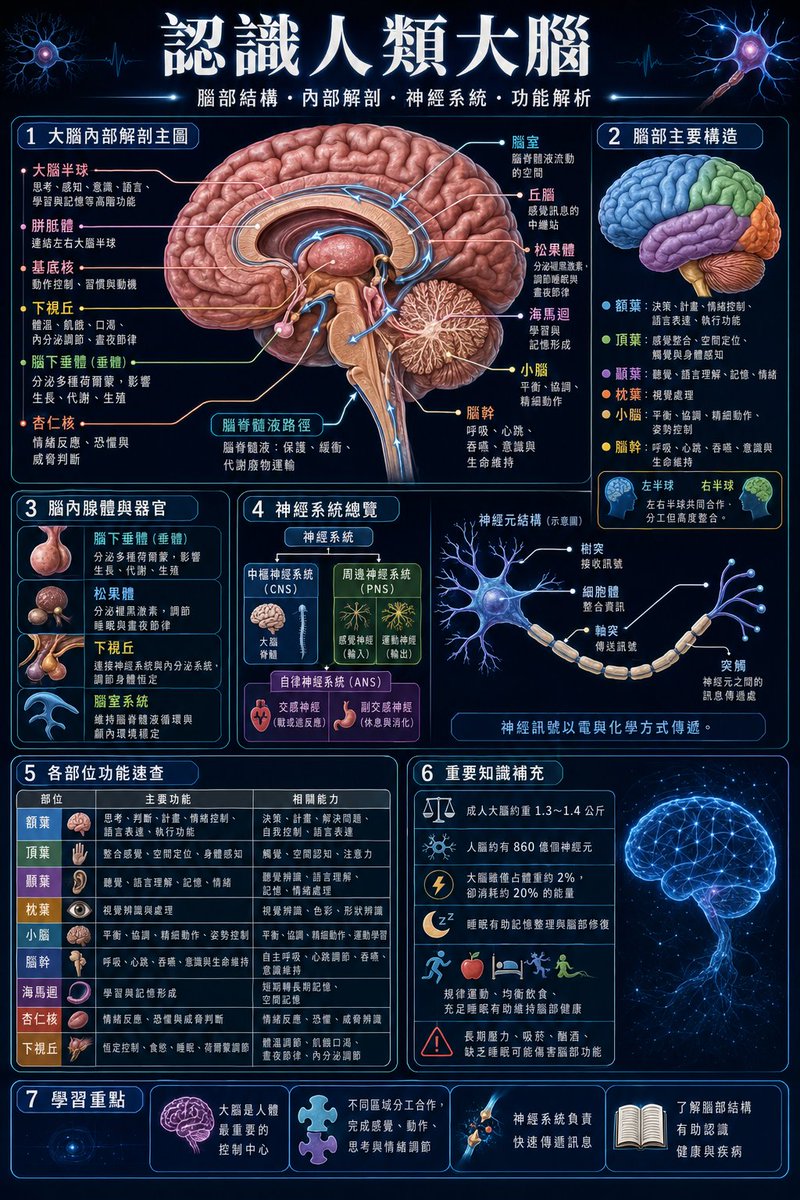
Traditional Chinese Human Brain Infographic
Generates a detailed Traditional Chinese educational poster explaining human brain anatomy, nervous-system structure, functions, and study points for classroom or science communication use.
This is a GPT Image 2 prompt case for 平面海报. Use the copy-ready prompt below to generate similar visuals, and review Awesome GPT Image 2 Prompts attribution plus commercial-use rights before reuse.
Prompt
Copy-ready prompt
{
  "type": "Educational and Medical Infographic Posters",
  "language": "Traditional Chinese",
  "overall_style": "A futuristic science classroom poster in deep navy blue, featuring highly detailed medical illustrations, a glowing cyan outline, a thin, rounded rectangular panel, neon blue dividing lines, white and colored Chinese fonts, a starry neural network background, and small neuron decorations in the top corner. Suitable for printing as a vertical poster.",
  "canvas": {
    "orientation": "portrait",
    "aspect_ratio": "2:3",
    "background": "Deep midnight blue, with subtle circuit lines, heartbeat waveform decorations, faint starlight, and a blue halo."
  },
  "title_block": {
    "headline": "{argument name=\"headline text\" default=\"Understanding the human brain\"}",
    "subtitle": "Brain structure, internal anatomy, nervous system, and functional analysis",
    "position": "top center",
    "style": "Large, bold white Chinese characters with an ice-blue halo."
  },
  "main_visual": {
    "position": "upper left and center",
    "description": "Large, detailed sagittal section of the human brain and brainstem, showing pink folds of the cerebral cortex, corpus callosum, thalamus, hypothalamus, pituitary gland, cerebellum, spinal cord, blue arrows indicating cerebrospinal fluid flow, and multiple colored guide lines pointing to the marked areas.",
    "labels_count": 10,
    "labels": [
      "cerebral hemisphere",
      "corpus callosum",
      "basal nucleus",
      "Hypothalamus",
      "The pituitary gland (hypophysis)",
      "amygdala",
      "ventricles",
      "thalamus",
      "pineal gland",
      "Seahorse Return"
    ],
    "callout_box": "Cerebrospinal fluid pathway"
  },
  "layout": {
    "sections_count": 7,
    "sections": [
      {
        "number": "1",
        "title": "Main diagram of brain internal anatomy",
        "position": "upper left large panel",
        "count": "One main anatomical section image, including 10 labeled structures and cerebrospinal fluid pathway labels.",
        "content": "Internal brain anatomy diagram with colored bullet points and fine medical guide lines"
      },
      {
        "number": "2",
        "title": "Main structures of the brain",
        "position": "upper right panel",
        "count": "One color whole-brain lateral view, seven bullet point labels, and one hemispherical miniature map.",
        "labels": [
          "frontal lobe",
          "Top leaf",
          "Temporal lobe",
          "occipital leaf",
          "Cerebellum",
          "brainstem",
          "Left hemisphere / Right hemisphere"
        ],
        "content": "The lateral lobes are labeled with blue, green, purple, orange, and brown, respectively; the small images at the bottom compare the coordination of the left and right hemispheres."
      },
      {
        "number": "3",
        "title": "Brain glands and organs",
        "position": "middle left panel",
        "count": "Four stacked organ thumbnails",
        "labels": [
          "The pituitary gland (hypophysis)",
          "pineal gland",
          "Hypothalamus",
          "Ventricular system"
        ],
        "content": "Small anatomical illustrations of the endocrine system and ventricular structures, with brief explanatory text."
      },
      {
        "number": "4",
        "title": "Overview of the Nervous System",
        "position": "middle center panel",
        "count": "Four subsystem boxes and one neuron structure diagram",
        "labels": [
          "Central Nervous System (CNS)",
          "Peripheral nervous system (PNS)",
          "Autonomic nervous system (ANS)",
          "Sympathetic/Parasympathetic",
          "dendrites",
          "cell body",
          "axon",
          "synapse"
        ],
        "content": "A flowchart-style hierarchical structure of the nervous system, next to a glowing blue neuron with myelinated axons and labeled locations."
      },
      {
        "number": "5",
        "title": "Quick Reference Guide to Functions of Each Part",
        "position": "lower left large table",
        "count": "8 rows of brain regions and 3 columns",
        "columns": [
          "Part",
          "Main functions",
          "Related capabilities"
        ],
        "rows": [
          "frontal lobe",
          "Top leaf",
          "Temporal lobe",
          "occipital leaf",
          "Cerebellum",
          "brainstem",
          "Seahorse Return",
          "amygdala",
          "Hypothalamus"
        ],
        "content": "A grid table with colored row headers, small icons for each section, and concise function descriptions."
      },
      {
        "number": "6",
        "title": "Important knowledge supplement",
        "position": "lower right panel",
        "count": "6 lines of fact and 1 illustration of a glowing brain network",
        "fact_icons": [
          "scales",
          "neuron",
          "lightning bolt",
          "sleep symbol",
          "lifestyle icons",
          "warning triangle"
        ],
        "content": "Brief facts about adult brain weight, number of neurons, energy consumption, sleep, health habits, and warnings; a bright cyan wireframe of the brain floats on the right."
      },
      {
        "number": "7",
        "title": "Learning Focus",
        "position": "bottom full-width strip",
        "count": "4 summary cards",
        "labels": [
          "The brain is the most important control center in the human body.",
          "Different brain regions work together to regulate sensation, movement, thought, and emotion.",
          "The nervous system is responsible for rapidly transmitting information.",
          "Understanding brain structure helps in understanding health and disease."
        ],
        "content": "Four rounded-corner cards with icons: a purple brain, a puzzle piece, a neural signal, and an open book."
      }
    ]
  },
  "visual_details": {
    "typography": "Compact yet legible Traditional Chinese infographic font; large glowing headings, numbered chapter badges, small white body text, and colored keywords.",
    "color_palette": "{argument name=\"color palette\" default=\"Deep navy blue, cyan neon, white, pink brain tissue, blue, green, purple, orange, and yellow accents.\"}",
    "linework": "Clean, thin cyan borders, medical chart guide lines, and a soft halo effect.",
    "accuracy_style": "Combining semi-realistic anatomical rendering with simplified educational icons",
    "mood": "Authoritative, scientific, and refined, suitable for classroom learning."
  },
  "generation_instructions": "Create a complete poster, not a collage of unrelated images. Keep all seven numbered sections visible and neatly arranged in the grid. Use the designated Traditional Chinese labels. Ensure the main brain section is the visual focus, while keeping smaller panels clear and legible."
}
Prompt variables
Editable argument placeholders found in the prompt, with their default values.
More cases in this category
Prioritized by category, input mode compatibility, quality, and lower risk.




Reuse and source notes
Use this prompt safely after previewing the case.
- 1.Copy the prompt or open it directly in Dovoo with the generation button.
- 2.Adjust variables, aspect ratio, and reference images for your own use case.
- 3.Before publishing or paid usage, verify source rights, attribution requirements, and brand or likeness risks.
Can I use this prompt commercially?
Commercial-use status is allowed. Review the original source, license, brand constraints, and legal requirements before paid usage.
Where does this case come from?
This case is imported from Awesome GPT Image 2 Prompts; keep attribution visible and check the source URL before reuse.