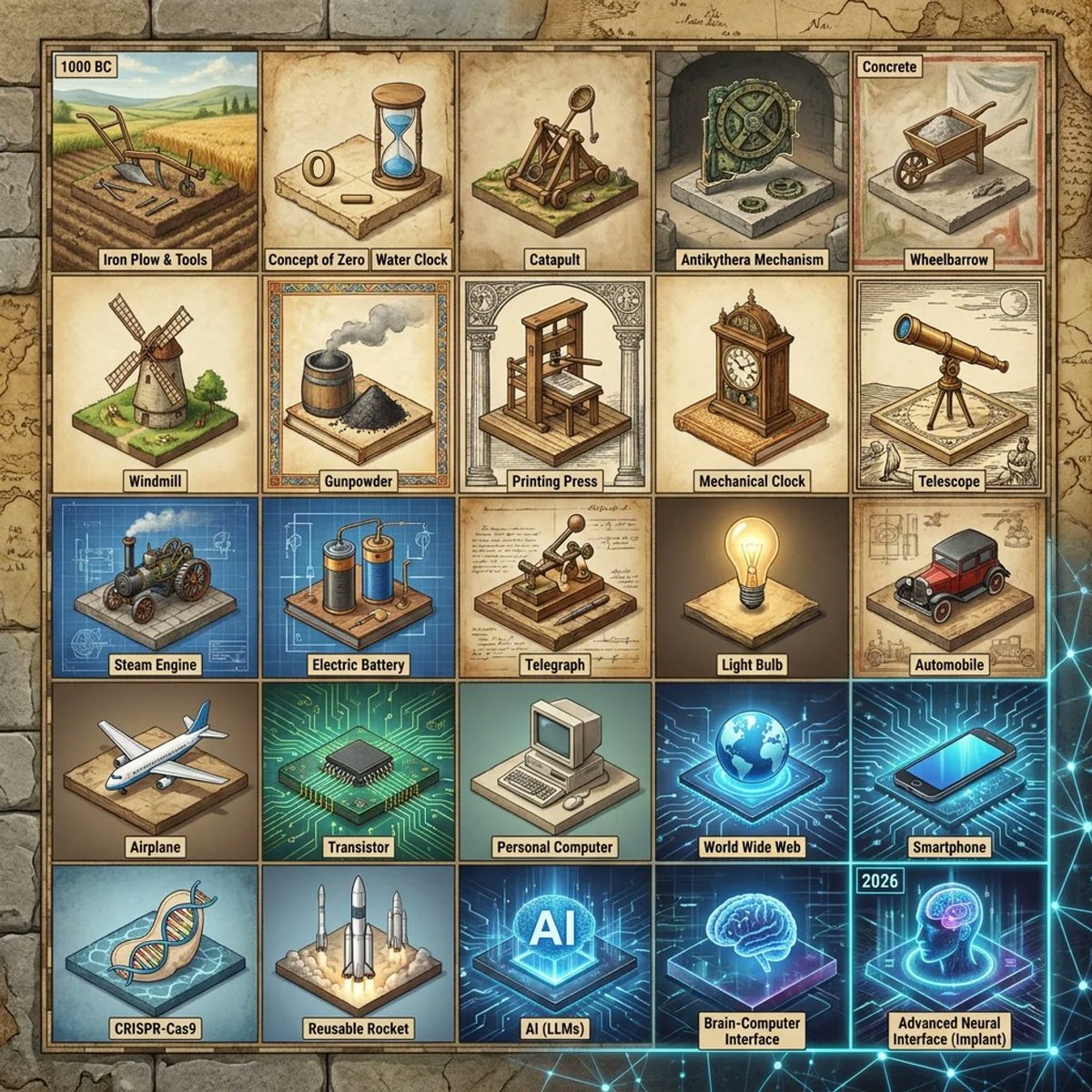
Historical Invention Timeline Grid
This prompt generates a parchment-styled educational poster showing a grid of labeled invention dioramas across history, ideal for timeline infographics and world-changing technology comparisons.
This is a GPT Image 2 prompt case for Graphic & Poster. Use the copy-ready prompt below to generate similar visuals, and review Awesome GPT Image 2 Prompts attribution plus commercial-use rights before reuse.
Free 1K preview
Generate one preview image instantly, no sign-up required.
Prompt
Copy-ready prompt
Create a square infographic-style illustration showing a {argument name="grid size" default="15×15"} invention timeline grid rendered as a collection of miniature isometric dioramas on aged parchment tiles. The image should look like a curated historical poster that spans from {argument name="starting year" default="1000 BC"} to {argument name="ending year" default="2026"}, with one invention per tile and no repeats. Show the visible portion as a 5 by 5 section of the larger grid, for a total of 25 labeled tiles, arranged in neat rows and columns with thin dark borders. Every tile contains a unique world-changing invention depicted as a small handcrafted diorama with era-appropriate materials, colors, and background details. Use a warm antiquarian palette for ancient and medieval inventions, sepia technical-document tones for early modern inventions, and cooler neon-blue futuristic lighting for modern digital and biotech inventions. Surround the grid with an old-map border and subtle historical cartography textures, blending into faint modern network graphics near the bottom right.

Label each visible tile with a small beige caption tag in bold black text. Include exactly these 25 visible inventions in reading order from top left to bottom right: 1) {argument name="first tile label" default="1000 BC"} tile showing an iron plow and simple hand tools in a farm field, captioned "Iron Plow & Tools"; 2) "Concept of Zero" shown as a parchment-like tile with a carved zero symbol and a blue hourglass; 3) "Water Clock" shown as a wooden water-timing device; 4) "Catapult" shown as a wooden siege engine; 5) "Antikythera Mechanism" shown as an intricate bronze gear device in a stone niche; 6) "Concrete" shown as a wheelbarrow filled with wet cement or mortar; 7) "Wheelbarrow" shown as a simple wooden one-wheel cart; 8) "Windmill" shown as a traditional mill on grassy ground; 9) "Gunpowder" shown as a barrel and a mound of black powder with smoke; 10) "Printing Press" shown as a wooden press framed by classical columns; 11) "Mechanical Clock" shown as an ornate standing clock; 12) "Telescope" shown as an early brass telescope on a tripod with sketch-like scientific notes; 13) "Steam Engine" shown on a blue blueprint-style tile with an early locomotive engine; 14) "Electric Battery" shown on a blueprint-like tile with two cylindrical battery cells and wiring; 15) "Telegraph" shown as a Morse telegraph key on technical paper; 16) "Light Bulb" shown glowing warmly on a neutral pedestal; 17) "Automobile" shown as an early red motorcar on a workshop-plan background; 18) "Airplane" shown as a commercial jet aircraft in miniature; 19) "Transistor" shown as a black microchip on a luminous circuit-board tile; 20) "Personal Computer" shown as a beige desktop computer with CRT monitor and keyboard; 21) "World Wide Web" shown as a glowing blue globe over digital circuitry; 22) "Smartphone" shown as a sleek modern phone on a neon-tech background; 23) "CRISPR-Cas9" shown as a DNA double helix in a biotech-blue display tile; 24) "Reusable Rocket" shown as several upright rockets launching with exhaust clouds; 25) "AI (LLMs)" shown as glowing large letters AI in a holographic tech cube; 26) "Brain-Computer Interface" shown as a glowing brain hologram on a blue platform; 27) "Advanced Neural Interface (Implant)" shown as a transparent human head profile with a glowing brain implant, with a small top label reading "2026".

Keep the composition highly organized, poster-like, and visually dense, with each tile readable at a glance. Use slight isometric perspective, crisp linework, painterly shading, and polished editorial illustration quality. The overall feeling should combine museum poster, educational timeline, and imaginative historical-tech diorama art.
Prompt variables
Editable argument placeholders found in the prompt, with their default values.
Best for
- - Graphic & Poster visual exploration
- - Image generation and reference-image edits
- - Reusable briefs that keep source attribution visible
Change these parts
- - Subject, product, character, or scene
- - Aspect ratio, camera, lighting, and background
- - Brand, text, color, and output constraints
Recommended model and settings
- - Model: gpt-image-2
- - Input mode: Text to Image
- - Aspect ratio: source
- - Commercial status: review original source
How to use this prompt
- 1. Copy the prompt and preserve its structure for the first test.
- 2. Replace the subject, context, and publishing channel.
- 3. Change one camera, lighting, or style variable per iteration.
- 4. Inspect the output, source, text, and rights before reuse.
Limitations, source, and reuse cautions
- - Generated output is an editable draft, not factual, legal, or rights evidence.
- - Review the linked source, people, brands, logos, text, and third-party media before commercial use.
More cases in this category
Prioritized by category, input mode compatibility, quality, and lower risk.


Reuse and source notes
Use this prompt safely after previewing the case.
- 1.Copy the prompt or open it directly in Dovoo with the generation button.
- 2.Adjust variables, aspect ratio, and reference images for your own use case.
- 3.Before publishing or paid usage, verify source rights, attribution requirements, and brand or likeness risks.
Can I use this prompt commercially?
Commercial-use status is allowed. Review the original source, license, brand constraints, and legal requirements before paid usage.
Where does this case come from?
This case is imported from Awesome GPT Image 2 Prompts; keep attribution visible and check the source URL before reuse.