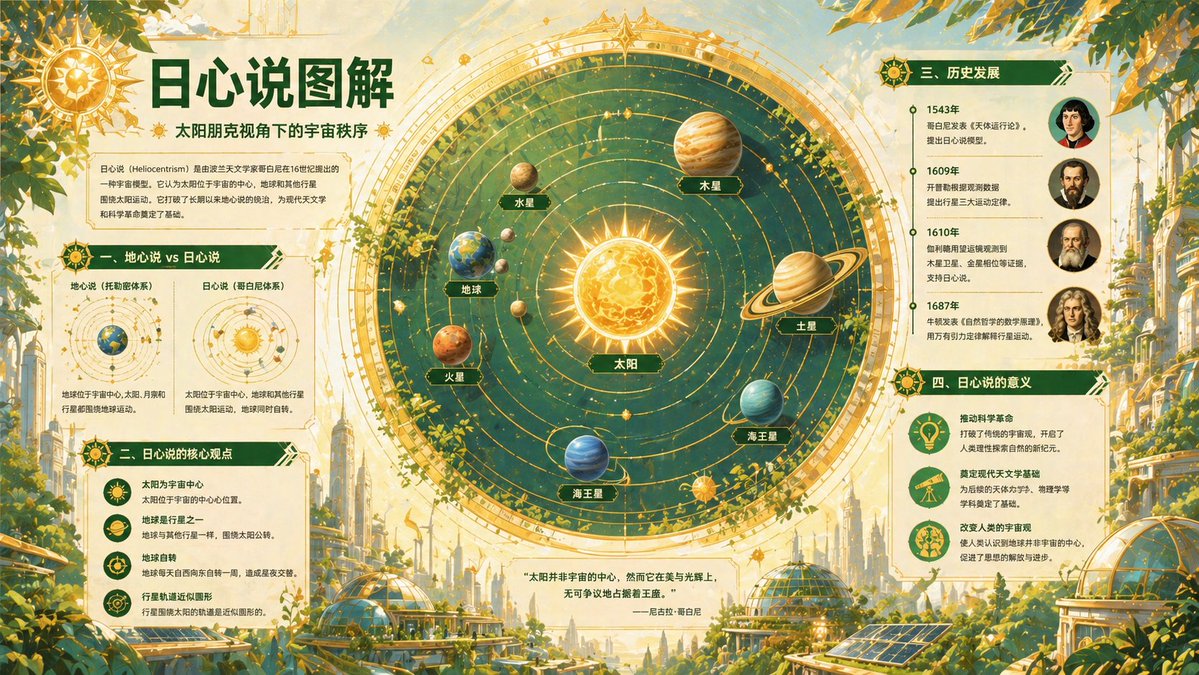
Heliocentric Theory Infographic Poster
A richly detailed Chinese educational infographic poster explaining heliocentrism, ideal for science education, history-of-astronomy visuals, or presentation slides.
This is a GPT Image 2 prompt case for Graphic & Poster. Use the copy-ready prompt below to generate similar visuals, and review Awesome GPT Image 2 Prompts attribution plus commercial-use rights before reuse.
Free 1K preview
Generate one preview image instantly, no sign-up required.
Prompt
Copy-ready prompt
{
  "type": "educational infographic poster",
  "topic": "{argument name=\"topic title\" default=\"Illustration of Heliocentrism\"}",
  "subtitle": "{argument name=\"subtitle text\" default=\"The Order of the Universe from a Bright Sun's Perspective\"}",
  "language": "Chinese",
  "style": "luxurious fantasy educational poster, ornate scientific diagram, art nouveau inspired, celestial atlas aesthetic, luminous gold and emerald palette, richly detailed, polished digital illustration",
  "composition": {
    "format": "wide landscape poster",
    "background": "utopian futuristic city with elegant towers, domes, terraces, vines, trees, and solar panels, bathed in warm sunlight",
    "border_elements": "leafy branches framing the top corners, decorative golden flourishes, radiant emblem in the upper left",
    "centerpiece": "a large circular heliocentric solar system diagram with concentric orbital rings, glowing sun at the center, planets arranged around it, intricate gold geometric markings and filigree"
  },
  "layout": {
    "sections": [
      {
        "title": "I. Geocentrism vs. Heliocentrism",
        "position": "left middle",
        "count": 2,
        "labels": [
          "Geocentrism (Ptolemaic system)",
          "Heliocentrism (Copernican system)"
        ]
      },
      {
        "title": "II. Core viewpoints of Heliocentrism",
        "position": "left lower",
        "count": 4,
        "labels": [
          "The Sun is the center of the universe",
          "The Earth is one of the planets",
          "Earth's rotation",
          "Planetary orbits are approximately circular"
        ]
      },
      {
        "title": "III. Historical Development",
        "position": "right upper",
        "count": 4,
        "labels": [
          "1543",
          "1609",
          "1610",
          "1687"
        ]
      },
      {
        "title": "Four, the significance of the heliocentric theory",
        "position": "right lower",
        "count": 3,
        "labels": [
          "Promoting the Scientific Revolution",
          "Laying the foundation for modern astronomy",
          "Changed humanity's view of the universe"
        ]
      }
    ],
    "count_total_sections": 4
  },
  "text_blocks": {
    "intro_paragraph": "{argument name=\"intro text\" default=\"Heliocentrism, proposed by Polish astronomer Nicolaus Copernicus in the 16th century, is a cosmological model that places the Sun at the center of the universe, with the Earth and other planets revolving around it. It broke the long-standing dominance of geocentrism and laid the foundation for modern astronomy and the scientific revolution.\"}",
    "quote": "{argument name=\"quote\" default=\"The sun is not the center of the universe, yet it undeniably holds the throne in our brilliance and light. — Nicolaus Copernicus\"}"
  },
  "central_diagram": {
    "title": "heliocentric system",
    "center_label": "Sun",
    "planet_count": 8,
    "planet_labels": [
      "Mercury",
      "Venus",
      "Earth",
      "Mars",
      "Jupiter",
      "Saturn",
      "Uranus",
      "Neptune"
    ],
    "details": "Earth shown with a small moon nearby, Saturn with prominent rings, each planet rendered as a dimensional painted sphere with a dark green and gold nameplate"
  },
  "visual_motifs": {
    "icon_count": 8,
    "icons": "small circular green-and-gold icons beside bullet lists and section headers, including sun, orbit, rotation, telescope, lightbulb, and worldview symbols",
    "ornamentation": "glowing particles, thin gold lines, elegant frames, botanical accents woven into the infographic",
    "mood": "inspiring, scholarly, radiant, mythic yet informative"
  },
  "rendering": {
    "quality": "highly detailed, crisp typography, premium poster design, harmonious hierarchy, readable infographic blocks",
    "lighting": "soft golden daylight with luminous highlights around the sun and metallic accents",
    "camera": "straight-on full poster view"
  }
}
Prompt variables
Editable argument placeholders found in the prompt, with their default values.
Best for
- - Graphic & Poster visual exploration
- - Image generation and reference-image edits
- - Reusable briefs that keep source attribution visible
Change these parts
- - Subject, product, character, or scene
- - Aspect ratio, camera, lighting, and background
- - Brand, text, color, and output constraints
Recommended model and settings
- - Model: gpt-image-2
- - Input mode: Text to Image
- - Aspect ratio: source
- - Commercial status: review original source
How to use this prompt
- 1. Copy the prompt and preserve its structure for the first test.
- 2. Replace the subject, context, and publishing channel.
- 3. Change one camera, lighting, or style variable per iteration.
- 4. Inspect the output, source, text, and rights before reuse.
Limitations, source, and reuse cautions
- - Generated output is an editable draft, not factual, legal, or rights evidence.
- - Review the linked source, people, brands, logos, text, and third-party media before commercial use.
More cases in this category
Prioritized by category, input mode compatibility, quality, and lower risk.


Reuse and source notes
Use this prompt safely after previewing the case.
- 1.Copy the prompt or open it directly in Dovoo with the generation button.
- 2.Adjust variables, aspect ratio, and reference images for your own use case.
- 3.Before publishing or paid usage, verify source rights, attribution requirements, and brand or likeness risks.
Can I use this prompt commercially?
Commercial-use status is allowed. Review the original source, license, brand constraints, and legal requirements before paid usage.
Where does this case come from?
This case is imported from Awesome GPT Image 2 Prompts; keep attribution visible and check the source URL before reuse.