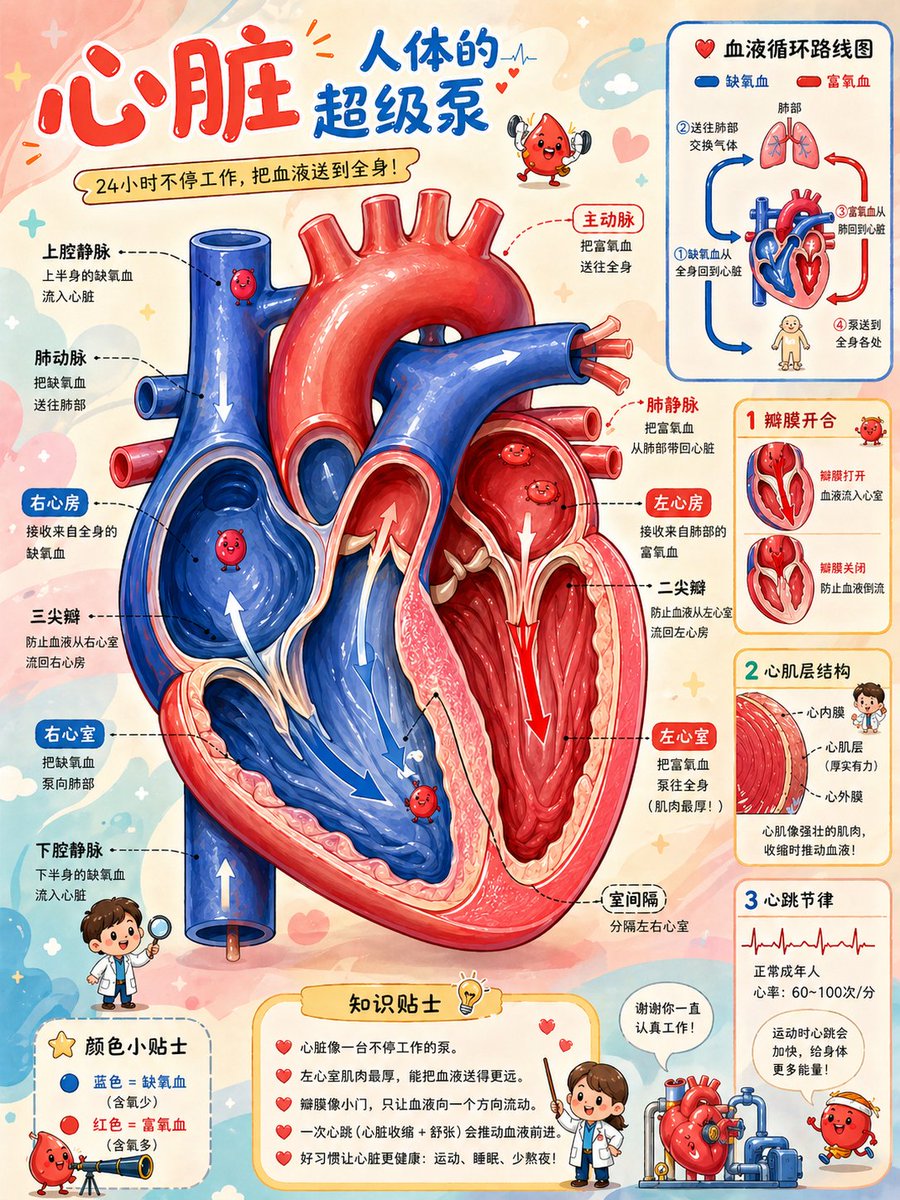
Cute Heart Cutaway Infographic
Creates a child-friendly Chinese science encyclopedia poster explaining the heart’s internal structure, blood flow, valves, wall layers, and heartbeat rhythm.
This is a gpt-image-2 prompt case for 插画艺术. Use the copy-ready prompt below to generate similar visuals, and review Awesome Seedance 2.0 Video Prompts attribution plus commercial-use rights before reuse.
Prompt
Copy-ready prompt
{
  "type": "Children's Science Popularization Medical Infographic Poster",
  "topic": "{argument name=\"headline text\" default=\"The heart, the body's super pump\"}",
  "subtitle": "{argument name=\"subtitle text\" default=\"Working non-stop 24 hours a day, delivering blood throughout the body!\"}",
  "style": "Adorable, publication-quality cross-sectional illustrations for science encyclopedias, suitable for children. Warm, creamy backgrounds are adorned with hearts, stars, clouds, and rounded annotation boxes. The glossy 3D cartoon rendering combined with simple vector tags creates rich detail. The anatomical structures are friendly and not frightening. (Chinese science poster layout)",
  "main_visual": {
    "subject": "Large central anatomical section of the human heart",
    "position": "The left-center position occupies most of the page space.",
    "colors": "The right heart and veins are blue (representing deoxygenated blood), while the left heart and arteries are red (representing oxygenated blood).",
    "details": "Transparent cross-section of the ventricle, valves, interventricular septum, thick ventricular wall, red aortic arch, blue pulmonary artery, vena cava, pulmonary vein, white directional arrows showing blood flow, and small red blood cell smiley face mascots inside the ventricle.",
    "main_labels_count": 12,
    "main_labels": [
      "superior vena cava",
      "Pulmonary artery",
      "right atrium",
      "Tricuspid valve",
      "Right ventricle",
      "Inferior vena cava",
      "aorta",
      "pulmonary veins",
      "left atrium",
      "Mitral valve",
      "Left ventricle",
      "Ventricular septum"
    ]
  },
  "layout": {
    "format": "Vertical infographic, 4:5 aspect ratio",
    "top_header": "The word \"heart\" is written in large red handwriting, and the title reads \"The Human Body's Super Pump\" in blue. Next to the title is a small mascot representing the heart/red blood cell.",
    "right_column": {
      "sections_count": 4,
      "sections": [
        {
          "title": "Blood circulation route map",
          "position": "Top right",
          "content": "Miniature illustrations featuring icons of the heart, lungs, and body, along with red and blue arrows.",
          "legend_count": 2,
          "legend_labels": [
            "hypoxic blood",
            "Oxygenated blood"
          ],
          "step_count": 4,
          "step_labels": [
            "1. Deoxygenated blood returns from the whole body to the heart.",
            "2. Sent to the lungs for gas exchange",
            "3. Oxygenated blood travels from the lungs to the heart.",
            "4. Pumped to all parts of the body"
          ]
        },
        {
          "title": "1. Valve opening and closing",
          "position": "Center upper right",
          "content": "Two small cross-sectional views of the heart, showing the opening and closing of the valves.",
          "diagram_count": 2,
          "labels": [
            "The valves open and blood flows into the ventricles.",
            "The valves close to prevent blood from flowing backward."
          ]
        },
        {
          "title": "2. Myocardial layer structure",
          "position": "center right",
          "content": "Close-up of the layers of the heart wall, accompanied by a pediatrician mascot.",
          "labels_count": 3,
          "labels": [
            "Endocardium",
            "Myocardial layer (thick and strong)",
            "Epicardium"
          ],
          "caption": "The heart muscle is like a strong muscle; it pumps blood when it contracts!"
        },
        {
          "title": "3. Heart rhythm",
          "position": "Bottom right",
          "content": "Electrocardiogram (ECG) line graph and brief popular science knowledge",
          "facts_count": 2,
          "facts": [
            "Normal adult heart rate: 60-100 beats/min",
            "During exercise, your heart rate increases, giving your body more energy!"
          ]
        }
      ]
    },
    "bottom_area": {
      "sections_count": 3,
      "sections": [
        {
          "title": "Color Tips",
          "position": "Bottom left",
          "item_count": 2,
          "items": [
            "Blue = hypoxic blood (low oxygen content)",
            "Red = Oxygenated blood (high oxygen content)"
          ],
          "decor": "The red blood cell mascot is observing through a telescope."
        },
        {
          "title": "Knowledge Tips",
          "position": "Shimonaka",
          "bullet_count": 5,
          "bullets": [
            "The heart is like a pump that never stops working.",
            "The left ventricle has the thickest muscle, allowing it to pump blood further.",
            "The valves act like small doors, allowing blood to flow in only one direction.",
            "A single heartbeat (heart contraction + relaxation) propels blood forward.",
            "Good habits for a healthier heart: exercise, sleep, and avoiding staying up late!"
          ]
        },
        {
          "title": "speech bubbles",
          "position": "Bottom right",
          "text": "{argument name=\"doctor speech bubble\" default=\"Thank you for your hard work!\"}",
          "decor": "The female doctor character stands next to an adorable mechanical heart pump and smiling red blood cells."
        }
      ]
    },
    "left_annotations": "A dashed guide line leads from the label to the heart structure, with a brief Chinese explanation below each label.",
    "character_elements_count": 5,
    "character_elements": [
      "Small red blood cell mascot near the top title",
      "Three smiling red blood cell mascots in the heart chambers and blood vessels",
      "The male doctor holding a magnifying glass in the bottom left corner",
      "The female doctor displaying knowledge tips in the lower middle position",
      "The mechanical heart pump character in the bottom right corner"
    ]
  },
  "text_rendering": "All visible labels are in Simplified Chinese, clear and easy to read, and are accompanied by rounded colored label borders and dashed annotation lines.",
  "lighting": "Soft, glossy highlights, clean shadows, high-resolution, print-quality composition.",
  "avoid": "The realistic, gory, and gloomy style of the medical textbook, the messy and barely legible tiny text, and the English labels."
}
Prompt variables
Editable argument placeholders found in the prompt, with their default values.
More cases in this category
Prioritized by category, input mode compatibility, quality, and lower risk.




Reuse and source notes
Use this prompt safely after previewing the case.
- 1.Copy the prompt or open it directly in Dovoo with the generation button.
- 2.Adjust variables, aspect ratio, and reference images for your own use case.
- 3.Before publishing or paid usage, verify source rights, attribution requirements, and brand or likeness risks.
Can I use this prompt commercially?
Commercial-use status is restricted. Review the original source, license, brand constraints, and legal requirements before paid usage.
Where does this case come from?
This case is imported from Awesome Seedance 2.0 Video Prompts; keep attribution visible and check the source URL before reuse.