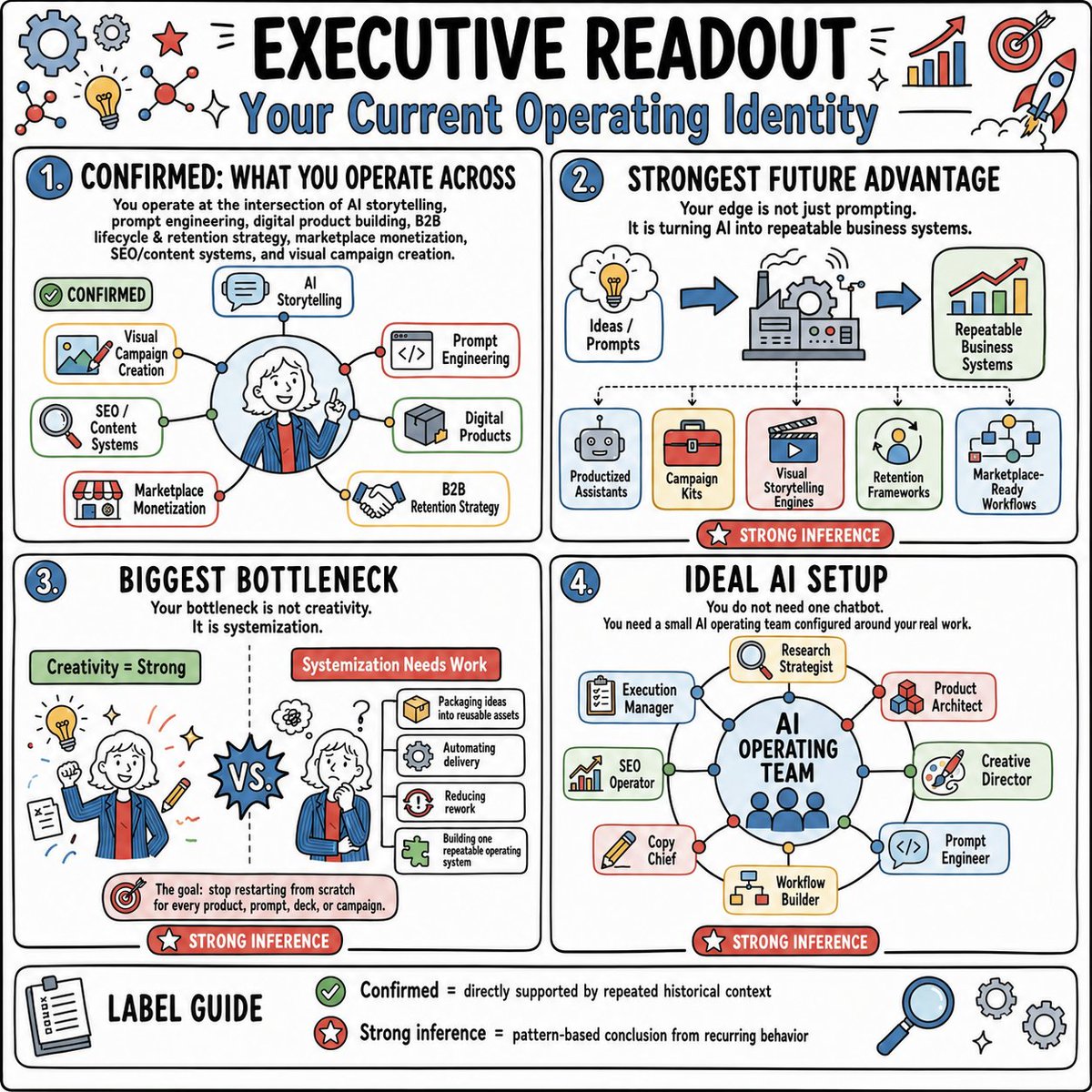
Executive AI Operating Readout
A square sketchnote-style executive infographic summarizing a personal AI operating identity, bottlenecks, future advantage, and ideal AI team setup.
This is a GPT Image 2 prompt case for 平面海报. Use the copy-ready prompt below to generate similar visuals, and review Awesome GPT Image 2 Prompts attribution plus commercial-use rights before reuse.
Prompt
Copy-ready prompt
Objective: To create a hand-drawn style strategic infographic, titled "{argument name="headline text" default="Executive Interpretation"} The subtitle is{argument name="subtitle text" default="Your current operational identity"} This document summarizes the AI/business operations identity using a fun, consultative whiteboard style. Canvas: 1:1 square image, white background, thick black rounded corner border, black handwritten font with blue accents, red reasoning badge, green confirmation badge, and small doodle icons along the edges. It adopts a clean, shorthand style with marker-like outlines, subtle gray-white card fill, and light-colored icon panels. Layout: The page is divided into four large rounded rectangular panels (2x2 grid), with a full-width label guide bar at the bottom. Each main panel has a blue numbered circle in the upper left corner. Decorative icons are added to the top edge: 11 visible doodles/icons in total, including a large blue gear, a small gray gear, a red star, two molecule/network icons, a yellow light bulb, two flashing symbols, an ascending bar chart with a red arrow, a red bullseye with an arrow, and a rocket. Panel 1: Numbered "1.", titled "Confirmed: Your Operational Area". Add the following text: “You are at the intersection of AI narrative, Prompt Engineering, digital product building, B2B lifecycle and retention strategies, monetization, SEO/content systems, and visual marketing creation.” Show a central circular portrait of a smiling, white-haired professional in a blue jacket and red tie, pointing forward, surrounded by connecting nodes. Around the portrait are seven labeled capability boxes: “AI Narrative,” “Prompt Engineering,” “Digital Product,” “B2B Retention Strategies,” “Monetization,” “SEO/Content Systems,” and “Visual Marketing Creation.” Add a green pill-shaped label that reads “Confirmed.” Panel 2: Numbered “2.”, titled “The Strongest Future Advantage.” Add the text: “Your advantage is not just in prompts. It’s in transforming AI into repeatable business systems.” Show a left-to-right process containing three main elements: a mind cloud labeled “Creativity/Prompts,” a central factory/machine with gears, and a chart card labeled “Repeatable Business Systems,” connected by blue arrows. Below are five output cards labeled "Productization Assistants," "Marketing Toolkit," "Visual Narrative Engine," "Retention Framework," and "Market-Ready Workflow." A red badge at the bottom reads "Strong Reasoning." Panel 3, numbered "3.", is titled "The Biggest Bottleneck." The text reads: "Your bottleneck isn't creativity. It's systematization." A dotted vertical divider separates the panel. The left side, with the green title "Creativity = Strong," shows the same person's back surrounded by creative doodles such as light bulbs, pencils, notes, flashlights, and bullseyes. The right side, with the red title "Systematization Needs Improvement," shows the person looking stressed, surrounded by question marks and a stack of process cards. It contains four process cards: "Packaging Ideas into Reusable Assets," "Automating Delivery," "Reducing Rework," and "Building a Repeatable Operating System." A spiked "VS." burst icon is placed in the center. A goal icon at the bottom reads: "Goal: Stop starting from scratch for every product, prompt, presentation, or marketing campaign." A red badge, "Strong Reasoning," is added. Panel 4: Numbered "4.", titled "The Ideal AI Configuration." Add the text: "You don't need a chatbot. You need a small AI operations team configured around your actual work setup." Show a central blue circle labeled {argument name="central system name" default="AI Operations Team"} The interface features small dots connecting to eight surrounding role cards: "Executive Manager," "Research Strategist," "Product Architect," "Creative Director," "Prompt Engineer," "Workflow Builder," "Copywriting Supervisor," and "SEO Operations." Thin connecting lines with colored nodes are used. A red badge, "Strong Reasoning," is added. The bottom label guide is a full-width rounded bar titled "Label Guide," with a clipboard icon on the left. It includes two legend entries: a green checkmark icon for "Confirmed = Directly Supported by Repeated Historical Background," and a red star icon for "Strong Reasoning = Patterned Conclusion Based on Repeated Behavior." Three decorative icons are added to the right: a magnifying glass and two gears, along with a tiny glitter symbol. The visual style is a playful executive whiteboard infographic with bold black marker outlines, rounded cards, a bright but restrained color palette of sky blue, red, green, yellow, and gray, hand-drawn business icons, a compact yet legible composition, no photorealistic feel, and no shadows other than simple marker shading. Constraints: Keep all text in English (Note: translated into Chinese as required here), maintain the precise four-panel structure, using 4 main panels, 7 capability boxes, 5 output cards, 4 process cards, 8 AI character cards, and 2 legend entries. Avoid extra sections, watermarks, logos, or irrelevant text.Prompt variables
Editable argument placeholders found in the prompt, with their default values.
More cases in this category
Prioritized by category, input mode compatibility, quality, and lower risk.

Reuse and source notes
Use this prompt safely after previewing the case.
- 1.Copy the prompt or open it directly in Dovoo with the generation button.
- 2.Adjust variables, aspect ratio, and reference images for your own use case.
- 3.Before publishing or paid usage, verify source rights, attribution requirements, and brand or likeness risks.
Can I use this prompt commercially?
Commercial-use status is allowed. Review the original source, license, brand constraints, and legal requirements before paid usage.
Where does this case come from?
This case is imported from Awesome GPT Image 2 Prompts; keep attribution visible and check the source URL before reuse.