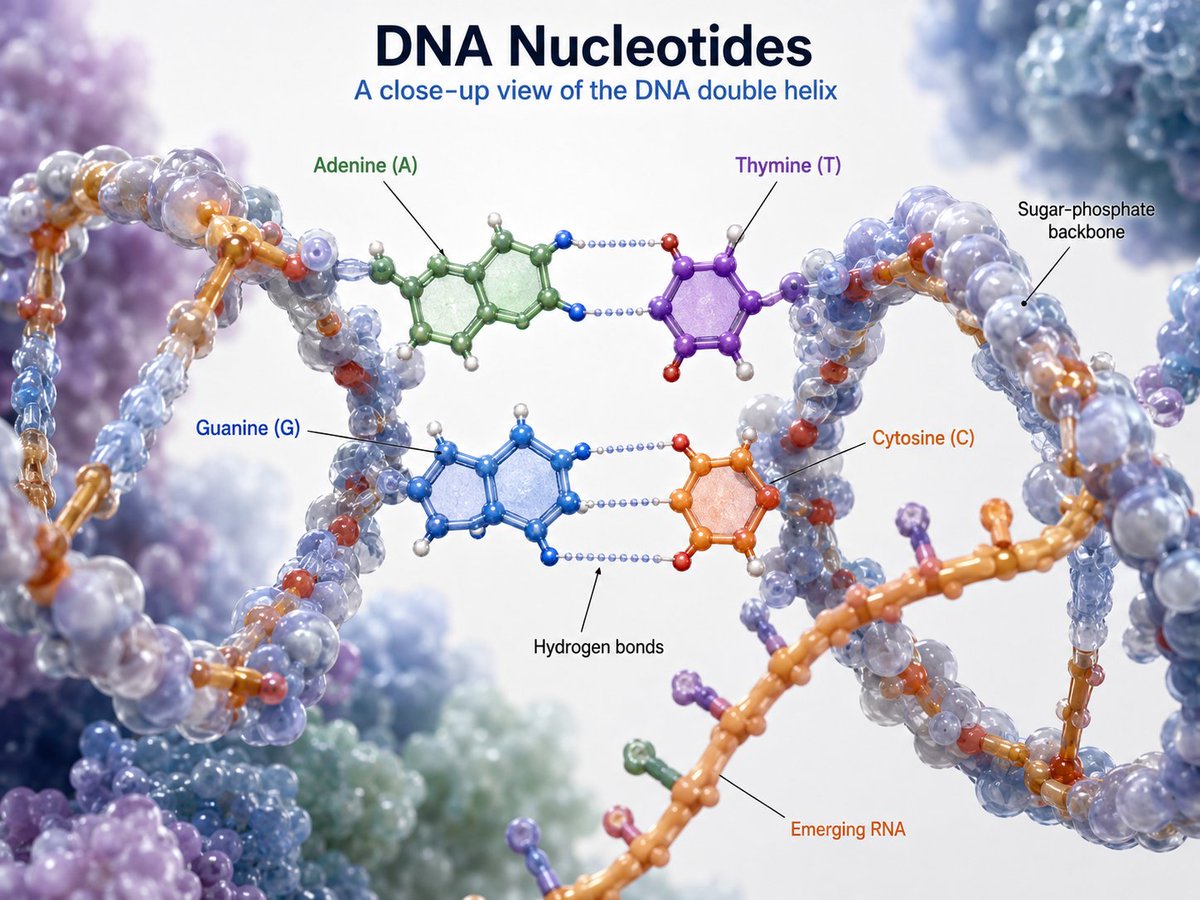
DNA Nucleotides 3D Infographic
A detailed 3D educational biology infographic showing a labeled DNA double helix with nucleotide base pairs, hydrogen bonds, backbone, and emerging RNA.
This is a GPT Image 2 prompt case for Graphic & Poster. Use the copy-ready prompt below to generate similar visuals, and review Awesome GPT Image 2 Prompts attribution plus commercial-use rights before reuse.
Free 1K preview
Generate one preview image instantly, no sign-up required.
Prompt
Copy-ready prompt
Goal: Create a polished 3D scientific educational infographic titled {argument name="headline text" default="DNA Nucleotides"}, showing a close-up view of a DNA double helix with labeled nucleotide bases and molecular structure.

Canvas: Landscape 4:3 composition, bright white laboratory-style background with soft depth-of-field molecular clusters in pale blue, lavender, mint, and purple around the edges. Use a clean, high-resolution textbook/medical visualization style with realistic glossy translucent spheres and rods, soft shadows, and shallow depth of field.

Layout: Center the title at the top in large dark navy bold type, with the subtitle {argument name="subtitle text" default="A close-up view of the DNA double helix"} directly beneath in smaller medium-blue type. Fill the frame with a large twisting DNA double helix running from the left foreground through the center to the right side, with a second orange strand crossing diagonally through the lower right foreground. Keep the central base-pair region open and readable for labels.

Subject details: Render the DNA as a molecular ball-and-stick model combined with translucent bead-like backbone surfaces. The sugar-phosphate backbone should be two twisting chains made of semi-transparent bluish-gray spheres with orange/gold connector rods and small red atoms. In the center, show exactly 4 labeled nucleotide bases: Adenine (A) in green at upper left center, Thymine (T) in purple at upper right center, Guanine (G) in blue at lower left center, and Cytosine (C) in orange at lower right center. Adenine pairs with Thymine across the top using dotted pale blue hydrogen bonds, and Guanine pairs with Cytosine below using three dotted pale blue hydrogen-bond rows. Molecular rings should be flat aromatic ring structures with small colored atom spheres and white hydrogen atoms.

Text content and labels: Include exactly 7 callout labels with thin black pointer lines: “Adenine (A)” in green pointing to the green upper-left base; “Thymine (T)” in purple pointing to the purple upper-right base; “Guanine (G)” in blue pointing to the blue lower-left base; “Cytosine (C)” in orange pointing to the orange lower-right base; “Sugar-phosphate backbone” in black pointing to the right-side helical backbone; “Hydrogen bonds” in black pointing to the dotted bond lines between base pairs; and “Emerging RNA” in orange pointing to the orange strand crossing the lower foreground. Use crisp sans-serif typography and avoid crowding.

Visual style: Hyper-detailed scientific 3D render, glossy translucent molecular beads, realistic refraction, soft bokeh background, professional biology textbook infographic, balanced educational clarity and cinematic depth.

Constraints: Use exactly the 4 nucleotide labels and exactly the 3 structural labels listed above; do not add extra labels, icons, captions, legends, watermarks, or borders. Keep all text sharp and correctly spelled.
Prompt variables
Editable argument placeholders found in the prompt, with their default values.
Best for
- - Graphic & Poster visual exploration
- - Image generation and reference-image edits
- - Reusable briefs that keep source attribution visible
Change these parts
- - Subject, product, character, or scene
- - Aspect ratio, camera, lighting, and background
- - Brand, text, color, and output constraints
Recommended model and settings
- - Model: gpt-image-2
- - Input mode: Text to Image
- - Aspect ratio: source
- - Commercial status: review original source
How to use this prompt
- 1. Copy the prompt and preserve its structure for the first test.
- 2. Replace the subject, context, and publishing channel.
- 3. Change one camera, lighting, or style variable per iteration.
- 4. Inspect the output, source, text, and rights before reuse.
Limitations, source, and reuse cautions
- - Generated output is an editable draft, not factual, legal, or rights evidence.
- - Review the linked source, people, brands, logos, text, and third-party media before commercial use.
More cases in this category
Prioritized by category, input mode compatibility, quality, and lower risk.
Reuse and source notes
Use this prompt safely after previewing the case.
- 1.Copy the prompt or open it directly in Dovoo with the generation button.
- 2.Adjust variables, aspect ratio, and reference images for your own use case.
- 3.Before publishing or paid usage, verify source rights, attribution requirements, and brand or likeness risks.
Can I use this prompt commercially?
Commercial-use status is allowed. Review the original source, license, brand constraints, and legal requirements before paid usage.
Where does this case come from?
This case is imported from Awesome GPT Image 2 Prompts; keep attribution visible and check the source URL before reuse.