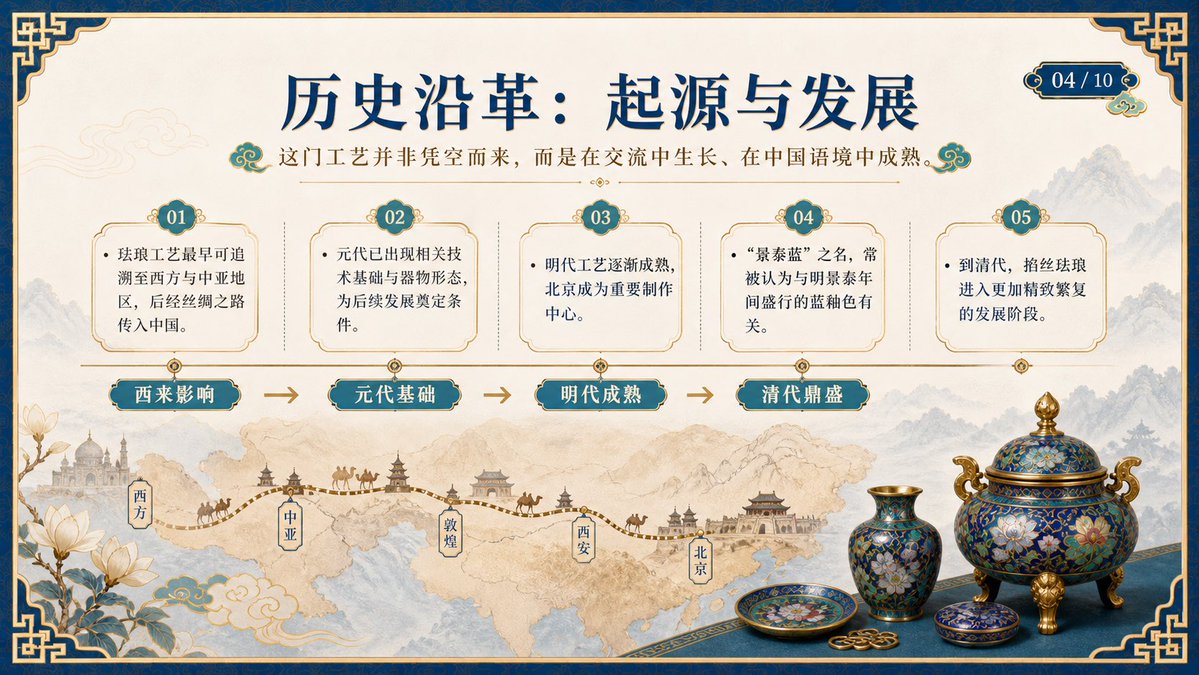
Cloisonne History PPT Slide
Generates an ornate Chinese-style educational PPT slide showing a five-stage timeline of cloisonne enamel origins and development.
This is a gpt-image-2 prompt case for 平面海报. Use the copy-ready prompt below to generate similar visuals, and review Awesome Seedance 2.0 Video Prompts attribution plus commercial-use rights before reuse.
Prompt
Copy-ready prompt
{"type":"Single-page educational PPT, featuring a gorgeous Chinese cultural style","canvas":{"aspect_ratio":"16:9 widescreen","background":"Warm ivory parchment background with subtle ink wash landscape, cloud and mist, and light blue-gray scenery textures","border":"Dark cyan thick border, decorated with gold double lines and Chinese-style corner knots"},"theme":{"topic":"{argument name="slide title" default="Historical Development: Origin and Development"} ","subtitle":"{argument name="subtitle text" default="This craft did not come out of thin air, but grew through communication and matured in the Chinese context."} ","style":"Elegant museum course presentation style, classical Chinese decoration, blue and gold cloisonné enamel color scheme, strong academic atmosphere"},"layout":{"page_number":{"position":"Top right corner, located in the gorgeous lapis lazuli label","text":"04 / 10"},"title_block":{"position":"Centered at the top","title_font":"Large bold dark navy blue Chinese serif calligraphy font","subtitle_font":"Smaller brown Chinese serif text","decorations":"The subtitle is decorated with lapis lazuli cloud patterns on both sides"},"timeline":{"position":"Center spans the entire screen horizontally","count":5,"cards":[{"number":"01","position":"Left side","text":"Enamel craftsmanship can be traced back to the West and Central Asia, and was later introduced to China via the Silk Road."} {"stage_label":"Western Influence"},{"number":"02","position":"Left Center","text":"The relevant technological foundation and artifact forms appeared in the Yuan Dynasty, laying the foundation for subsequent development.","stage_label":"Yuan Dynasty Foundation"},{"number":"03","position":"Center","text":"The craftsmanship gradually matured in the Ming Dynasty, and Beijing became an important production center.","stage_label":"Maturation in the Ming Dynasty"},{"number":"04","position":"Right Center","text":"The name 'Jingtai Blue' is often thought to be related to the blue glaze that was popular during the Jingtai period of the Ming Dynasty.","stage_label":"Peak in the Qing Dynasty"},{"number":"05","position":"Right Side","text":"By the Qing Dynasty, cloisonné enamel entered a more refined and complex stage of development."} ","stage_label":""}],"card_style":"Rounded cream-colored plaque with a thin gold border, decorated with a cyan number and floral emblem at the top, with a small black dot at the beginning of each text block,""connector":"Thin horizontal gold lines, small dots at nodes, and gold arrows between cyan stage labels"},"bottom_illustration":{"position":"Lower third","map":"Brown Silk Road map, spanning the mountains from left to right, with dotted caravan routes, camels, pagodas, city gates, and small vertical landmark labels","place_t ags_count":5,"place_tags":["Western","Central Asia","Dunhuang","Xi'an","Beijing"],"foreground_left":"White magnolia blossoms with light-colored ink-wash cloud patterns","foreground_right":"On a dark cyan table are three magnificent pieces of blue cloisonné enamelware: a floral plate, a tall vase, and a large covered incense burner with a gold handle and base, plus a small round covered box and several gold rings","object_count":5},"visual_requirements":"Create a refined finished PPT page, not a mock-up. Use clear, legible Chinese fonts, balanced spacing, antique watercolor textures, and highly detailed illustrations of blue and gold cloisonné enamelware. Keep the five timeline cards clear and aligned, with no stage label below the fifth card. Maintain a high-quality presentation aesthetic suitable for a cloisonné history lecture."}Prompt variables
Editable argument placeholders found in the prompt, with their default values.
More cases in this category
Prioritized by category, input mode compatibility, quality, and lower risk.





Reuse and source notes
Use this prompt safely after previewing the case.
- 1.Copy the prompt or open it directly in Dovoo with the generation button.
- 2.Adjust variables, aspect ratio, and reference images for your own use case.
- 3.Before publishing or paid usage, verify source rights, attribution requirements, and brand or likeness risks.
Can I use this prompt commercially?
Commercial-use status is restricted. Review the original source, license, brand constraints, and legal requirements before paid usage.
Where does this case come from?
This case is imported from Awesome Seedance 2.0 Video Prompts; keep attribution visible and check the source URL before reuse.