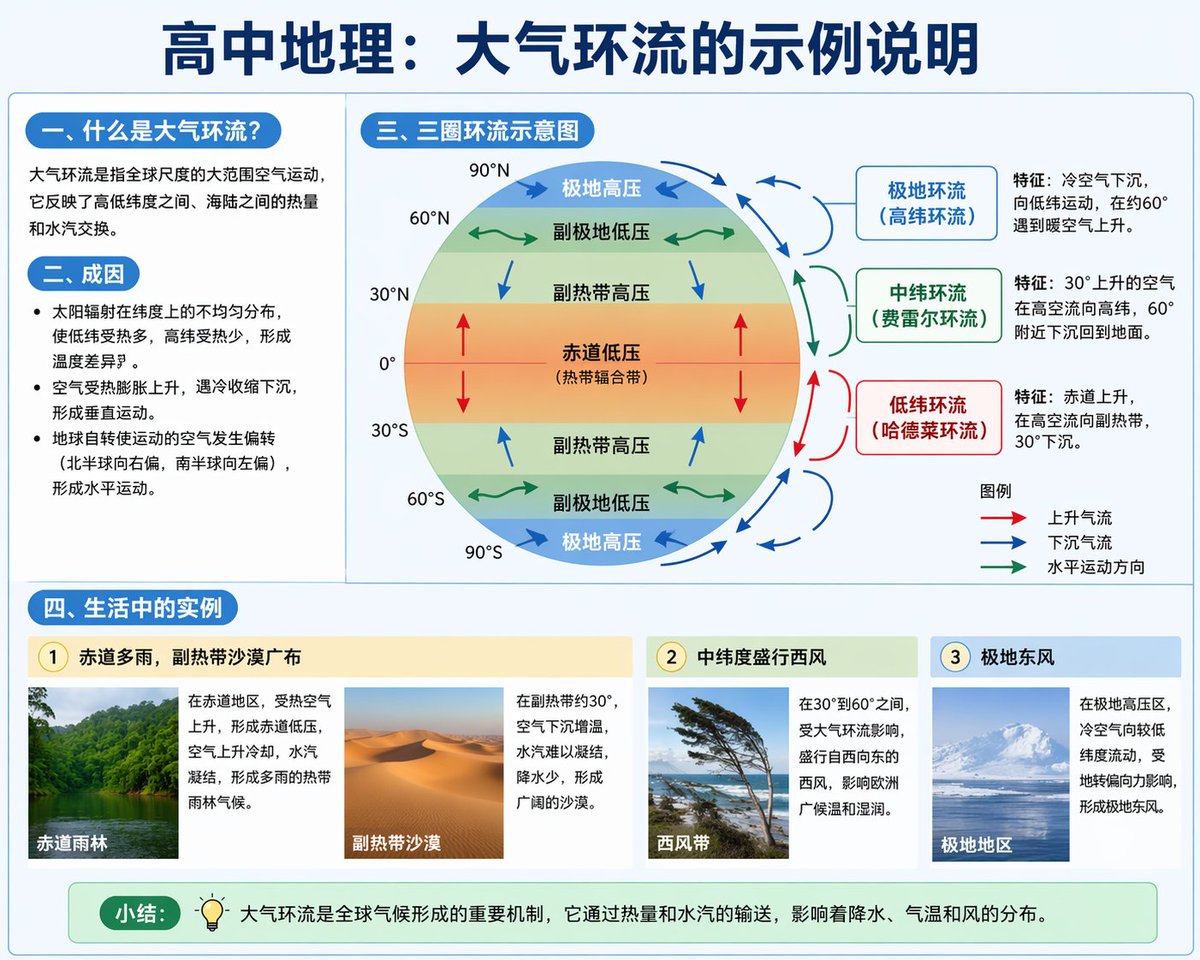
Educational Infographic on Atmospheric Circulation
Generates a detailed, multi-section educational infographic suitable for textbooks, featuring diagrams, bullet points, and real-world photographic examples.
This is a GPT Image 2 prompt case for 平面海报. Use the copy-ready prompt below to generate similar visuals, and review Awesome GPT Image 2 Prompts attribution plus commercial-use rights before reuse.
Prompt
Copy-ready prompt
{
  "type": "Educational Infographic",
  "style": "The textbook illustrations feature a clean, modern style with a light blue and white color scheme.",
  "header": "{argument name=\"main title\" default=\"High School Geography: Examples of Atmospheric Circulation\"}",
  "layout": {
    "top_left_column": {
      "section_1": {
        "title": "{argument name=\"section one title\" default=\"I. What is atmospheric circulation?\"}",
        "content": "A brief explanation of global air movement"
      },
      "section_2": {
        "title": "II. Causes",
        "content": "Three key points to explain solar radiation, vertical motion, and the Coriolis force."
      }
    },
    "top_right_column": {
      "section_3": {
        "title": "{argument name=\"diagram title\" default=\"III. Schematic diagram of the three-cell circulation\"}",
        "diagram_features": [
          "Showing cross-sections of the Earth from 0 degrees north latitude to 90 degrees south latitude.",
          "Color-coded pressure belts: red (equatorial), yellow (subtropical), green (subpolar), blue (polar).",
          "Arrows indicating the direction of airflow"
        ],
        "circulation_cells": {
          "count": 3,
          "labels": [
            "Polar circulation (high-latitude circulation)",
            "Mid-latitude circulation (Ferrell circulation)",
            "Low-latitude circulation (Hadley circulation)"
          ],
          "descriptions": "Three text boxes detailing the characteristics of each circulation cell."
        },
        "legend": {
          "title": "legend",
          "items": "Three types of arrows: red (rising), blue (sinking), and green (horizontal)."
        }
      }
    },
    "bottom_row": {
      "section_4": {
        "title": "{argument name=\"examples title\" default=\"IV. Examples from daily life\"}",
        "examples": {
          "count": 3,
          "items": [
            {
              "subtitle": "1. The equator is rainy, and subtropical deserts are widespread.",
              "images": "2 photos: rainforest and desert",
              "text": "2 text blocks explaining climate"
            },
            {
              "subtitle": "2. Prevailing westerly winds in mid-latitudes",
              "images": "1 photo: Trees bent by the wind along the coast",
              "text": "1 text block explaining the westerly wind belt"
            },
            {
              "subtitle": "3. Polar East Wind",
              "images": "1 photo: Snow-capped mountains",
              "text": "1 text block explaining the polar easterlies"
            }
          ]
        }
      }
    },
    "footer": {
      "label": "{argument name=\"footer label\" default=\"summary:\"}",
      "icon": "lightbulb",
      "content": "A summary of global climate mechanisms in one sentence."
    }
  }
}
Prompt variables
Editable argument placeholders found in the prompt, with their default values.
More cases in this category
Prioritized by category, input mode compatibility, quality, and lower risk.



Reuse and source notes
Use this prompt safely after previewing the case.
- 1.Copy the prompt or open it directly in Dovoo with the generation button.
- 2.Adjust variables, aspect ratio, and reference images for your own use case.
- 3.Before publishing or paid usage, verify source rights, attribution requirements, and brand or likeness risks.
Can I use this prompt commercially?
Commercial-use status is allowed. Review the original source, license, brand constraints, and legal requirements before paid usage.
Where does this case come from?
This case is imported from Awesome GPT Image 2 Prompts; keep attribution visible and check the source URL before reuse.