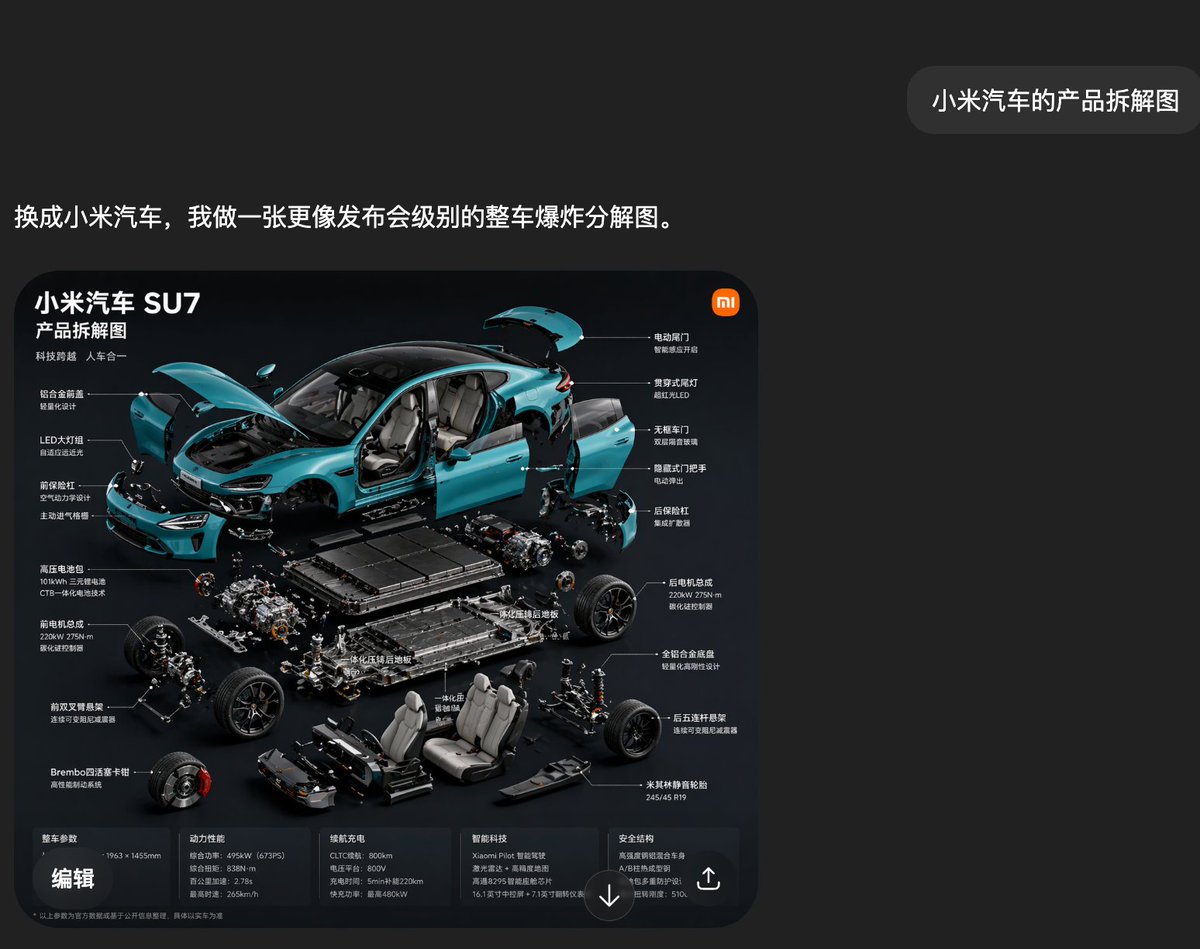
小米SU7爆炸視圖聊天截圖
這將產生一個暗色調的中國應用程式風格的螢幕截圖,其中包含小米 SU7 電動車的高級主題演講品質的爆炸視圖資訊圖,可用於 AI 演示視覺效果和科技產品演示模型。
這是一個產品與商業的GPT Image 2範例。請使用下方可直接使用的提示資訊產生類似的視覺素材,並在重複使用前查看Awesome GPT Image 2 Prompts署名和商業用途授權資訊。
需要完整的提示符號集?請使用 產品與商業 主題中心提供更多相關範例,或打開 GPT Image 2 提示庫 有關完整範例索引、可重複使用結構和來源歸屬的資訊。
Free 1K preview
Generate one preview image instantly, no sign-up required.
3429/4000
提示詞
可直接複製的提示
A stylish Chinese social media-style screenshot with a deep carbon black interface, featuring a minimalist and high-end design. A large, rounded rectangular image card is positioned in the lower-left center, and a small, rounded chat bubble is in the upper-right corner. The overall canvas has ample whitespace, creating a clean and technological presentation. In the upper-left area, a line of bold white Chinese characters reads: “Switch to Xiaomi car, and I’ll create a full-vehicle exploded view diagram more akin to a launch event.” In the upper-right corner, a gray rounded bubble contains the white Chinese characters: “Xiaomi car component breakdown diagram.” Below, a poster-style rounded infographic card is displayed with a bright black background. Inside the card, a beautiful exploded view product presentation is created for a turquoise {argument name="car model" default="Xiaomi SU7"} electric sedan, using a highly dynamic 45-degree front-side perspective. The car body is broken down into multiple components, suspended around the chassis. The hood is open, the trunk lid is raised, the four side doors are detached and suspended outwards, the front bumper and front fascia are separated, the headlights are displayed independently, and the interior is visible. The main mechanical and structural modules are neatly layered below and around the car body. The visual style should resemble high-end launch event Slides: cinematic studio lighting, realistic reflections, sharp details, a dark background, subtle blue highlights, and precise technical composition. At the top-left of the infographic card, place three large white Chinese titles: “Xiaomi Car SU7,” “Product Breakdown Diagram,” “Technological Leap, Harmony Between Man and Machine.” Add a small orange Xiaomi-style logo in the upper-right corner of the card. Surround the car with 14 Chinese labels, connected by thin white lines, indicating visible parts and systems. The left side contains 6 functional labels, such as integrated closed front face, LED headlights, front trunk design, high-voltage battery, front motor assembly, front double-wishbone suspension, and Brembo four-piston brake calipers. The right side contains 8 functional labels, such as electric tailgate, through-type taillights, frameless doors, hidden door handles, rear motor assembly, rear motor parameters, all-aluminum alloy chassis, five-link rear suspension, and Michelin high-performance tires. Below the exploded car body, clearly display the battery pack, front and rear drive units, suspension subframes, wheel hub components, braking parts, front and rear seats, center console parts, underbody protection, and structural floor elements, all meticulously organized in an exploded suspended arrangement. At the bottom of the infographic card, add a horizontal information strip divided into 5 columns of small Chinese specification text, with titles for vehicle dimensions, power performance, range, intelligent driving, and safety structure. Place a bold white Chinese label “Edit” in the lower-left corner of the card. Include a circular downward arrow icon in the bottom center and a share/export icon in the lower-right corner. The overall composition should look like a genuine screenshot from a Chinese AI chat app, showcasing an automatically generated car breakdown infographic, with modern UI spacing, clear typography, and a luxurious dark teal color scheme.提示變數
提示符號中可編輯的參數佔位符及其預設值。
多變的
car model
預設
Xiaomi SU7
Best for
- - 產品與商業 visual exploration
- - Image generation and reference-image edits
- - Reusable briefs that keep source attribution visible
Change these parts
- - Subject, product, character, or scene
- - Aspect ratio, camera, lighting, and background
- - Brand, text, color, and output constraints
Recommended model and settings
- - Model: gpt-image-2
- - Input mode: 文生圖
- - Aspect ratio: source
- - Commercial status: review original source
How to use this prompt
- 1. Copy the prompt and preserve its structure for the first test.
- 2. Replace the subject, context, and publishing channel.
- 3. Change one camera, lighting, or style variable per iteration.
- 4. Inspect the output, source, text, and rights before reuse.
Limitations, source, and reuse cautions
- - Generated output is an editable draft, not factual, legal, or rights evidence.
- - Review the linked source, people, brands, logos, text, and third-party media before commercial use.
內容來自Awesome GPT Image 2 Prompts 。必須註明出處。商業用途狀態為allowed ;付費使用前請查看來源版權資訊。
此類案例更多
按類別、輸入模式相容性、品質和低風險進行優先排序。
重用和來源註釋
預覽案例後,請謹慎使用此提示。
- 1.複製提示或直接在 Dovoo 中使用生成按鈕開啟提示。
- 2.根據您的實際使用情況調整變數、寬高比和參考影像。
- 3.發布或付費使用前,請確認版權、署名要求以及品牌或肖像權風險。