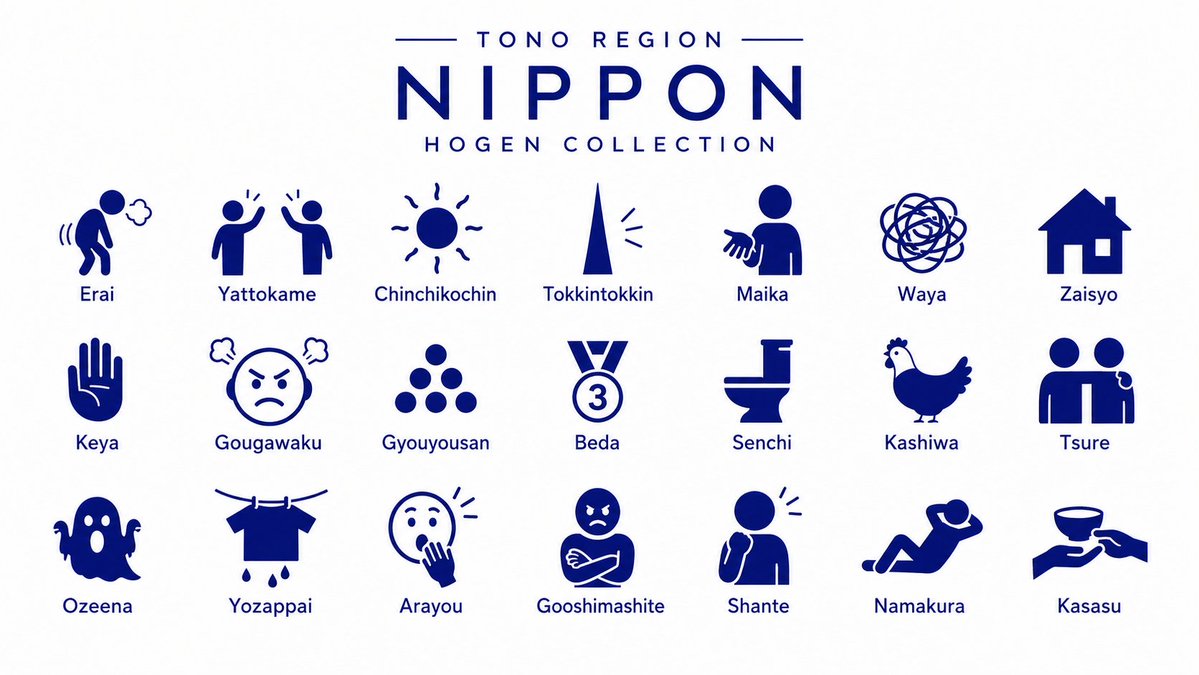
東名地區方言象形圖海報
一張簡潔的藍白資訊圖表海報,以簡單的象形圖形式展示了 21 個東音地區方言詞彙,適用於文化教育、社群媒體貼文或地區語言品牌推廣。
這是一個平面設計和海報設計的GPT Image 2範例。請使用下方可直接使用的提示資訊產生類似的視覺素材,並在重複使用前查看Awesome GPT Image 2 Prompts署名和商業用途授權資訊。
需要完整的提示符號集?請使用 平面設計和海報設計 主題中心提供更多相關範例,或打開 GPT Image 2 提示庫 有關完整範例索引、可重複使用結構和來源歸屬的資訊。
Free 1K preview
Generate one preview image instantly, no sign-up required.
4000/4000
提示詞
可直接複製的提示
{
  "type": "dialect pictogram poster",
  "style": "minimal Japanese infographic poster, clean white background, bold monochrome cobalt-blue vector icons, flat design, geometric sans-serif typography, balanced spacing, centered composition, modern museum-poster aesthetic",
  "topic": "regional Japanese dialect words rendered as pictograms",
  "region": {
    "english": "{argument name=\"region name\" default=\"TONO REGION\"}",
    "series": "{argument name=\"series title\" default=\"NIPPON HOGEN COLLECTION\"}"
  },
  "canvas": {
    "orientation": "landscape",
    "aspect_ratio": "16:9"
  },
  "header": {
    "count": 3,
    "lines": [
      {
        "text": "TONO REGION",
        "position": "top center",
        "style": "small uppercase with thin horizontal divider lines on both sides"
      },
      {
        "text": "NIPPON",
        "position": "upper center",
        "style": "very large uppercase, wide tracking"
      },
      {
        "text": "HOGEN COLLECTION",
        "position": "below NIPPON",
        "style": "medium uppercase, wide tracking"
      }
    ]
  },
  "layout": {
    "grid": {
      "rows": 3,
      "columns": 7,
      "total_items": 21,
      "position": "center to lower center",
      "alignment": "evenly spaced"
    },
    "sections": [
      {
        "title": "row 1",
        "position": "upper grid",
        "count": 7,
        "labels": [
          "Erai",
          "Yattokame",
          "Chinchikochin",
          "Tokkintokkin",
          "Maika",
          "Waya",
          "Zaisyo"
        ]
      },
      {
        "title": "row 2",
        "position": "middle grid",
        "count": 7,
        "labels": [
          "Keya",
          "Gougawaku",
          "Gyouyousan",
          "Beda",
          "Senchi",
          "Kashiwa",
          "Tsure"
        ]
      },
      {
        "title": "row 3",
        "position": "lower grid",
        "count": 7,
        "labels": [
          "Ozeena",
          "Yozappai",
          "Arayou",
          "Gooshimashite",
          "Shante",
          "Namakura",
          "Kasasu"
        ]
      }
    ]
  },
  "items": [
    {
      "label": "Erai",
      "icon": "a hunched person walking with bent knees and a small puff symbol behind them suggesting exhaustion or strain"
    },
    {
      "label": "Yattokame",
      "icon": "2 simplified people facing each other, each with one raised hand, with small motion marks above"
    },
    {
      "label": "Chinchikochin",
      "icon": "a round sun-like circle with short radiating lines around it"
    },
    {
      "label": "Tokkintokkin",
      "icon": "a very sharp tall triangular spike with 3 short accent lines on the right"
    },
    {
      "label": "Maika",
      "icon": "a person shown from the waist up with one open hand extended outward as if inviting or offering"
    },
    {
      "label": "Waya",
      "icon": "a tangled scribble knot, circular and chaotic"
    },
    {
      "label": "Zaisyo",
      "icon": "a simple house silhouette with chimney and centered doorway"
    },
    {
      "label": "Keya",
      "icon": "an upright open palm hand symbol"
    },
    {
      "label": "Gougawaku",
      "icon": "an angry face with furrowed brows and steam-puff marks on both sides of the head"
    },
    {
      "label": "Gyouyousan",
      "icon": "6 solid circles arranged in a compact triangular cluster, 1 at top, 2 in middle, 3 at bottom"
    },
    {
      "label": "Beda",
      "icon": "a medal or ribbon badge with the number 3 centered inside a circle"
    },
    {
      "label": "Senchi",
      "icon": "a western-style toilet silhouette in side view"
    },
    {
      "label": "Kashiwa",
      "icon": "a chicken in side profile standing upright"
    },
    {
      "label": "Tsure",
      "icon": "2 shoulder-to-shoulder people icons with a small looped mark near the right figure indicating connection or companionship"
    },
    {
      "label": "Ozeena",
      "icon": "a cartoon ghost with oval mouth, 2 eyes, and raised arms"
    },
    {
      "label": "Yozappai",
      "icon": "a short-sleeved T-shirt hanging on a clothesline with 4 droplets falling below"
    },
    {
      "label": "Arayou",
      "icon": "a round face with a hand covering the mouth, with 2 short accent lines near the top right"
    },
    {
      "label": "Gooshimashite",
      "icon": "an upset person with crossed arms and frowning face"
    },
    {
      "label": "Shante",
      "icon": "a standing person touching the side of the neck or shoulder, with 2 short accent lines near the head"
    },
    {
      "label": "Namakura",
      "icon": "a reclining lounging figure with hands behind head"
    },
    {
      "label": "Kasasu",
      "icon": "a hand offering or holding a bowl while another hand reaches toward it from the right"
    }
  ],
  "text_style": {
    "item_labels": "title case Roman letters centered under each icon",
    "color": "{argument name=\"ink color\" default=\"deep cobalt blue\"}"
  },
  "background": {
    "color": "{argument name=\"background color\" default=\"white\"}"
  },
  "quality": "crisp print-ready vector poster, highly legible, no gradients, no shadows, no texture"
}
提示變數
提示符號中可編輯的參數佔位符及其預設值。
多變的
region name
預設
TONO REGION
多變的
series title
預設
NIPPON HOGEN COLLECTION
多變的
ink color
預設
deep cobalt blue
多變的
background color
預設
white
Best for
- - 平面設計和海報設計 visual exploration
- - Image generation and reference-image edits
- - Reusable briefs that keep source attribution visible
Change these parts
- - Subject, product, character, or scene
- - Aspect ratio, camera, lighting, and background
- - Brand, text, color, and output constraints
Recommended model and settings
- - Model: gpt-image-2
- - Input mode: 文生圖
- - Aspect ratio: source
- - Commercial status: review original source
How to use this prompt
- 1. Copy the prompt and preserve its structure for the first test.
- 2. Replace the subject, context, and publishing channel.
- 3. Change one camera, lighting, or style variable per iteration.
- 4. Inspect the output, source, text, and rights before reuse.
Limitations, source, and reuse cautions
- - Generated output is an editable draft, not factual, legal, or rights evidence.
- - Review the linked source, people, brands, logos, text, and third-party media before commercial use.
內容來自Awesome GPT Image 2 Prompts 。必須註明出處。商業用途狀態為allowed ;付費使用前請查看來源版權資訊。
此類案例更多
按類別、輸入模式相容性、品質和低風險進行優先排序。


重用和來源註釋
預覽案例後,請謹慎使用此提示。
- 1.複製提示或直接在 Dovoo 中使用生成按鈕開啟提示。
- 2.根據您的實際使用情況調整變數、寬高比和參考影像。
- 3.發布或付費使用前,請確認版權、署名要求以及品牌或肖像權風險。