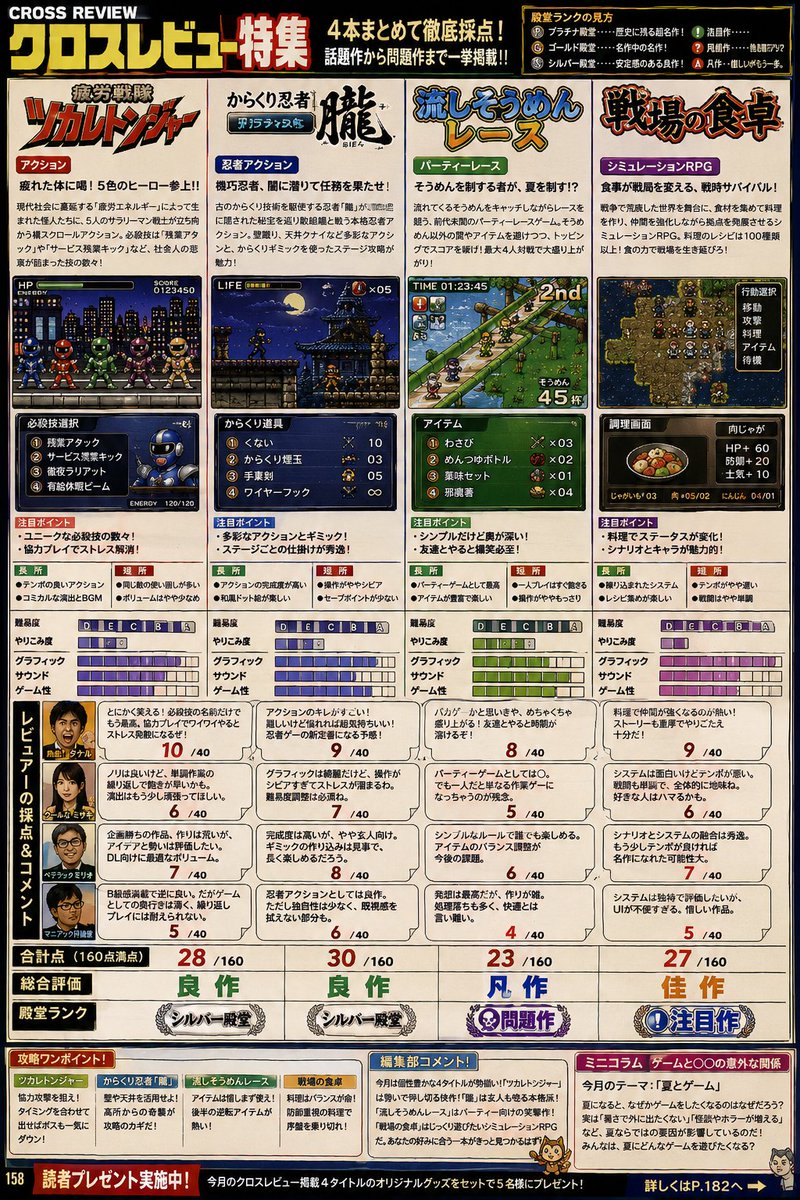
Retro Japanese Gaming Magazine Review Page
Generates a dense, highly detailed editorial layout for a 1990s Japanese gaming magazine, featuring multiple game reviews with scores and pixel art screenshots.
這是一個平面設計和海報設計的GPT Image 2範例。請使用下方可直接使用的提示資訊產生類似的視覺素材,並在重複使用前查看Awesome GPT Image 2 Prompts署名和商業用途授權資訊。
需要完整的提示符號集?請使用 平面設計和海報設計 主題中心提供更多相關範例,或打開 GPT Image 2 提示庫 有關完整範例索引、可重複使用結構和來源歸屬的資訊。
Free 1K preview
Generate one preview image instantly, no sign-up required.
3423/4000
提示詞
可直接複製的提示
At the start of generation, the user enters four game titles. If left blank, they are created randomly.

【Game 1】
({argument name="game title 1" default="Game Title"})

【Game 2】
({argument name="game title 2" default="Game Title"})

【Game 3】
({argument name="game title 3" default="Game Title"})

【Game 4】
(Game Title)

The subsequent magazine content is automatically generated by inferring the worldview, genre, and game content from the entered titles.

---

Style of a cross-review feature page found in Japanese gaming magazines from the late 1990s to early 2000s.

One vertical page.

Information-dense magazine layout.

Do not use real game companies, real game consoles, or real magazine names.

Completely original fictional game review feature.

---

Display four games simultaneously.

Automatically generate the following for each game:

- Game title logo
- Genre
- Game content introduction
- Catchphrase
- Pixel art screenshot
- In-game style UI screen
- Review comments
- Scoring results
- Overall evaluation

Game screens are produced by inferring content from the title.

Examples:

Robot title -> 16-bit style mech action
Fantasy title -> Classic RPG
Racing title -> High-speed racing game
Horror title -> Exploration adventure
Shooting title -> Vertical or horizontal scrolling STG

Depicted as distinct game genres.

Screenshots have persuasive power as if they are actual game screens during play.

Include UI appropriate for the genre, such as mini-maps, HP gauges, score displays, and dialogue windows.

---

Four review personnel:

- Hot-blooded male reviewer
- Calm female reviewer
- Veteran editor
- Maniacal game critic

Each with a face illustration.

Review comments in speech bubble format.

Opinions differ for each game.

---

Ratings are random.

Mixed from high praise to harsh criticism.

Examples:

"Very high level of perfection"
"Rough around the edges but shows promise"
"Works for specific tastes"
"Interesting idea"
"Difficulty with balance adjustment"
"Quite a sharp title"
"Hard to wrap my head around"

A mix of positive and biting comments.

---

Score is out of 40.

Four reviewers score individually.

Examples:

10 / 10 / 9 / 10
8 / 7 / 8 / 6
5 / 4 / 6 / 5
2 / 1 / 3 / 2

Automatically display according to the evaluation results:

- Platinum Hall of Fame
- Gold Hall of Fame
- Silver Hall of Fame
- Notable Title
- Good Title
- Commendable Title
- Ordinary Title
- Controversial Title

---

The page further includes:

- Key points of interest
- Strengths
- Weaknesses
- Difficulty chart
- Replayability level
- Graphic rating
- Sound rating
- Gameplay rating
- Editorial department comments
- Strategy tips
- Mini column

---

Overwhelming amount of information across the page.

Numerous subheadings.

Numerous sidebars.

Numerous graphs.

Numerous icons.

Fine decorations.

Texture of retro printed matter.

Slightly faded paper.

Density like a game guide book or a collectible magazine feature page.

A layout where more information is discovered the more it is read.

Completely original design that does not look like real games or real manufacturers.

professional Japanese gaming magazine editorial layout, retro review page, pixel art game screenshots, reviewer portraits, dense typography, score charts, magazine print design, high detail, authentic late 1990s and early 2000s Japanese game culture, collectible magazine feature, highly detailed editorial design
提示變數
提示符號中可編輯的參數佔位符及其預設值。
多變的
game title 1
預設
Game Title
多變的
game title 2
預設
Game Title
多變的
game title 3
預設
Game Title
Best for
- - 平面設計和海報設計 visual exploration
- - Image generation and reference-image edits
- - Reusable briefs that keep source attribution visible
Change these parts
- - Subject, product, character, or scene
- - Aspect ratio, camera, lighting, and background
- - Brand, text, color, and output constraints
Recommended model and settings
- - Model: gpt-image-2
- - Input mode: 文生圖
- - Aspect ratio: source
- - Commercial status: review original source
How to use this prompt
- 1. Copy the prompt and preserve its structure for the first test.
- 2. Replace the subject, context, and publishing channel.
- 3. Change one camera, lighting, or style variable per iteration.
- 4. Inspect the output, source, text, and rights before reuse.
Limitations, source, and reuse cautions
- - Generated output is an editable draft, not factual, legal, or rights evidence.
- - Review the linked source, people, brands, logos, text, and third-party media before commercial use.
內容來自Awesome GPT Image 2 Prompts 。必須註明出處。商業用途狀態為allowed ;付費使用前請查看來源版權資訊。
此類案例更多
按類別、輸入模式相容性、品質和低風險進行優先排序。


重用和來源註釋
預覽案例後,請謹慎使用此提示。
- 1.複製提示或直接在 Dovoo 中使用生成按鈕開啟提示。
- 2.根據您的實際使用情況調整變數、寬高比和參考影像。
- 3.發布或付費使用前,請確認版權、署名要求以及品牌或肖像權風險。