Manga Infographic: AI Prompt Engineering
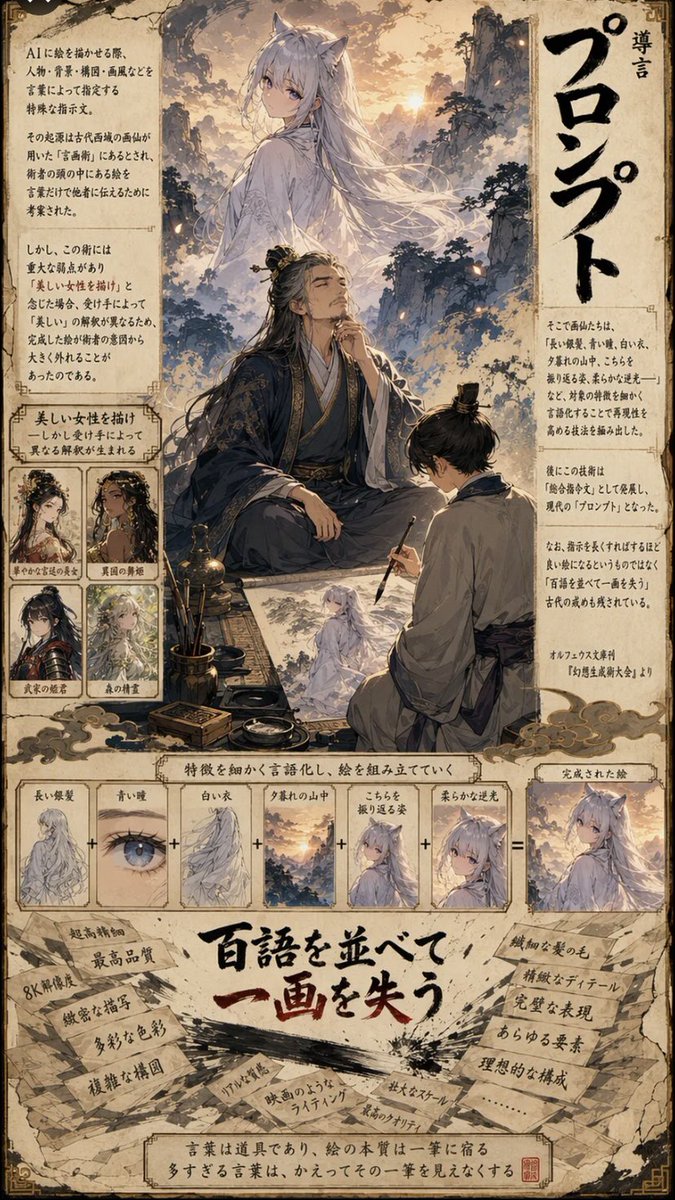
A stylized manga page illustrating the concept of prompt engineering for AI image generation, featuring a kitsune character and a breakdown of visual elements.
這是一個平面設計和海報設計的GPT Image 2範例。請使用下方可直接使用的提示資訊產生類似的視覺素材,並在重複使用前查看Awesome GPT Image 2 Prompts署名和商業用途授權資訊。
需要完整的提示符號集?請使用 平面設計和海報設計 主題中心提供更多相關範例,或打開 GPT Image 2 提示庫 有關完整範例索引、可重複使用結構和來源歸屬的資訊。
Free 1K preview
Generate one preview image instantly, no sign-up required.
2013/4000
提示詞
可直接複製的提示
A vertical, highly detailed manga-style infographic page with a parchment-like background. The layout is divided into three main sections: a top illustration area, a middle diagrammatic breakdown, and a bottom text-heavy conclusion.

Top Section:
- A large, ethereal illustration of a woman with long white hair and fox ears (a kitsune) standing on a mountain peak at sunset. She wears flowing white robes.
- Below her, an elderly man with long black hair tied back, wearing dark blue traditional Chinese robes, sits cross-legged holding a calligraphy brush, looking up thoughtfully.
- To his right, a younger man in grey robes kneels, sketching the kitsune onto paper.
- Surrounding this scene are blocks of Japanese text explaining the concept of 'Prompt' (プロンプト).
- On the left side, there are four small square character portraits labeled with descriptions like 'Beautiful Woman', 'Dancer', etc., showing variations of female characters.
- Large vertical Japanese text on the right reads 'Introduction to Prompts'.

Middle Section:
- A horizontal flow diagram titled 'Verbalizing features to compose a picture'.
- It shows a sequence of six small square images connected by plus signs (+), leading to an equals sign (=) and a final result image.
- The sequence includes: 1. Long silver hair, 2. Blue eyes, 3. White clothes, 4. Mountain sunset, 5. Looking back pose, 6. Soft backlighting.
- The final result is the complete image of the kitsune from the top section.

Bottom Section:
- A large, bold Japanese headline in red and black ink style: "Listing hundreds of words loses one stroke" (百語を並べて一画を失う).
- Surrounding the headline are torn pieces of paper with handwritten notes listing negative effects of over-prompting, such as '8K resolution', 'ultra-high quality', 'complex composition', 'unnatural lighting', 'film-like lighting', 'large scale', 'highest quality'.
- At the very bottom, a concluding sentence in a box states that words are tools, but too many obscure the essence of the single stroke.
Best for
- - 平面設計和海報設計 visual exploration
- - Image generation and reference-image edits
- - Reusable briefs that keep source attribution visible
Change these parts
- - Subject, product, character, or scene
- - Aspect ratio, camera, lighting, and background
- - Brand, text, color, and output constraints
Recommended model and settings
- - Model: gpt-image-2
- - Input mode: 文生圖
- - Aspect ratio: source
- - Commercial status: review original source
How to use this prompt
- 1. Copy the prompt and preserve its structure for the first test.
- 2. Replace the subject, context, and publishing channel.
- 3. Change one camera, lighting, or style variable per iteration.
- 4. Inspect the output, source, text, and rights before reuse.
Limitations, source, and reuse cautions
- - Generated output is an editable draft, not factual, legal, or rights evidence.
- - Review the linked source, people, brands, logos, text, and third-party media before commercial use.
內容來自Awesome GPT Image 2 Prompts 。必須註明出處。商業用途狀態為allowed ;付費使用前請查看來源版權資訊。
此類案例更多
按類別、輸入模式相容性、品質和低風險進行優先排序。

重用和來源註釋
預覽案例後,請謹慎使用此提示。
- 1.複製提示或直接在 Dovoo 中使用生成按鈕開啟提示。
- 2.根據您的實際使用情況調整變數、寬高比和參考影像。
- 3.發布或付費使用前,請確認版權、署名要求以及品牌或肖像權風險。