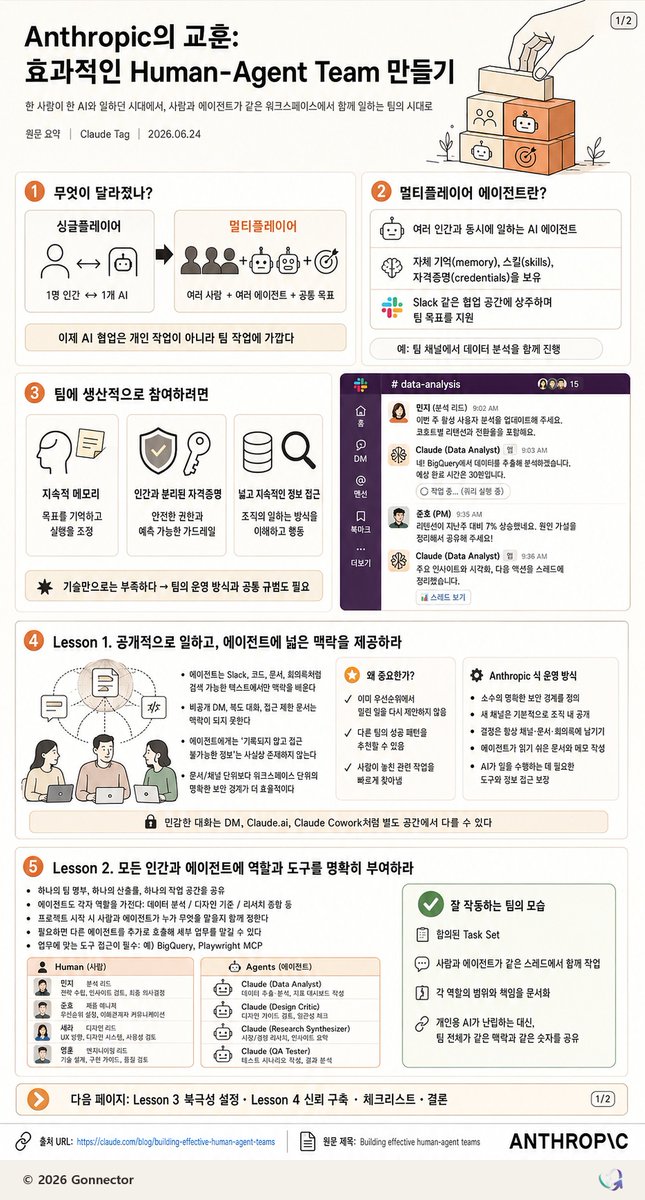
Korean Human-Agent Team Infographic
A structured prompt for generating a dense Korean infographic summarizing Anthropic-style guidance for effective human-agent teams.
這是一個平面設計和海報設計的GPT Image 2範例。請使用下方可直接使用的提示資訊產生類似的視覺素材,並在重複使用前查看Awesome GPT Image 2 Prompts署名和商業用途授權資訊。
需要完整的提示符號集?請使用 平面設計和海報設計 主題中心提供更多相關範例,或打開 GPT Image 2 提示庫 有關完整範例索引、可重複使用結構和來源歸屬的資訊。
Free 1K preview
Generate one preview image instantly, no sign-up required.
4000/4000
提示詞
可直接複製的提示
Goal: Create a tall Korean infographic poster summarizing Anthropic’s lesson on building effective human-agent teams, page {argument name="page number" default="1/2"}, with a clean beige editorial tech style and numbered lesson sections.

Canvas: Vertical 2:3 poster, off-white warm background, thin rounded cards, orange numbered circles, black Korean typography, subtle gray dividers, small line-art illustrations, and Anthropic-like minimal branding. Use a dense but readable layout similar to a blog-summary infographic.

Header: Large bold title in Korean: “Anthropic의 교훈: 효과적인 Human-Agent Team 만들기”. Under it, small subtitle: “한 사람이 한 AI와 일하던 시대에서, 사람과 에이전트가 같은 워크스페이스에서 함께 일하는 팀의 시대로”. Metadata row: “원문 요약 | Claude Tag | 2026.06.24”. Top-right corner has a small rounded page badge “1/2” and an illustration of a hand placing blocks on three orange drawers; the drawers show simple icons for humans, a robot, and a target.

Layout: Use exactly 5 main numbered sections on this page, stacked in a clear grid. Section 1 and 2 sit side by side below the header. Section 3 is a wide band split between three participation cards and a mock chat screenshot. Section 4 is a full-width lesson card. Section 5 is another full-width lesson card. Bottom has a navigation strip, source strip, and footer branding.

Section 1: Number badge “1” and title “무엇이 달라졌나?”. Show a comparison diagram with exactly 2 panels: left panel labeled “싱글플레이어”, showing one human icon ↔ one AI robot icon with caption “1명 인간 ↔ 1개 AI”; right panel labeled “멀티플레이어”, showing multiple human silhouettes + multiple robot icons + a target icon with caption “여러 사람 + 여러 에이전트 + 공동 목표”. Add a bottom callout: “이제 AI 협업은 개인 작업이 아니라 팀 작업에 가깝다”.

Section 2: Number badge “2” and title “멀티플레이어 에이전트란?”. Include exactly 3 definition rows with icons: robot icon row “여러 인간과 동시에 일하는 AI 에이전트”; brain icon row “자체 기억(memory), 스킬(skills), 자격증명(credentials)을 보유”; Slack logo-inspired colored icon row “Slack 같은 협업 공간에 상주하며 팀 목표를 지원”. Bottom example pill: “예: 팀 채널에서 데이터 분석을 함께 진행”.

Section 3: Number badge “3” and title “팀에 생산적으로 참여하려면”. Left side contains exactly 3 rounded cards: card 1 with head and sticky-note icon, title “지속적 메모리”, description “목표를 기억하고 실행을 조정”; card 2 with shield and key icon, title “인간과 분리된 자격증명”, description “안전한 권한과 예측 가능한 가드레일”; card 3 with database and magnifying-glass icon, title “넓고 지속적인 정보 접근”, description “조직이 원하는 방식을 이해하고 행동”. Below those cards add a star callout: “기술만으로는 부족하다 → 팀의 운영 방식과 공통 규범도 필요”. Right side shows a Slack-like chat screenshot titled “# data-analysis” with a purple sidebar and exactly 5 visible chat messages from these senders: “민지 (분석 리드)”, “Claude (Data Analyst)”, “호준 (PM)”, “Claude (Data Analyst)”, and a small final status/message area. Include tiny avatars and timestamps, but keep text mostly legible and compact.

Section 4: Number badge “4” and title “Lesson 1. 공개적으로 일하고, 에이전트에 넓은 맥락을 제공하라”. Left illustration: exactly 3 people sitting with laptops around a dotted shared workspace diagram containing document, chat, and code icons. Middle bullet area explains that agents should work in visible spaces like Slack, Jira, documents, and repositories; private DMs can hide context; and agents need access to recorded conversations and artifacts. Add two side cards: card titled “왜 중요한가?” with orange star icon and bullet points about memory not being automatic, missing context lowering output quality, and shared context improving recommendations; card titled “Anthropic 식 운영 방식” with gear icon and bullets about shared channels, openly sharing work products, moving useful DMs into shared space, and documenting easy-to-read summaries. Bottom lock callout: “민감한 대화는 DM, Claude.ai, Claude Code와처럼 별도 공간에서 다룰 수 있다”.

Section 5: Number badge “5” and title “Lesson 2. 모든 인간과 에이전트에 역할과 도구를 명확히 부여하라”. Include a short Korean bullet list about assigning clear roles, tools, credentials, and expectations. Below left, create exactly 2 small tables: “Human (사람)” table with 4 rows of human teammates and roles; “Agents (에이전트)” table with 4 rows: “Claude (Data Analyst)”, “Claude (Design Critic)”, “Claude (Research Synthesizer)”, “Claude (QA Tester)”. On the right, a green bordered checklist card titled “잘 작동하는 팀의 모습” with exactly 5 checklist items: “합의된 Task Set”, “사람과 에이전트가 같은 스레드에서 함께 작업”, “각 역할의 범위와 책임을 문서화”, “개인은 AI가 나타나는 대신, 팀 전체가 같은 맥락과 같은 숫자를 공유”, and one concise final item about shared tools and permissions.

Bottom navigation: Add an orange arrow icon and text: “다음 페이지: Lesson 3 복잡성 설정 · Lesson 4 신뢰 구축 · 체크리스트 · 결론”, with a small “1/2” badge on the right. Source strip contains two icon-labeled items: “출처 URL: https://claude.com/blog/building-effective-human-agent-teams” and “원문 제목: Building effective human-agent teams”. Bottom-right large wordmark “ANTHROPIC”. Bottom-left copyright “© 2026 Gonnecter”. Add a tiny colorful abstract logo at the bottom-right corner.

Visual style: Modern Korean business infographic, crisp vector line art, warm cream background, orange accents, muted purple for chat mockup, green for success checklist, precise alignment, high information density, readable Korean text, no photorealism, no shadows beyond very subtle card depth.

Constraints: Keep exactly 5 numbered main sections, exactly 2 comparison panels, exactly 3 definition rows, exactly 3 participation cards, exactly 5 chat messages, exactly 2 role tables, and exactly 5 checklist items. Do not add extra pages, extra lesson numbers, watermarks, or unrelated icons.
提示變數
提示符號中可編輯的參數佔位符及其預設值。
多變的
page number
預設
1/2
Best for
- - 平面設計和海報設計 visual exploration
- - Image generation and reference-image edits
- - Reusable briefs that keep source attribution visible
Change these parts
- - Subject, product, character, or scene
- - Aspect ratio, camera, lighting, and background
- - Brand, text, color, and output constraints
Recommended model and settings
- - Model: gpt-image-2
- - Input mode: 文生圖
- - Aspect ratio: source
- - Commercial status: review original source
How to use this prompt
- 1. Copy the prompt and preserve its structure for the first test.
- 2. Replace the subject, context, and publishing channel.
- 3. Change one camera, lighting, or style variable per iteration.
- 4. Inspect the output, source, text, and rights before reuse.
Limitations, source, and reuse cautions
- - Generated output is an editable draft, not factual, legal, or rights evidence.
- - Review the linked source, people, brands, logos, text, and third-party media before commercial use.
內容來自Awesome GPT Image 2 Prompts 。必須註明出處。商業用途狀態為allowed ;付費使用前請查看來源版權資訊。
此類案例更多
按類別、輸入模式相容性、品質和低風險進行優先排序。


重用和來源註釋
預覽案例後,請謹慎使用此提示。
- 1.複製提示或直接在 Dovoo 中使用生成按鈕開啟提示。
- 2.根據您的實際使用情況調整變數、寬高比和參考影像。
- 3.發布或付費使用前,請確認版權、署名要求以及品牌或肖像權風險。