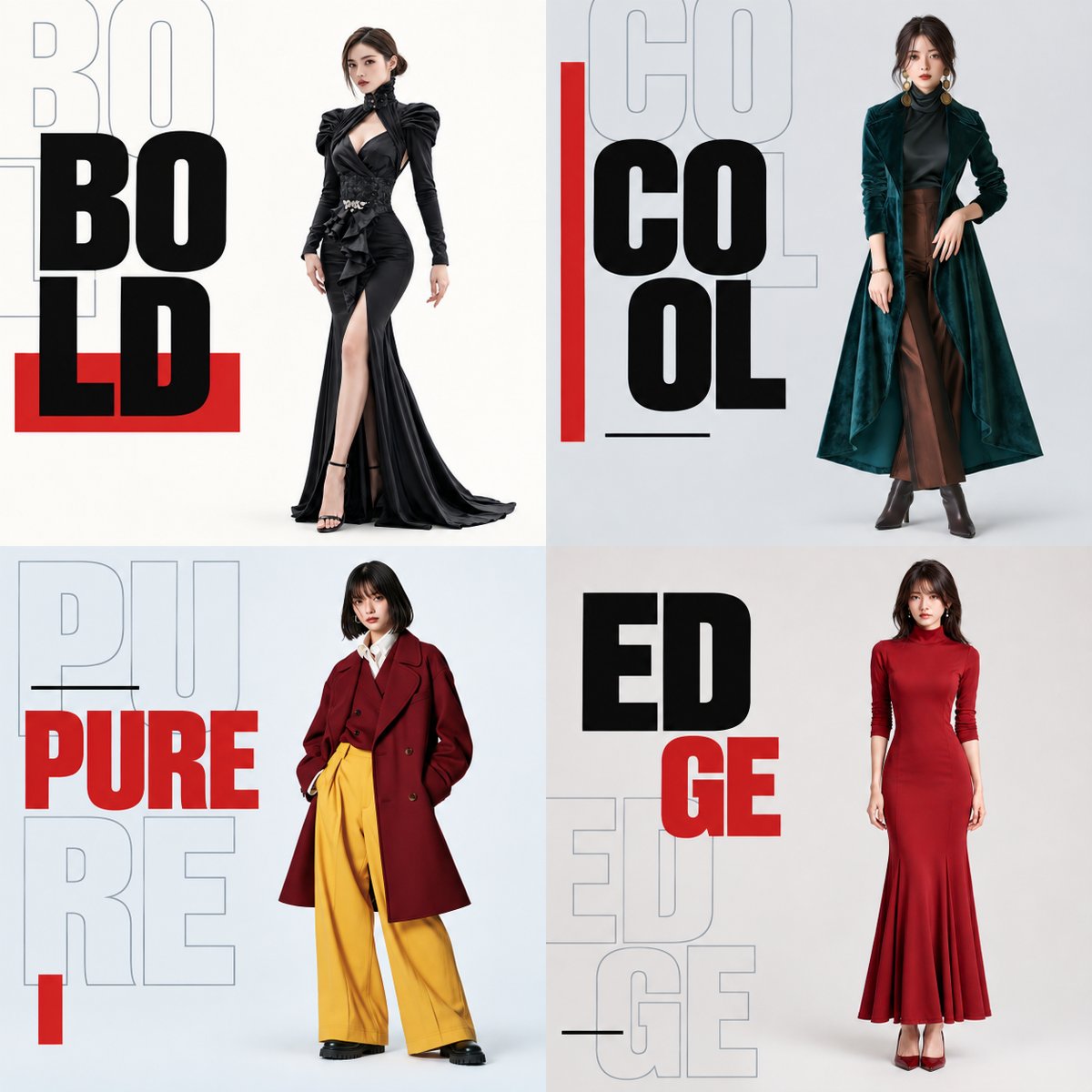
Fashion Campaign 4-Panel Collage Prompt
A sophisticated technical prompt for creating a 2x2 grid fashion campaign poster. It uses four reference images to maintain specific model features while applying a high-end typography design for a modern aesthetic.
這是一個平面設計和海報設計的GPT Image 2範例。請使用下方可直接使用的提示資訊產生類似的視覺素材,並在重複使用前查看Awesome GPT Image 2 Prompts署名和商業用途授權資訊。
需要完整的提示符號集?請使用 平面設計和海報設計 主題中心提供更多相關範例,或打開 GPT Image 2 提示庫 有關完整範例索引、可重複使用結構和來源歸屬的資訊。
Free 1K preview
Generate one preview image instantly, no sign-up required.
4000/4000
提示詞
可直接複製的提示
Refer to the four attached full-body images of women and generate one square 4-panel image to be used as material for a fashion video.

[Final Form]
The overall aspect ratio is 1:1. Divide the screen into an even 2x2 grid, making each panel square. Place one woman in each panel for a total of four. In order of attachment, 1st = top left, 2nd = top right, 3rd = bottom left, 4th = bottom right. No outer borders, gaps between panels, or 3D frames are needed.

This is a modern fashion campaign featuring a sharp contrast between text size, solid fill and outlines, and overlapping versus empty space, using a limited range of elements. Keep the person's area clean and create a rich, art-directed composition for the text area. This is a poster image to be used as final video material. It should be a finished design, not a mockup. Each of the four images must stand as a complete poster on its own while maintaining unity as a whole.

[Maintaining Reference Subject: Priority Conditions Over Placement]
This is a common instruction set corresponding to the four full-body images of women provided by the user. Do not pre-set specific faces, body types, outfits, or hairstyles. The information for the person in each panel must come only from the image corresponding to that panel. Do not mix features or standardize the four women to a common face or model body type.

Maintain facial contours, eye/nose/mouth shapes and placement, expression, age, skin tone, hairstyle, and hair color exactly as shown in the reference. Maintain head-to-body ratio, neck length, shoulder width, torso length/width, hip width, limb length/thickness, and hand/foot size. Do not perform body corrections such as slimming the face, thinning the torso, lengthening legs, or stretching the body. Maintain the subject's pose, face/body orientation, gaze, arm/hand/leg positions, stance, and weight distribution. Do not flip horizontally. Carry over the shape, color, material, length, fit, and key folds or silhouettes of clothing, shoes, and accessories. Do not misinterpret loose clothing contours as body contours. Do not carry over the background, text, or borders of the reference photos.

[Method for Placing Subjects in Space]
Treat the person and clothing as a single unit, scaling them uniformly to place them. Do not apply different scaling to parts like the face, torso, or legs. Adjust placement while preserving the original silhouette rather than redrawing the pose to fit the frame. Ensure the entire outline, from top of head to soles of shoes, including hair and fingertips, fits within the panel. The height of the person should be roughly 80-85% of the panel height as a guide. If the subject has wide arms or clothing, scale down the whole person uniformly. Do not slim the body or cut off edges to fit. Set placement guides at y=7.5% and y=92.5% within the panel coordinate system. These are invisible guides. Place the whole person within these guides. Center the silhouette at y=50% while maintaining aspect ratio. Ensure visible clear space above the head and below the feet. Do not allow contact with the panel edges. Blend brightness and tone without changing silhouettes, and add subtle, natural contact shadows at the feet. Do not redraw features for 3D effect.

[Separation of Subject and Text]
The left ~35% of each panel is for typography, and the right ~65% is for the person. Do not draw a dividing line. Keep the person on the right and text/shapes on the left, ensuring no overlap with the body. Leave a clear gap. If fit is difficult, prioritize uniform scaling of the person.

[Typography Common Design]
Use the same condensed sans-serif font family, combining ultra-bold solid characters with bold outline characters. Design with size and layering without distorting characters. Use the following words: top left {argument name="top left text" default="BOLD"}, top right {argument name="top right text" default="COOL"}, bottom left {argument name="bottom left text" default="PURE"}, bottom right {argument name="bottom right text" default="EDGE"}. Use one main heading per panel, ensuring all letters are readable. Add one repeating outline of the same word as a supplementary element. Do not add other words or fine text. Maintain a clear size difference (helper text ~1.3-1.5x larger, in pale slate gray). Text overlaps should only happen in the left text area. No extreme perspective distortion or 3D effects. No barcodes or logos.

[Background and Color Palette]
Use bright backgrounds for all panels. Top left: ivory; Top right: cool gray; Bottom left: pale blue-gray; Bottom right: warm gray. Keep brightness levels similar. Avoid dark backgrounds. Use solid colors behind the person. Adjust brightness/warmth slightly to separate the silhouette naturally from the background. Main headings are ink black with vermilion red accents. Outlines are pale slate gray. Red is the same across all panels. Costume colors follow references.

[Composition of 4-Panel Text and Graphics]
Limit shapes to red rectangles and thin black lines. Strictly follow area separation. Create different compositions and centers of gravity for each panel.

Top Left - BOLD: Large solid text with offset outline overlap. Heading is BO/LD in two lines. Large black ultra-bold text occupies the upper-to-middle text area. One outline of BOLD is behind it, shifted slightly to the top left. Parts of the outline can be off-panel to the left.
提示變數
提示符號中可編輯的參數佔位符及其預設值。
多變的
top left text
預設
BOLD
多變的
top right text
預設
COOL
多變的
bottom left text
預設
PURE
多變的
bottom right text
預設
EDGE
Best for
- - 平面設計和海報設計 visual exploration
- - Image generation and reference-image edits
- - Reusable briefs that keep source attribution visible
Change these parts
- - Subject, product, character, or scene
- - Aspect ratio, camera, lighting, and background
- - Brand, text, color, and output constraints
Recommended model and settings
- - Model: gpt-image-2
- - Input mode: 文生圖
- - Aspect ratio: source
- - Commercial status: review original source
How to use this prompt
- 1. Copy the prompt and preserve its structure for the first test.
- 2. Replace the subject, context, and publishing channel.
- 3. Change one camera, lighting, or style variable per iteration.
- 4. Inspect the output, source, text, and rights before reuse.
Limitations, source, and reuse cautions
- - Generated output is an editable draft, not factual, legal, or rights evidence.
- - Review the linked source, people, brands, logos, text, and third-party media before commercial use.
內容來自Awesome GPT Image 2 Prompts 。必須註明出處。商業用途狀態為allowed ;付費使用前請查看來源版權資訊。
此類案例更多
按類別、輸入模式相容性、品質和低風險進行優先排序。
重用和來源註釋
預覽案例後,請謹慎使用此提示。
- 1.複製提示或直接在 Dovoo 中使用生成按鈕開啟提示。
- 2.根據您的實際使用情況調整變數、寬高比和參考影像。
- 3.發布或付費使用前,請確認版權、署名要求以及品牌或肖像權風險。