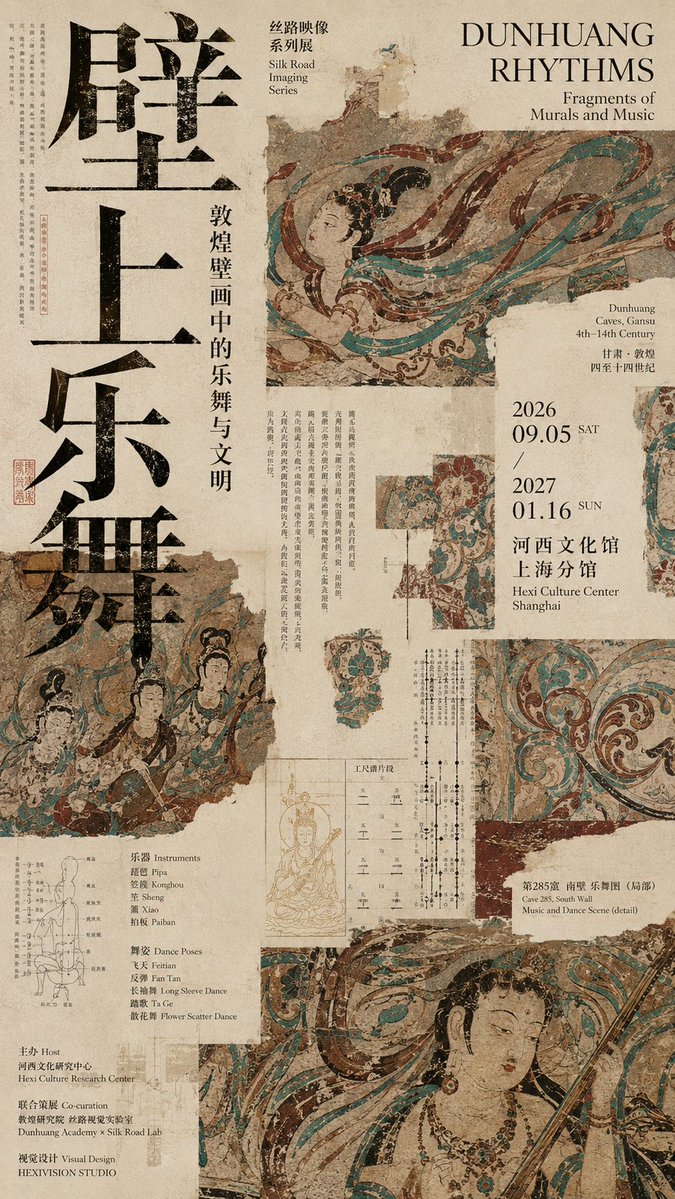
Dunhuang Rhythms Exhibition Poster
Creates a dense archival museum poster blending Dunhuang mural fragments, Chinese calligraphy, exhibition details, and editorial collage typography.
這是一個平面設計和海報設計的GPT Image 2範例。請使用下方可直接使用的提示資訊產生類似的視覺素材,並在重複使用前查看Awesome GPT Image 2 Prompts署名和商業用途授權資訊。
需要完整的提示符號集?請使用 平面設計和海報設計 主題中心提供更多相關範例,或打開 GPT Image 2 提示庫 有關完整範例索引、可重複使用結構和來源歸屬的資訊。
Free 1K preview
Generate one preview image instantly, no sign-up required.
3596/4000
提示詞
可直接複製的提示
Goal: Create a dense editorial cultural-exhibition poster about {argument name="exhibition title" default="Dunhuang Rhythms"}, combining Dunhuang mural fragments, music-and-dance archive typography, and layered museum ephemera.

Canvas: Tall vertical poster, approximately 2:3 ratio, aged warm beige rice-paper background with visible grain, stains, torn edges, faded ink, and pasted-collage seams. Overall mood is scholarly, archaeological, and highly designed, with intentional clutter but a strong grid.

Layout: Use an asymmetric high-density collage. On the far left, place four enormous stacked black Chinese calligraphy characters reading 「壁上乐舞」, occupying nearly the full height, distressed and ink-textured. Beside the large characters, add a narrow vertical Chinese subtitle reading 「敦煌壁画中的乐舞与文明」. At the top center-left, add a small bilingual series label: 「丝路映像 系列展」 with “Silk Road Imaging Series” underneath. At the top right, place the main English title in elegant serif capitals: “DUNHUANG RHYTHMS”, with the smaller subtitle “Fragments of Murals and Music” below.

Main imagery: Use exactly 6 visible mural/image fragments, all in faded Dunhuang cave-painting colors of turquoise, cinnabar red, ochre, black, and parchment beige: 1) a large upper-right flying apsara musician fragment with flowing ribbons crossing diagonally; 2) a lower-left torn fragment showing three mural musicians or dancers; 3) a mid-right small rectangular fragment of a standing dancer; 4) a mid-lower ornate floral scroll pattern fragment; 5) a large bottom-right close-up of a female bodhisattva or apsara face with jewelry and flowing ribbons; 6) a right-edge partial vertical mural strip cropped off the page. Make the fragments look like scanned ancient wall paintings with cracks, missing plaster, chipped edges, and uneven opacity.

Information blocks: Add many thin vertical Chinese text columns like museum notes and archival captions around the collage, especially along the far left margin, middle columns, and lower center. Include exactly 4 primary info panels: 1) a right-side date and venue panel with “2026 09.05 SAT / 2027 01.16 SUN”, Chinese venue text, and “Hexi Culture Center Shanghai”; 2) a lower-left educational panel listing “Instruments” and “Dance Poses” with a small line drawing of an instrument; 3) a bottom-left organizer/credits panel with Host, Co-operation, and Visual Design lines; 4) a lower-right cave caption panel reading “Cave 285, South Wall Music and Dance Scene (detail)” with Chinese above it.

Typography and style: Mix oversized rough black Chinese brush type, refined Western serif uppercase, small Chinese Song/Ming-style vertical text, and tiny English museum captions. Use black, dark brown, muted red stamp ink, and occasional faded grid marks. Add small red seal stamps, thin archival diagrams, faint measurement lines, and marginal annotations. The design should feel like a contemporary museum poster, editorial magazine spread, and historical archive board fused together.

Constraints: Preserve a clear exhibition-poster hierarchy despite the dense collage. Do not make it modern glossy; keep everything matte, aged, weathered, and printed on textured paper. Use no photorealistic people outside the mural fragments, no 3D effects, no bright neon colors, and no empty clean white background. The most prominent readable texts should be 「壁上乐舞」, {argument name="Chinese subtitle" default="Dunhuang Mural Music and Dance and Civilization"}, “DUNHUANG RHYTHMS”, and the date range {argument name="exhibition dates" default="2026 09.05 / 2027 01.16"}.
提示變數
提示符號中可編輯的參數佔位符及其預設值。
多變的
exhibition title
預設
Dunhuang Rhythms
多變的
Chinese subtitle
預設
Dunhuang Mural Music and Dance and Civilization
多變的
exhibition dates
預設
2026 09.05 / 2027 01.16
Best for
- - 平面設計和海報設計 visual exploration
- - Image generation and reference-image edits
- - Reusable briefs that keep source attribution visible
Change these parts
- - Subject, product, character, or scene
- - Aspect ratio, camera, lighting, and background
- - Brand, text, color, and output constraints
Recommended model and settings
- - Model: gpt-image-2
- - Input mode: 文生圖
- - Aspect ratio: source
- - Commercial status: review original source
How to use this prompt
- 1. Copy the prompt and preserve its structure for the first test.
- 2. Replace the subject, context, and publishing channel.
- 3. Change one camera, lighting, or style variable per iteration.
- 4. Inspect the output, source, text, and rights before reuse.
Limitations, source, and reuse cautions
- - Generated output is an editable draft, not factual, legal, or rights evidence.
- - Review the linked source, people, brands, logos, text, and third-party media before commercial use.
內容來自Awesome GPT Image 2 Prompts 。必須註明出處。商業用途狀態為allowed ;付費使用前請查看來源版權資訊。
此類案例更多
按類別、輸入模式相容性、品質和低風險進行優先排序。
重用和來源註釋
預覽案例後,請謹慎使用此提示。
- 1.複製提示或直接在 Dovoo 中使用生成按鈕開啟提示。
- 2.根據您的實際使用情況調整變數、寬高比和參考影像。
- 3.發布或付費使用前,請確認版權、署名要求以及品牌或肖像權風險。