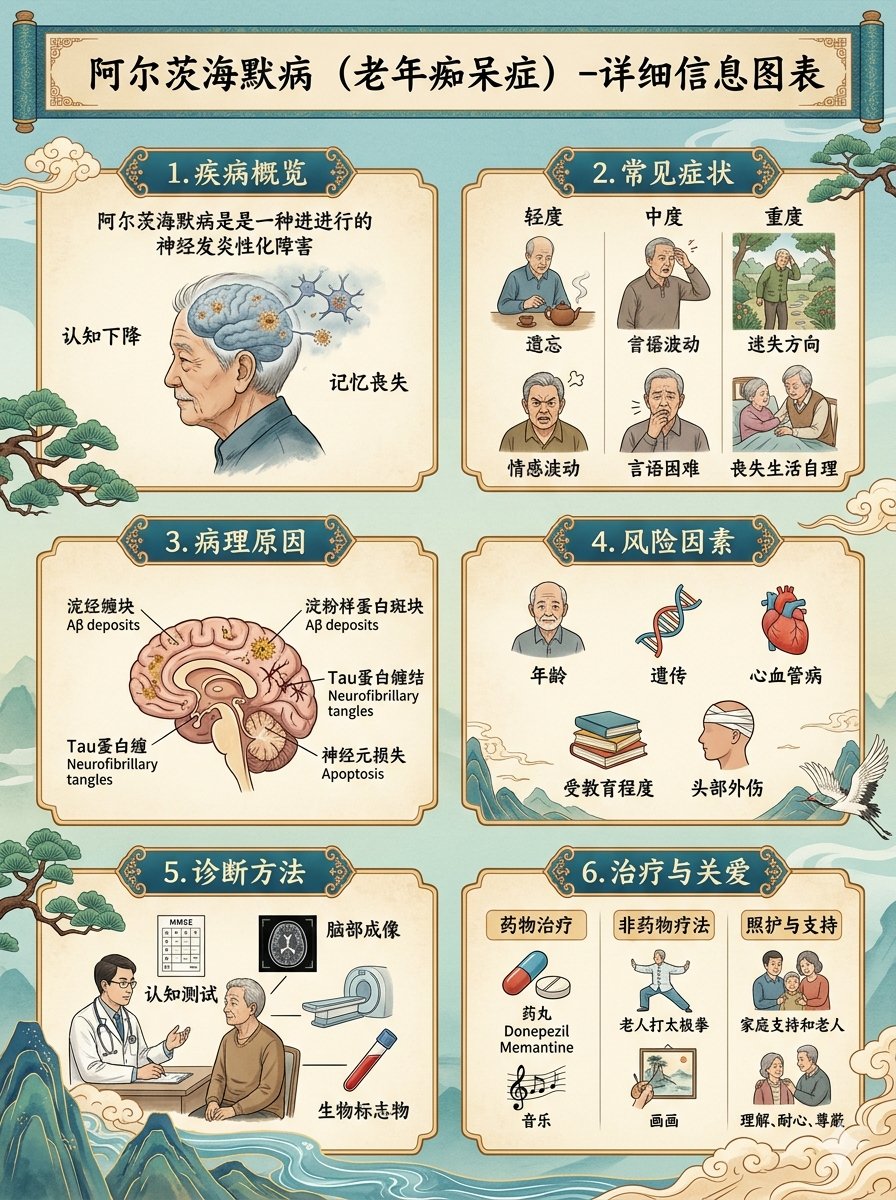
中國阿茲海默症資訊圖表海報
一張詳細的傳統中式醫學資訊圖表海報,解釋了阿茲海默症,可用於健康教育、宣傳活動和社交媒體科學貼文。
這是一個平面設計和海報設計的GPT Image 2範例。請使用下方可直接使用的提示資訊產生類似的視覺素材,並在重複使用前查看Awesome GPT Image 2 Prompts署名和商業用途授權資訊。
需要完整的提示符號集?請使用 平面設計和海報設計 主題中心提供更多相關範例,或打開 GPT Image 2 提示庫 有關完整範例索引、可重複使用結構和來源歸屬的資訊。
Free 1K preview
Generate one preview image instantly, no sign-up required.
4000/4000
提示詞
可直接複製的提示
{
  "type": "traditional Chinese medical infographic poster",
  "topic": "{argument name=\"topic\" default=\"Alzheimer's disease (dementia)\"}",
  "title": "{argument name=\"headline text\" default=\"Alzheimer's Disease (Dementia) - Detailed Infographic\"}",
  "language": "Chinese",
  "style": {
    "overall": "educational health infographic in vintage Chinese poster style",
    "rendering": "clean hand-painted illustration, soft watercolor textures, thin ink outlines, muted pastel colors",
    "palette": "teal, beige, cream, jade green, dusty blue, warm brown, light coral",
    "decorative frame": "ornate scroll-like border with gold trim",
    "background": "pale sky-blue backdrop with traditional Chinese landscape motifs, stylized clouds, pine trees, mountains, cranes, and waves"
  },
  "layout": {
    "format": "vertical poster",
    "sections": [
      {
        "title": "1. Disease Overview",
        "position": "top-left",
        "count": 1,
        "labels": [
          "Cognitive Decline",
          "Memory Loss"
        ],
        "content": "one large panel explaining that Alzheimer disease is a progressive neurodegenerative disorder, featuring an elderly side-profile portrait with a semi-transparent brain illustration showing degeneration and small neuron icons around the brain"
      },
      {
        "title": "2. Common Symptoms",
        "position": "top-right",
        "count": 6,
        "labels": [
          "Mild",
          "Moderate",
          "Severe",
          "Forgetfulness",
          "Emotional fluctuations",
          "Speech difficulties",
          "Disorientation",
          "Loss of ability to care for oneself"
        ],
        "content": "a symptom panel arranged as 3 columns by severity, with 6 vignette illustrations of elderly people: forgetting at a table, emotional fluctuation, headache or confusion, speech difficulty, getting lost outdoors, and losing ability for daily self-care with assistance from another person"
      },
      {
        "title": "3. Pathological causes",
        "position": "middle-left",
        "count": 4,
        "labels": [
          "Amyloid plaques",
          "Aβ deposits",
          "Tau protein tangles",
          "Neurofibrillary tangles",
          "Neuron loss",
          "Apoptosis"
        ],
        "content": "a cross-section anatomical brain diagram with bilingual annotations pointing to amyloid beta deposits, tau protein tangles, neurofibrillary tangles, and neuron loss"
      },
      {
        "title": "4. Risk factors",
        "position": "middle-right",
        "count": 5,
        "labels": [
          "Age",
          "Genetics",
          "Cardiovascular disease",
          "Education level",
          "Head trauma"
        ],
        "content": "five icon-based risk factors shown in a grid: an elderly bust for age, DNA helix for genetics, anatomical heart for cardiovascular disease, stacked books for education level, and a head profile with bandage for head trauma"
      },
      {
        "title": "5. Diagnostic methods",
        "position": "bottom-left",
        "count": 4,
        "labels": [
          "Cognitive testing",
          "MMSE",
          "Brain imaging",
          "Biomarker"
        ],
        "content": "a diagnosis panel with a doctor consulting an elderly patient at a desk, plus three diagnostic visuals: an MMSE test sheet, a brain imaging scan with MRI-like machine, and a test tube representing biomarkers"
      },
      {
        "title": "6. Treatment and Care",
        "position": "bottom-right",
        "count": 7,
        "labels": [
          "Drug therapy",
          "Pills",
          "Donepezil",
          "Memantine",
          "Non-pharmacological therapies",
          "Old man practicing Tai Chi",
          "Music",
          "Painting",
          "Care and support",
          "Family support and elderly care",
          "Understanding, patience, respect"
        ],
        "content": "a care and treatment panel divided into 3 columns: medication with two pills and the words Donepezil and Memantine, non-drug therapy with tai chi, music, and painting, and caregiving support with family companionship plus a smaller scene emphasizing understanding, patience, and respect"
      }
    ],
    "header": {
      "count": 1,
      "text": "large centered Chinese calligraphy title banner at the top"
    },
    "panel_style": "six rounded rectangular cream panels with decorative teal-and-gold title tabs"
  },
  "composition": {
    "symmetry": "balanced two-column arrangement with three rows of paired panels",
    "readability": "clear educational hierarchy with large title, numbered section headers, medium illustrations, and bold labels",
    "density": "information-dense but visually friendly"
  },
  "negative_constraints": [
    "no photorealism",
    "no modern flat UI",
    "no dark horror tone",
    "no clutter outside the six main panels",
    "no extra sections beyond the 6 numbered panels"
  ],
  "quality": "high-resolution, polished infographic suitable for public health education, hospital waiting rooms, science communication posts, or social media comparison graphics"
}
提示變數
提示符號中可編輯的參數佔位符及其預設值。
多變的
topic
預設
Alzheimer's disease (dementia)
多變的
headline text
預設
Alzheimer's Disease (Dementia) - Detailed Infographic
Best for
- - 平面設計和海報設計 visual exploration
- - Image generation and reference-image edits
- - Reusable briefs that keep source attribution visible
Change these parts
- - Subject, product, character, or scene
- - Aspect ratio, camera, lighting, and background
- - Brand, text, color, and output constraints
Recommended model and settings
- - Model: gpt-image-2
- - Input mode: 文生圖
- - Aspect ratio: source
- - Commercial status: review original source
How to use this prompt
- 1. Copy the prompt and preserve its structure for the first test.
- 2. Replace the subject, context, and publishing channel.
- 3. Change one camera, lighting, or style variable per iteration.
- 4. Inspect the output, source, text, and rights before reuse.
Limitations, source, and reuse cautions
- - Generated output is an editable draft, not factual, legal, or rights evidence.
- - Review the linked source, people, brands, logos, text, and third-party media before commercial use.
內容來自Awesome GPT Image 2 Prompts 。必須註明出處。商業用途狀態為allowed ;付費使用前請查看來源版權資訊。
此類案例更多
按類別、輸入模式相容性、品質和低風險進行優先排序。




重用和來源註釋
預覽案例後,請謹慎使用此提示。
- 1.複製提示或直接在 Dovoo 中使用生成按鈕開啟提示。
- 2.根據您的實際使用情況調整變數、寬高比和參考影像。
- 3.發布或付費使用前,請確認版權、署名要求以及品牌或肖像權風險。