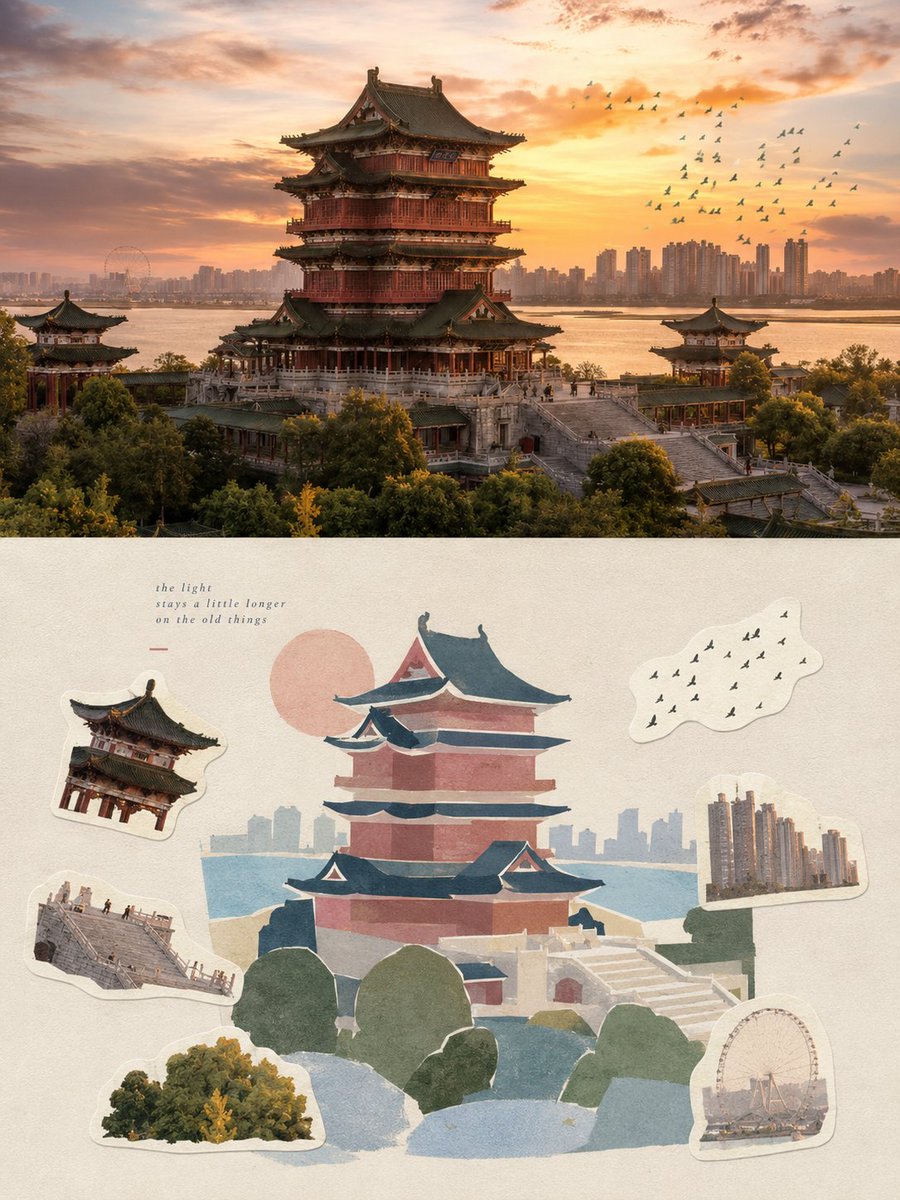
Selective Memory Sticker Poster Design
A sophisticated prompt that transforms photographs into high-end posters featuring a blend of realistic photography and minimalist flat-vector 'selective memory' illustrations with a sticker-based aesthetic.
Bu Grafik ve Poster için bir GPT Image 2 örnek senaryosudur. Benzer görseller oluşturmak için aşağıdaki hazır metni kullanın ve yeniden kullanmadan önce Awesome GPT Image 2 Prompts atıfını ve ticari kullanım haklarını inceleyin.
Free 1K preview
Generate one preview image instantly, no sign-up required.
Free text preview doesn’t preserve reference-image consistency.
İpucu
Kopyalamaya hazır istemi
Please create an independent high-end design poster for each photo I upload. Use a 3:4 vertical composition with a top-and-bottom dual-layer logic: the top half is realistic photography, and the bottom half is a flat reconstruction based on selective memory, creating a natural echo between them.

The top half retains the original photo, keeping the subject's identity, structure, posture, realistic texture, natural lighting, and original color atmosphere, with only slight professional color grading to give it an art magazine or exhibition photography feel. The background can be naturally extended to fit the frame, but the subject must not be stretched or distorted.

The bottom half extracts the most recognizable subjects, outlines, and narrative relationships from the photo, reconstructing them in a way of 'selective memory' rather than descriptive realism. Do not trace the photo completely; keep only the visual clues worth remembering, compressing complex scenes into 3–6 large geometric blocks, reorganized with matte gouache, paper collage, Risograph, or screen-printing styles so the subject is instantly identifiable with a modern graphic and handcrafted feel.

The bottom half uses a composition of a main visual plus six memory stickers. The main visual carries the primary narrative and visual weight; additionally, select six memorable details from the original photo—such as subject features, actions, local structures, plants, utensils, transportation, food, patterns, textures, lighting, or accidental details—and refine them into six independent stickers. The stickers should have thick, light-colored borders, naturally tiled and scattered at different scales, forming loose rows or asymmetrical clusters around the main visual with plenty of negative space. There should be clear primary and secondary relationships and size variations among the six stickers, like fragments cut from the same memory.

The composition emphasizes visual focus, block proportions, scale contrast, positive/negative space, and rhythmic spacing. The main visual should be significantly larger than the sticker fragments. Stickers can overlap, rotate slightly, or echo the subject without stealing the focus. Complex environments are actively reduced to let large areas of quiet background color become a breathing space, resulting in a professional graphic order with a relaxed, natural scrapbook feel.

Materials use opaque gouache, paper collage, Risograph, or screen-printed blocks, retaining slight powdery edges, paper grain, hand-cut edges, and printing deviations. Use the same material language for stickers and the main visual, avoiding watercolor smudges, complex strokes, dense line drafts, realistic textures, smooth vectors, and 3D plastic textures.

The color palette is based on soft, transparent, slightly desaturated high-end colors. Create the main atmosphere with {argument name="main atmosphere colors" default="light powder blue, mist blue, sky blue, and airy cool blue"}, balanced with {argument name="secondary colors" default="ivory white, cream white, light beige, soft gray-green, and architectural neutrals"}. Only a small amount of {argument name="accent color" default="dusty rose or muted blush"} is allowed as tiny accents for flowers, clothing, small logos, or local decorations to give the image breathability and refined layers.

Text is not preset with fixed titles or locations. Freely generate a minimal amount of truly meaningful text based on the subject, action, environment, and cultural context of the photo, naturally placing it in negative spaces or sticker gaps to form an editorial layout relationship. Text should be small, light, and restrained.

The overall result is like an independently published visual travel guide or private memory book page: quiet, modern, sharp, and relaxed, possessing professional graphic order while retaining the warmth of collage and handcrafted materials.
İstem değişkenleri
Komut isteminde bulunan, düzenlenebilir argüman yer tutucuları ve varsayılan değerleri.
Best for
- - Grafik ve Poster visual exploration
- - Image generation and reference-image edits
- - Reusable briefs that keep source attribution visible
Change these parts
- - Subject, product, character, or scene
- - Aspect ratio, camera, lighting, and background
- - Brand, text, color, and output constraints
Recommended model and settings
- - Model: gpt-image-2
- - Input mode: Görselden görsele
- - Aspect ratio: source
- - Commercial status: review original source
How to use this prompt
- 1. Copy the prompt and preserve its structure for the first test.
- 2. Replace the subject, context, and publishing channel.
- 3. Change one camera, lighting, or style variable per iteration.
- 4. Inspect the output, source, text, and rights before reuse.
Limitations, source, and reuse cautions
- - Generated output is an editable draft, not factual, legal, or rights evidence.
- - Review the linked source, people, brands, logos, text, and third-party media before commercial use.
Bu kategoride daha fazla vaka
Kategoriye, giriş modu uyumluluğuna, kaliteye ve düşük riske göre önceliklendirilmiştir.
Yeniden kullanım ve kaynak notları
Vaka önizlemesini yaptıktan sonra bu istemi güvenle kullanın.
- 1.Komut istemini kopyalayın veya oluşturma düğmesini kullanarak doğrudan Dovoo'da açın.
- 2.Değişkenleri, en boy oranını ve referans görselleri kendi kullanım durumunuza göre ayarlayın.
- 3.Yayınlamadan veya ücretli kullanımdan önce, kaynak haklarını, atıf gerekliliklerini ve marka veya benzerlik risklerini doğrulayın.