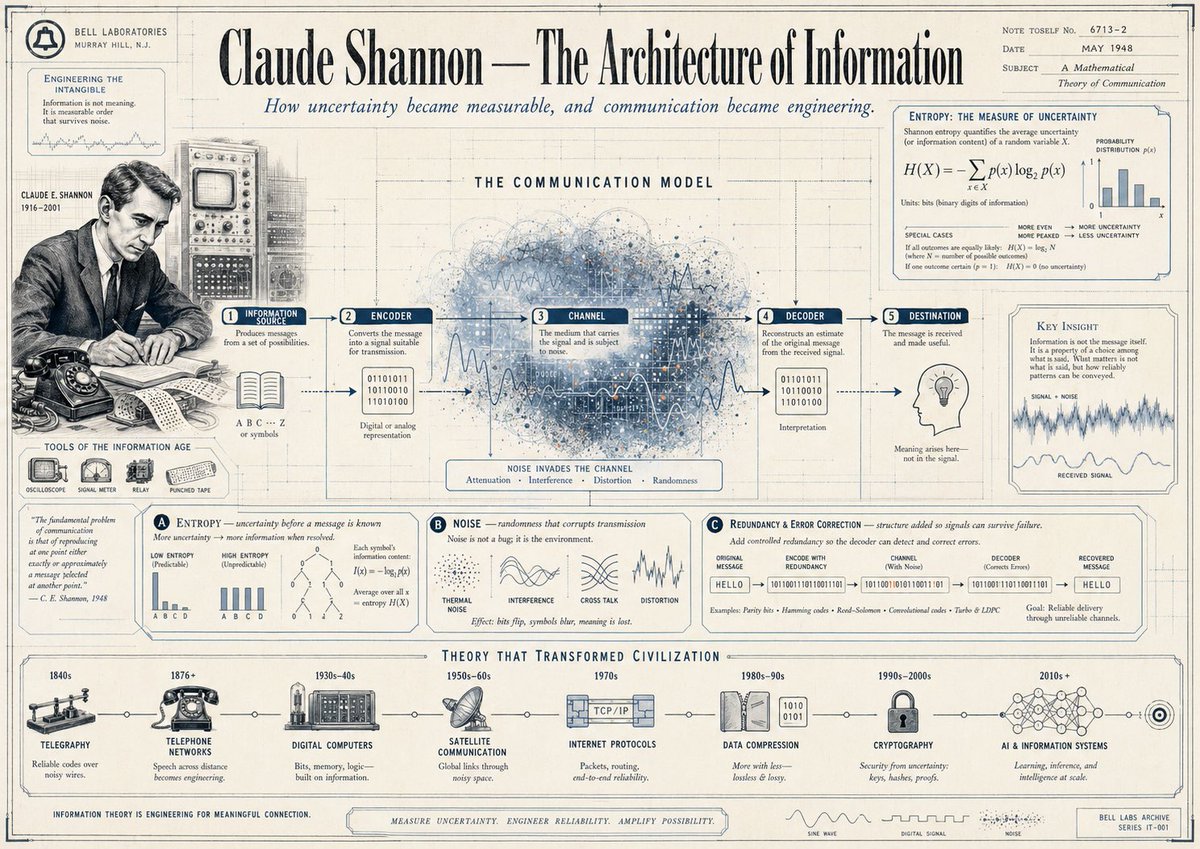
Винтажный инфографический постер Клода Шеннона
Этот запрос позволяет создать объемный образовательный постер в стиле ретро от Bell Labs, посвященный Клоду Шеннону и теории информации, идеально подходящий для графического оформления исторических материалов или для украшения научных стен в музейном стиле.
Это пример использования шаблона GPT Image 2 для Графика и плакаты . Используйте приведенный ниже шаблон, готовый к копированию, чтобы создать аналогичные визуальные элементы, и перед повторным использованием проверьте указание авторства Awesome GPT Image 2 Prompts и права на коммерческое использование.
Free 1K preview
Generate one preview image instantly, no sign-up required.
Промпт
Подсказка для копирования
{
  "aspectRatio": "16:9 landscape",
  "color": {
    "accent": "faded steel blue",
    "background": "warm ivory paper",
    "primaryInk": "dark navy",
    "secondaryInk": "charcoal gray"
  },
  "composition": "symmetrical wide poster with dense boxed annotations, fine border lines, and a museum-quality educational infographic feel",
  "layout": {
    "centerpiece": "a large abstract cloud of blue and gray signal noise, dots, lines, and waveforms behind the communication model, with arrows moving left to right through the five stages",
    "sections": [
      {
        "count": 5,
        "labels": [
          "BELL LABORATORIES MURRAY HILL, N.J.",
          "ENGINEERING THE INTANGIBLE",
          "CLAUDE E. SHANNON 1916–2001",
          "TOOLS OF THE INFORMATION AGE",
          "quote panel"
        ],
        "position": "far left vertical column",
        "title": "left archival sidebar"
      },
      {
        "count": 5,
        "labels": [
          "1 INFORMATION SOURCE",
          "2 ENCODER",
          "3 CHANNEL",
          "4 DECODER",
          "5 DESTINATION"
        ],
        "position": "upper middle wide panel",
        "title": "THE COMMUNICATION MODEL"
      },
      {
        "count": 4,
        "labels": [
          "H(X) = −Σ p(x) log₂ p(x)",
          "PROBABILITY DISTRIBUTION p(x)",
          "MORE EVEN MORE MAXED UNCERTAINTY",
          "MORE LOPSIDED LESS UNCERTAINTY"
        ],
        "position": "upper right box",
        "title": "ENTROPY: THE MEASURE OF UNCERTAINTY"
      },
      {
        "count": 3,
        "labels": [
          "A ENTROPY — uncertainty before a message is known",
          "B NOISE — randomness that corrupts transmission",
          "C Redundancy & Error Correction — structure added so signals can survive failure"
        ],
        "position": "middle to lower band",
        "title": "lower theory panels"
      },
      {
        "count": 8,
        "labels": [
          "1840s TELEGRAPHY",
          "1876+ TELEPHONE NETWORKS",
          "1930s–40s DIGITAL COMPUTERS",
          "1950s–60s SATELLITE COMMUNICATION",
          "1970s INTERNET PROTOCOLS",
          "1980s–90s DATA COMPRESSION",
          "1990s–2000s CRYPTOGRAPHY",
          "2010s+ AI & INFORMATION SYSTEMS"
        ],
        "position": "bottom horizontal timeline",
        "title": "THEORY THAT TRANSFORMED CIVILIZATION"
      }
    ]
  },
  "poster": {
    "headline": "Claude Shannon — The Architecture of Information",
    "subheadline": "How uncertainty became measurable, and communication became engineering.",
    "topRightMeta": {
      "date": "MAY 1948",
      "note": "NOTE TOSELF No. 6713–2",
      "subject": "A Mathematical Theory of Communication"
    }
  },
  "style": {
    "era": "1940s Bell Labs archival poster",
    "look": "aged cream paper, blueprint drafting grid, thin ink linework, muted navy and charcoal printing, subtle stains and paper wear, technical illustration mixed with newspaper editorial design",
    "rendering": "high-detail diagrammatic collage with engraved portrait, scientific charts, labeled panels, and hand-drawn signal graphics"
  },
  "subject": "Claude Shannon and information theory",
  "textDensity": "very high, with many small labels, formulas, captions, and historical notes in a carefully organized grid",
  "type": "vintage editorial infographic poster",
  "visualElements": {
    "bottomDecor": [
      "small waveform legend with sine wave, digital signal, and noise",
      "archival stamp or footer on lower right"
    ],
    "chartsAndDiagrams": [
      "bar chart for entropy probabilities",
      "two low vs high entropy mini bar charts",
      "tree diagram and entropy notation",
      "signal distortion sketches labeled thermal noise, cross talk, distortion",
      "error-correction binary pipeline from original message to recovered message"
    ],
    "communicationModel": [
      "book and symbols under source",
      "binary digits under encoder",
      "large noisy channel cloud with wave overlays",
      "binary digits and interpretation under decoder",
      "light bulb icon under destination"
    ],
    "objectsLeft": [
      "rotary telephone on desk",
      "open notebook or papers",
      "technical console with CRT screen and knobs behind portrait",
      "small icon row of 4 tools: oscilloscope, signal meter, relay, punched tape"
    ],
    "portrait": {
      "placement": "left-center",
      "style": "Show every face clearly with natural, detailed facial features, wearing suit and tie, writing on paper",
      "subject": "{argument name=\"scientist name\" default=\"Claude Shannon\"}"
    }
  }
}
Переменные подсказки
Редактируемые заполнители аргументов, найденные в подсказке, с их значениями по умолчанию.
Best for
- - Графика и плакаты visual exploration
- - Image generation and reference-image edits
- - Reusable briefs that keep source attribution visible
Change these parts
- - Subject, product, character, or scene
- - Aspect ratio, camera, lighting, and background
- - Brand, text, color, and output constraints
Recommended model and settings
- - Model: gpt-image-2
- - Input mode: Текст в изображение
- - Aspect ratio: source
- - Commercial status: review original source
How to use this prompt
- 1. Copy the prompt and preserve its structure for the first test.
- 2. Replace the subject, context, and publishing channel.
- 3. Change one camera, lighting, or style variable per iteration.
- 4. Inspect the output, source, text, and rights before reuse.
Limitations, source, and reuse cautions
- - Generated output is an editable draft, not factual, legal, or rights evidence.
- - Review the linked source, people, brands, logos, text, and third-party media before commercial use.
Больше случаев в этой категории
Приоритет отдается категориям, совместимости с режимами ввода, качеству и низкому уровню риска.




Примечания по повторному использованию и источникам
Используйте это подсказку безопасно после предварительного просмотра дела.
- 1.Скопируйте подсказку или откройте ее непосредственно в Dovoo с помощью кнопки генерации.
- 2.Настройте переменные, соотношение сторон и эталонные изображения в соответствии с вашими потребностями.
- 3.Перед публикацией или платным использованием проверьте права на источник, требования к указанию авторства, а также риски, связанные с использованием товарного знака или изображения.