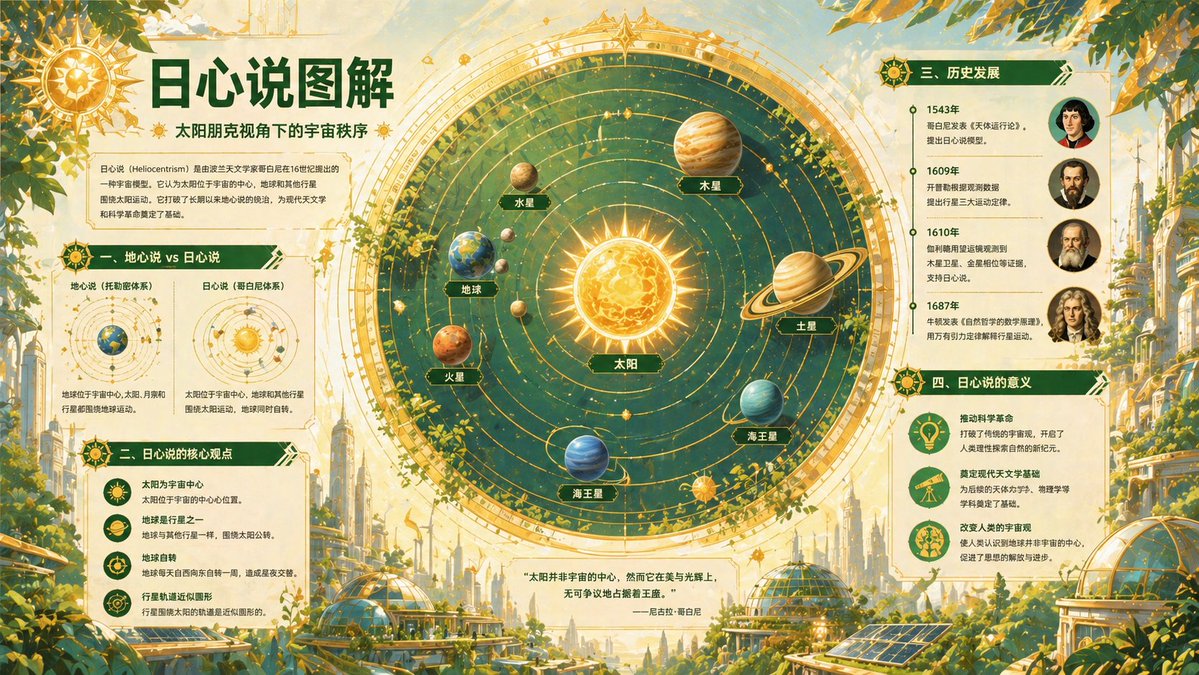
Инфографический постер по гелиоцентрической теории
Подробный китайский образовательный инфографический плакат, объясняющий гелиоцентрическую систему, идеально подходит для научного образования, наглядного представления истории астрономии или презентаций.
Это пример использования шаблона GPT Image 2 для Графика и плакаты . Используйте приведенный ниже шаблон, готовый к копированию, чтобы создать аналогичные визуальные элементы, и перед повторным использованием проверьте указание авторства Awesome GPT Image 2 Prompts и права на коммерческое использование.
Free 1K preview
Generate one preview image instantly, no sign-up required.
Промпт
Подсказка для копирования
{
  "type": "educational infographic poster",
  "topic": "{argument name=\"topic title\" default=\"Illustration of Heliocentrism\"}",
  "subtitle": "{argument name=\"subtitle text\" default=\"The Order of the Universe from a Bright Sun's Perspective\"}",
  "language": "Chinese",
  "style": "luxurious fantasy educational poster, ornate scientific diagram, art nouveau inspired, celestial atlas aesthetic, luminous gold and emerald palette, richly detailed, polished digital illustration",
  "composition": {
    "format": "wide landscape poster",
    "background": "utopian futuristic city with elegant towers, domes, terraces, vines, trees, and solar panels, bathed in warm sunlight",
    "border_elements": "leafy branches framing the top corners, decorative golden flourishes, radiant emblem in the upper left",
    "centerpiece": "a large circular heliocentric solar system diagram with concentric orbital rings, glowing sun at the center, planets arranged around it, intricate gold geometric markings and filigree"
  },
  "layout": {
    "sections": [
      {
        "title": "I. Geocentrism vs. Heliocentrism",
        "position": "left middle",
        "count": 2,
        "labels": [
          "Geocentrism (Ptolemaic system)",
          "Heliocentrism (Copernican system)"
        ]
      },
      {
        "title": "II. Core viewpoints of Heliocentrism",
        "position": "left lower",
        "count": 4,
        "labels": [
          "The Sun is the center of the universe",
          "The Earth is one of the planets",
          "Earth's rotation",
          "Planetary orbits are approximately circular"
        ]
      },
      {
        "title": "III. Historical Development",
        "position": "right upper",
        "count": 4,
        "labels": [
          "1543",
          "1609",
          "1610",
          "1687"
        ]
      },
      {
        "title": "Four, the significance of the heliocentric theory",
        "position": "right lower",
        "count": 3,
        "labels": [
          "Promoting the Scientific Revolution",
          "Laying the foundation for modern astronomy",
          "Changed humanity's view of the universe"
        ]
      }
    ],
    "count_total_sections": 4
  },
  "text_blocks": {
    "intro_paragraph": "{argument name=\"intro text\" default=\"Heliocentrism, proposed by Polish astronomer Nicolaus Copernicus in the 16th century, is a cosmological model that places the Sun at the center of the universe, with the Earth and other planets revolving around it. It broke the long-standing dominance of geocentrism and laid the foundation for modern astronomy and the scientific revolution.\"}",
    "quote": "{argument name=\"quote\" default=\"The sun is not the center of the universe, yet it undeniably holds the throne in our brilliance and light. — Nicolaus Copernicus\"}"
  },
  "central_diagram": {
    "title": "heliocentric system",
    "center_label": "Sun",
    "planet_count": 8,
    "planet_labels": [
      "Mercury",
      "Venus",
      "Earth",
      "Mars",
      "Jupiter",
      "Saturn",
      "Uranus",
      "Neptune"
    ],
    "details": "Earth shown with a small moon nearby, Saturn with prominent rings, each planet rendered as a dimensional painted sphere with a dark green and gold nameplate"
  },
  "visual_motifs": {
    "icon_count": 8,
    "icons": "small circular green-and-gold icons beside bullet lists and section headers, including sun, orbit, rotation, telescope, lightbulb, and worldview symbols",
    "ornamentation": "glowing particles, thin gold lines, elegant frames, botanical accents woven into the infographic",
    "mood": "inspiring, scholarly, radiant, mythic yet informative"
  },
  "rendering": {
    "quality": "highly detailed, crisp typography, premium poster design, harmonious hierarchy, readable infographic blocks",
    "lighting": "soft golden daylight with luminous highlights around the sun and metallic accents",
    "camera": "straight-on full poster view"
  }
}
Переменные подсказки
Редактируемые заполнители аргументов, найденные в подсказке, с их значениями по умолчанию.
Best for
- - Графика и плакаты visual exploration
- - Image generation and reference-image edits
- - Reusable briefs that keep source attribution visible
Change these parts
- - Subject, product, character, or scene
- - Aspect ratio, camera, lighting, and background
- - Brand, text, color, and output constraints
Recommended model and settings
- - Model: gpt-image-2
- - Input mode: Текст в изображение
- - Aspect ratio: source
- - Commercial status: review original source
How to use this prompt
- 1. Copy the prompt and preserve its structure for the first test.
- 2. Replace the subject, context, and publishing channel.
- 3. Change one camera, lighting, or style variable per iteration.
- 4. Inspect the output, source, text, and rights before reuse.
Limitations, source, and reuse cautions
- - Generated output is an editable draft, not factual, legal, or rights evidence.
- - Review the linked source, people, brands, logos, text, and third-party media before commercial use.
Больше случаев в этой категории
Приоритет отдается категориям, совместимости с режимами ввода, качеству и низкому уровню риска.


Примечания по повторному использованию и источникам
Используйте это подсказку безопасно после предварительного просмотра дела.
- 1.Скопируйте подсказку или откройте ее непосредственно в Dovoo с помощью кнопки генерации.
- 2.Настройте переменные, соотношение сторон и эталонные изображения в соответствии с вашими потребностями.
- 3.Перед публикацией или платным использованием проверьте права на источник, требования к указанию авторства, а также риски, связанные с использованием товарного знака или изображения.