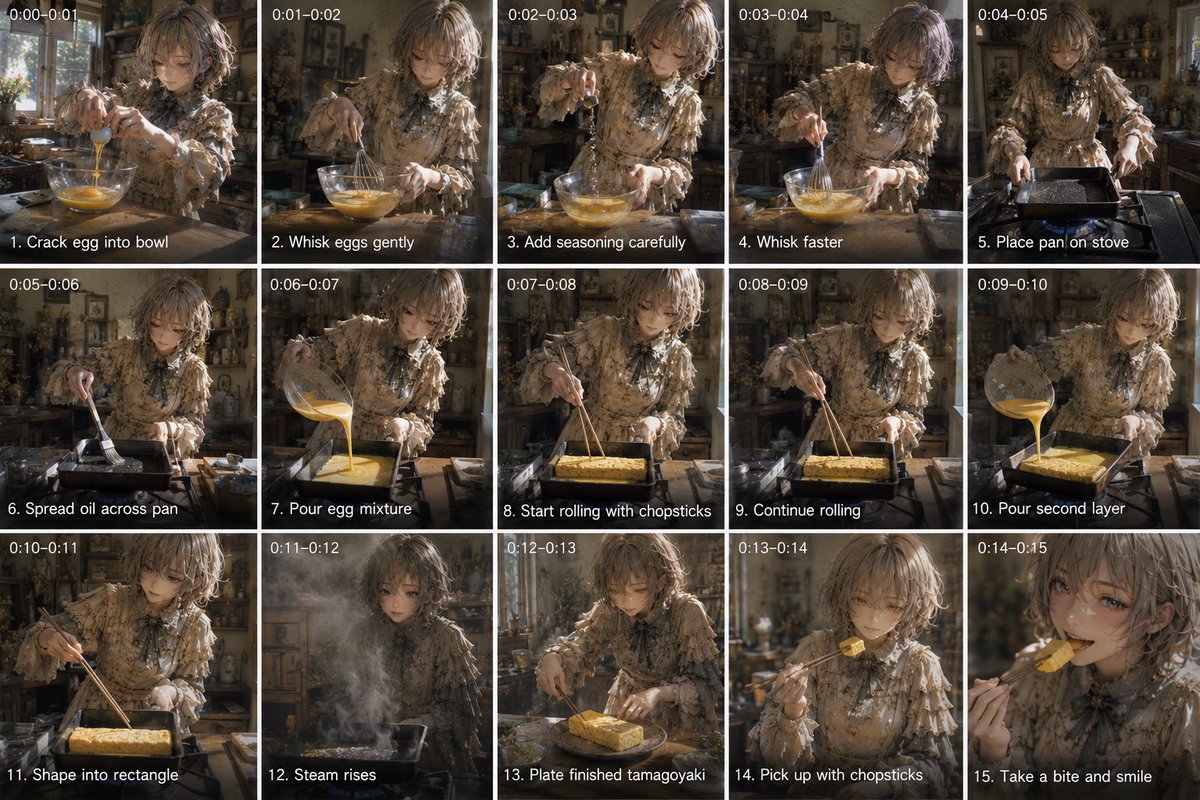
Storyboard gotowania Tamagoyaki
Ustrukturyzowany przewodnik po tworzeniu 15-panelowej scenopisu filmowego przedstawiającego młodą kobietę przygotowującą japońskie tamagoyaki w rustykalnej kuchni.
To jest przykładowy przykład GPT Image 2 dla Ilustracja i sztuka . Skorzystaj z poniższego przykładu gotowego do skopiowania, aby wygenerować podobne materiały wizualne i sprawdź atrybucję Awesome GPT Image 2 Prompts oraz prawa do użytku komercyjnego przed ponownym wykorzystaniem.
Potrzebujesz pełnego zestawu podpowiedzi? Użyj Ilustracja i sztuka aby uzyskać więcej powiązanych przykładów, odwiedź centrum tematyczne lub otwórz GPT Image 2 szybki katalog aby zobaczyć pełny przykładowy indeks, struktury wielokrotnego użytku i informacje o źródle.
Free 1K preview
Generate one preview image instantly, no sign-up required.
3382/4000
Opis
Monit o przygotowanie do kopiowania
Goal: Create a 15-panel cinematic cooking storyboard showing a young woman making tamagoyaki in a rustic kitchen, with each panel labeled by timestamp and step caption.

Canvas: Wide 16:9 contact-sheet layout, exactly 5 columns by 3 rows, thin white dividers between panels. Each panel has small white timestamp text at the top-left and a white step caption with a black shadow at the bottom-left.

Subject details: A delicate anime-inspired young woman with {argument name="hair color" default="soft ash-blonde wavy bob hair"}, wearing a {argument name="outfit" default="frilly vintage beige floral blouse with lace ruffles and a dark ribbon bow at the collar"}. She cooks at a wooden counter in an old cozy kitchen filled with shelves, jars, utensils, plants, warm sunlight, and atmospheric dust. Show every face clearly with natural, detailed facial features, while hands, food, cookware, and clothing remain detailed.

Visual style: Photorealistic cinematic anime realism, warm golden-brown color grade, shallow depth of field, moody natural window light, textured rustic kitchen background, realistic steam, oil shine, egg texture, and handheld film-still feeling.

Panel sequence: Include exactly 15 discrete panels with these visible labels and actions:
1. timestamp “0:00-0:01”, caption “1. Crack egg into bowl”, she cracks an egg into a glass bowl on the counter.
2. timestamp “0:01-0:02”, caption “2. Whisk eggs gently”, she gently whisks yellow eggs in the glass bowl.
3. timestamp “0:02-0:03”, caption “3. Add seasoning carefully”, she sprinkles seasoning into the bowl while holding the whisk.
4. timestamp “0:03-0:04”, caption “4. Whisk faster”, she vigorously whisks the egg mixture.
5. timestamp “0:04-0:05”, caption “5. Place pan on stove”, she sets a rectangular tamagoyaki pan on a stovetop.
6. timestamp “0:05-0:06”, caption “6. Spread oil across pan”, she brushes oil across the rectangular pan.
7. timestamp “0:06-0:07”, caption “7. Pour egg mixture”, she pours egg mixture from the glass bowl into the pan.
8. timestamp “0:07-0:08”, caption “8. Start rolling with chopsticks”, she begins rolling the egg sheet with chopsticks.
9. timestamp “0:08-0:09”, caption “9. Continue rolling”, she continues shaping the rolled omelette with chopsticks.
10. timestamp “0:09-0:10”, caption “10. Pour second layer”, she pours another layer of egg mixture into the pan around the roll.
11. timestamp “0:10-0:11”, caption “11. Shape into rectangle”, she shapes the tamagoyaki into a neat rectangle with chopsticks.
12. timestamp “0:11-0:12”, caption “12. Steam rises”, the pan releases a dramatic cloud of steam in front of her.
13. timestamp “0:12-0:13”, caption “13. Plate finished tamagoyaki”, the finished rectangular golden tamagoyaki sits on a plate on the counter.
14. timestamp “0:13-0:14”, caption “14. Pick up with chopsticks”, she lifts a bite-sized piece with chopsticks.
15. timestamp “0:14-0:15”, caption “15. Take a bite and smile”, close-up of her bringing the tamagoyaki to her mouth with chopsticks, face still obscured.

Constraints: Preserve the exact 15-panel count, exact timestamps, and exact English captions. Do not add extra panels, logos, watermarks, or unrelated text. The food should be {argument name="dish" default="golden Japanese tamagoyaki"}, and the kitchen mood should feel {argument name="mood" default="warm, nostalgic, and cinematic"}.
Zmienne monitujące
Edytowalne symbole zastępcze argumentów znalezione w monicie, wraz z ich wartościami domyślnymi.
Zmienny
hair color
Domyślny
soft ash-blonde wavy bob hair
Zmienny
outfit
Domyślny
frilly vintage beige floral blouse with lace ruffles and a dark ribbon bow at the collar
Zmienny
dish
Domyślny
golden Japanese tamagoyaki
Zmienny
mood
Domyślny
warm, nostalgic, and cinematic
Best for
- - Ilustracja i sztuka visual exploration
- - Image generation and reference-image edits
- - Reusable briefs that keep source attribution visible
Change these parts
- - Subject, product, character, or scene
- - Aspect ratio, camera, lighting, and background
- - Brand, text, color, and output constraints
Recommended model and settings
- - Model: gpt-image-2
- - Input mode: Tekst na obraz
- - Aspect ratio: source
- - Commercial status: review original source
How to use this prompt
- 1. Copy the prompt and preserve its structure for the first test.
- 2. Replace the subject, context, and publishing channel.
- 3. Change one camera, lighting, or style variable per iteration.
- 4. Inspect the output, source, text, and rights before reuse.
Limitations, source, and reuse cautions
- - Generated output is an editable draft, not factual, legal, or rights evidence.
- - Review the linked source, people, brands, logos, text, and third-party media before commercial use.
Zaimportowano z Awesome GPT Image 2 Prompts . Wymagane jest podanie źródła. Status do użytku komercyjnego to allowed ; przed płatnym użyciem sprawdź prawa autorskie do źródła.
Więcej przypadków w tej kategorii
Priorytety według kategorii, zgodności trybu wprowadzania, jakości i niższego ryzyka.
Ponowne wykorzystanie i źródło notatek
Użyj tego monitu bezpiecznie po zapoznaniu się ze sprawą.
- 1.Skopiuj monit lub otwórz go bezpośrednio w Dovoo za pomocą przycisku generowania.
- 2.Dostosuj zmienne, proporcje obrazu i obrazy referencyjne do własnego przypadku użycia.
- 3.Przed publikacją lub płatnym wykorzystaniem należy sprawdzić prawa autorskie do źródła, wymogi dotyczące atrybucji oraz ryzyko związane z marką lub podobizną.