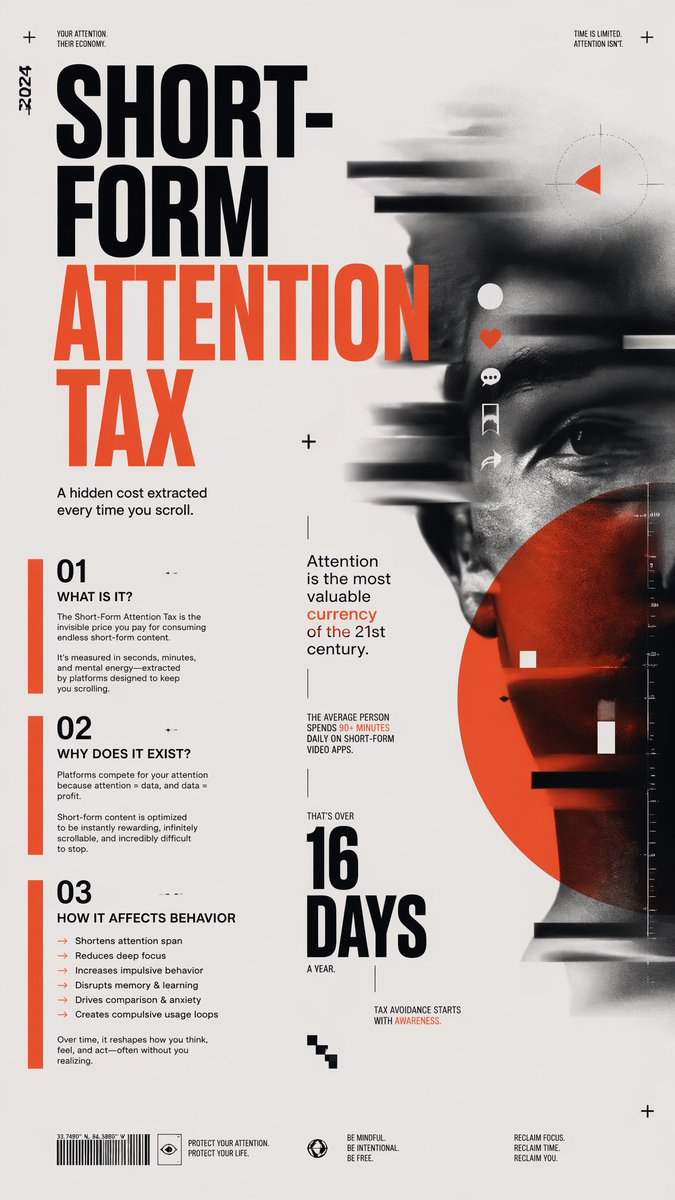
Krótki plakat dotyczący podatku od uwagi
Plakat w formie infografiki o wysokim kontraście, poruszający temat ukrytych kosztów poznawczych mediów krótkometrażowych, odpowiedni do kampanii uświadamiających, komentarzy społecznych lub projektów w stylu magazynu.
To jest przykładowy przykład GPT Image 2 dla Grafika i plakat . Skorzystaj z poniższego przykładu gotowego do skopiowania, aby wygenerować podobne materiały wizualne i sprawdź atrybucję Awesome GPT Image 2 Prompts oraz prawa do użytku komercyjnego przed ponownym wykorzystaniem.
Free 1K preview
Generate one preview image instantly, no sign-up required.
Opis
Monit o przygotowanie do kopiowania
A bold editorial poster in a brutalist Swiss-modern infographic style on a light warm-gray background, portrait orientation, with a split composition: oversized typography dominating the left half and a blurred monochrome human face dominating the right half. The main headline is stacked in huge condensed sans-serif uppercase text reading {argument name="headline text" default="SHORT-FORM ATTENTION TAX"}, with “SHORT-FORM” in black and “ATTENTION TAX” in vivid red-orange. Along the far left margin place a small vertical year mark reading “-2024”. At the top left add tiny uppercase text “YOUR ATTENTION. THEIR ECONOMY.” and at the top right add tiny uppercase text “TIME IS LIMITED. ATTENTION ISN’T.” with small plus-sign registration marks near the corners. Beneath the headline on the left, add the subheading “A hidden cost extracted every time you scroll.”

Create 3 numbered information blocks stacked down the lower left side, each marked by a vertical red-orange bar and large black numerals: section 01 titled “WHAT IS IT?”, section 02 titled “WHY DOES IT EXIST?”, and section 03 titled “HOW IT AFFECTS BEHAVIOR”. Under section 01, include body text explaining that the Short-Form Attention Tax is the invisible price paid for consuming endless short-form content and that it is measured in seconds, minutes, and mental energy extracted by platforms designed to keep you scrolling. Under section 02, include body text explaining that platforms compete for attention because attention, data, and profit are linked, and that short-form content is optimized to be instantly rewarding, infinitely scrollable, and hard to stop. Under section 03, include exactly 6 bullet points in red-orange dash style: “Shortens attention span”, “Reduces deep focus”, “Increases impulsive behavior”, “Disrupts memory & learning”, “Drives comparison & anxiety”, and “Creates compulsive usage loops”, followed by a short concluding sentence about reshaping how you think, feel, and act.

In the center-left and lower-middle areas, add supporting editorial typography in mixed sizes: “Attention is the most valuable currency of the 21st century.” with the word “currency” in red-orange; a small stat block saying “THE AVERAGE PERSON SPENDS 90+ MINUTES DAILY ON SHORT-FORM VIDEO APPS.” with “90+ MINUTES” in red-orange; a giant stacked numeric statement reading “16 DAYS” in black with the surrounding text “THAT’S OVER” above and “A YEAR.” below; and a small closing line “TAX AVOIDANCE STARTS WITH AWARENESS.”

On the right half, show a close-up portrait of a human face in black and white, partially cropped, looking forward, with a serious neutral expression. Apply heavy horizontal motion blur, digital smear, scanline-like streaks, and glitch bars crossing the face, especially across the forehead, nose, and mouth. Overlay exactly 5 vertical social-media style interface icons near the center-right of the face: a white circle/profile dot, a red-orange heart, a white speech bubble, a white bookmark ribbon, and a white share arrow. Add a large translucent red-orange circle covering the lower-right part of the face. Include subtle HUD-like graphic elements: a faint circular reticle with a small red-orange triangular wedge near the upper right, a thin vertical measurement scale near the far right edge, a few white square markers, small black and white horizontal bars, and scattered tiny plus signs for layout texture.

At the bottom, place a barcode on the left with tiny coordinate-like text above it, then 3 footer callouts spaced across the width: “PROTECT YOUR ATTENTION. PROTECT YOUR LIFE.”, “BE MINDFUL. BE INTENTIONAL. BE FREE.”, and “RECLAIM FOCUS. RECLAIM TIME. RECLAIM YOU.” Use a restrained palette of black, off-white, and red-orange only. The overall look should feel like a high-end social critique poster, mixing typographic activism, data editorial design, and dystopian tech-noise portraiture, with crisp layout, strong negative space, and print-poster realism.
Zmienne monitujące
Edytowalne symbole zastępcze argumentów znalezione w monicie, wraz z ich wartościami domyślnymi.
Best for
- - Grafika i plakat visual exploration
- - Image generation and reference-image edits
- - Reusable briefs that keep source attribution visible
Change these parts
- - Subject, product, character, or scene
- - Aspect ratio, camera, lighting, and background
- - Brand, text, color, and output constraints
Recommended model and settings
- - Model: gpt-image-2
- - Input mode: Tekst na obraz
- - Aspect ratio: source
- - Commercial status: review original source
How to use this prompt
- 1. Copy the prompt and preserve its structure for the first test.
- 2. Replace the subject, context, and publishing channel.
- 3. Change one camera, lighting, or style variable per iteration.
- 4. Inspect the output, source, text, and rights before reuse.
Limitations, source, and reuse cautions
- - Generated output is an editable draft, not factual, legal, or rights evidence.
- - Review the linked source, people, brands, logos, text, and third-party media before commercial use.
Więcej przypadków w tej kategorii
Priorytety według kategorii, zgodności trybu wprowadzania, jakości i niższego ryzyka.


Ponowne wykorzystanie i źródło notatek
Użyj tego monitu bezpiecznie po zapoznaniu się ze sprawą.
- 1.Skopiuj monit lub otwórz go bezpośrednio w Dovoo za pomocą przycisku generowania.
- 2.Dostosuj zmienne, proporcje obrazu i obrazy referencyjne do własnego przypadku użycia.
- 3.Przed publikacją lub płatnym wykorzystaniem należy sprawdzić prawa autorskie do źródła, wymogi dotyczące atrybucji oraz ryzyko związane z marką lub podobizną.