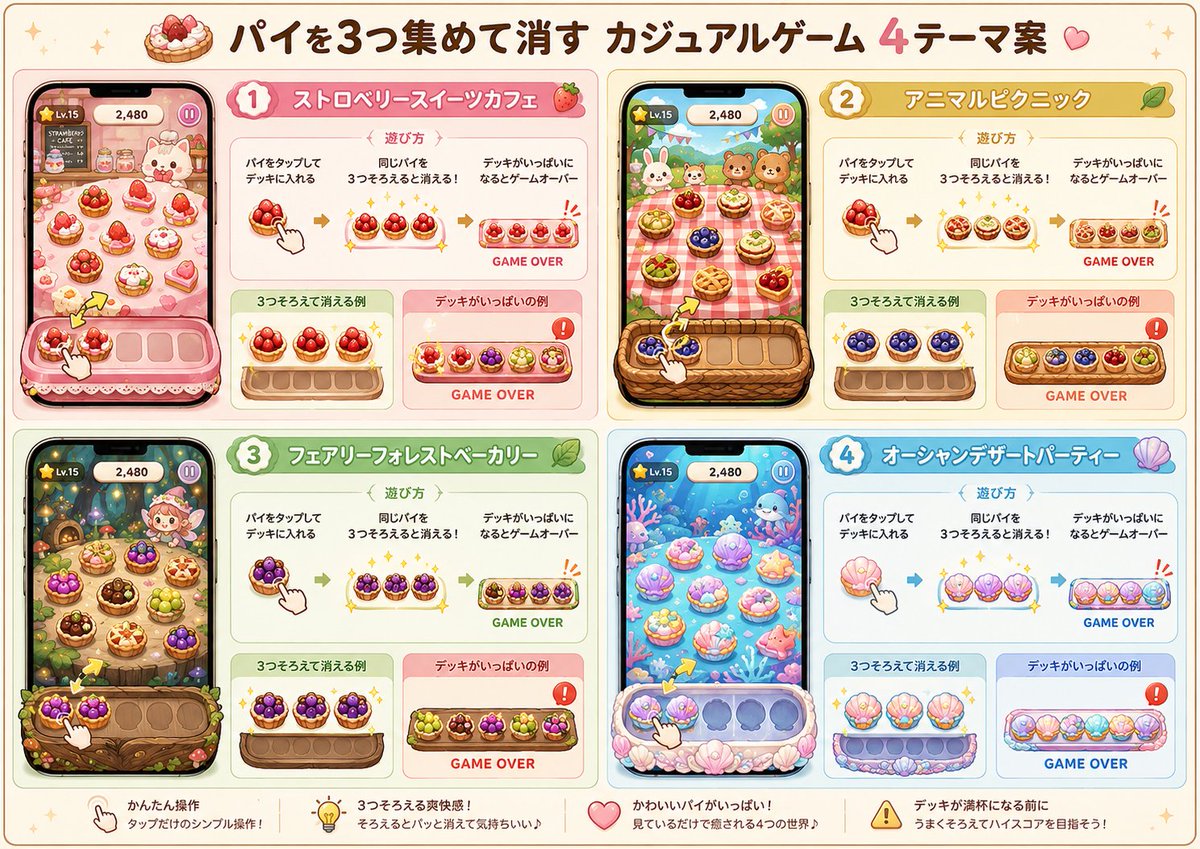
Four Theme Pie Puzzle Game Sheet
Generates a cute Japanese proposal-style concept sheet for a casual mobile pie-matching game with four themed UI mockups.
To jest przykładowy przykład GPT Image 2 dla Anime i gry . Skorzystaj z poniższego przykładu gotowego do skopiowania, aby wygenerować podobne materiały wizualne i sprawdź atrybucję Awesome GPT Image 2 Prompts oraz prawa do użytku komercyjnego przed ponownym wykorzystaniem.
Potrzebujesz pełnego zestawu podpowiedzi? Użyj Anime i gry aby uzyskać więcej powiązanych przykładów, odwiedź centrum tematyczne lub otwórz GPT Image 2 szybki katalog aby zobaczyć pełny przykładowy indeks, struktury wielokrotnego użytku i informacje o źródle.
Free 1K preview
Generate one preview image instantly, no sign-up required.
3535/4000
Opis
Monit o przygotowanie do kopiowania
Goal: Create a polished Japanese proposal-style idea sheet for a casual mobile puzzle game where players collect 3 matching pies to clear them, titled {argument name="headline text" default="パイを3つ集めて消す カジュアルゲーム 4テーマ案"}. The sheet should look like a cheerful game design concept board, with cute UI mockups and explanatory diagrams.

Canvas: Wide landscape 16:9 presentation sheet, warm cream background, thin rounded border, tiny sparkles and dessert decorations. Use a soft pastel kawaii illustration style with clean vector-like edges, subtle shadows, glossy game UI highlights, and high readability.

Layout: Divide the canvas into exactly 4 large rounded theme panels arranged in a 2×2 grid. Each panel has a numbered badge, a Japanese theme title banner, a smartphone gameplay mockup on the left, and instruction/example cards on the right. Add a bottom strip with exactly 4 short feature notes and icons.

Main title: At the top center, show a small pie icon followed by the large headline. Emphasize the number “4” in pink and add a small heart at the end.

Panel count and themes: Use exactly 4 theme concepts.
1. Pink dessert cafe theme titled {argument name="theme 1 title" default="ストロベリースイーツカフェ"}, with strawberry shortcakes, berry tarts, whipped cream, pink trays, and a cute bunny cafe mascot.
2. Yellow picnic theme titled {argument name="theme 2 title" default="アニマルピクニック"}, with a red-checkered picnic cloth, wicker basket tray, small animal friends, fruit pies, and sunny outdoor greenery.
3. Green fantasy woodland theme titled {argument name="theme 3 title" default="フェアリーフォレストベーカリー"}, with a magical forest bakery, mushrooms, lanterns, fairy-like character, berry pies, wooden tray, vines, leaves, and warm glowing lights.
4. Blue ocean dessert theme titled {argument name="theme 4 title" default="オーシャンデザートパーティー"}, with underwater pastel scenery, coral, shells, sea creatures, shell-shaped desserts, and a shell-decorated tray.

Smartphone mockups: Each of the 4 panels must include exactly 1 vertical phone screen on the left, for a total of 4 phones. Every phone shows a cute match-3-like pie collection game screen with a top HUD showing “Lv.15”, score “2,480”, and a pause button. In each game board, show many individual pies on a themed background, plus a bottom deck/tray with empty slots and a white hand cursor tapping or dragging a pie. Include a small yellow arrow indicating movement toward the tray.

Instruction cards: In each of the 4 panels, include a top explanation card headed “遊び方” with exactly 3 illustrated steps from left to right: tap a pie and put it into the deck, collect 3 of the same pie to clear them, and if the deck becomes full it is GAME OVER. Below it, include exactly 2 smaller example cards: one green/positive card labeled “3つそろえて消える例” showing 3 matching pies clearing with sparkles, and one red/warning card labeled “デッキがいっぱいの例” showing a full tray and the text “GAME OVER” with an exclamation warning icon.

Bottom strip: Add exactly 4 feature notes separated across the bottom, each with one icon: a hand icon with “かんたん操作 / タップだけのシンプル操作!”, a lightbulb icon with “3つそろえる爽快感! / そろえるとパッと消えて気持ちいい♪”, a heart icon with “かわいいパイがいっぱい! / 見ているだけで癒される4つの世界♪”, and a warning icon with “デッキが満杯になる前に / うまくそろえてハイスコアを目指そう!”.

Visual constraints: Keep all Japanese text crisp and legible, use rounded friendly fonts, maintain a consistent proposal-board layout, avoid photorealism, avoid dark or gritty styling, avoid extra panels, avoid extra phones, and do not add watermarks or logos.
Zmienne monitujące
Edytowalne symbole zastępcze argumentów znalezione w monicie, wraz z ich wartościami domyślnymi.
Zmienny
headline text
Domyślny
パイを3つ集めて消す カジュアルゲーム 4テーマ案
Zmienny
theme 1 title
Domyślny
ストロベリースイーツカフェ
Zmienny
theme 2 title
Domyślny
アニマルピクニック
Zmienny
theme 3 title
Domyślny
フェアリーフォレストベーカリー
Zmienny
theme 4 title
Domyślny
オーシャンデザートパーティー
Best for
- - Anime i gry visual exploration
- - Image generation and reference-image edits
- - Reusable briefs that keep source attribution visible
Change these parts
- - Subject, product, character, or scene
- - Aspect ratio, camera, lighting, and background
- - Brand, text, color, and output constraints
Recommended model and settings
- - Model: gpt-image-2
- - Input mode: Tekst na obraz
- - Aspect ratio: source
- - Commercial status: review original source
How to use this prompt
- 1. Copy the prompt and preserve its structure for the first test.
- 2. Replace the subject, context, and publishing channel.
- 3. Change one camera, lighting, or style variable per iteration.
- 4. Inspect the output, source, text, and rights before reuse.
Limitations, source, and reuse cautions
- - Generated output is an editable draft, not factual, legal, or rights evidence.
- - Review the linked source, people, brands, logos, text, and third-party media before commercial use.
Zaimportowano z Awesome GPT Image 2 Prompts . Wymagane jest podanie źródła. Status do użytku komercyjnego to allowed ; przed płatnym użyciem sprawdź prawa autorskie do źródła.
Więcej przypadków w tej kategorii
Priorytety według kategorii, zgodności trybu wprowadzania, jakości i niższego ryzyka.

Ponowne wykorzystanie i źródło notatek
Użyj tego monitu bezpiecznie po zapoznaniu się ze sprawą.
- 1.Skopiuj monit lub otwórz go bezpośrednio w Dovoo za pomocą przycisku generowania.
- 2.Dostosuj zmienne, proporcje obrazu i obrazy referencyjne do własnego przypadku użycia.
- 3.Przed publikacją lub płatnym wykorzystaniem należy sprawdzić prawa autorskie do źródła, wymogi dotyczące atrybucji oraz ryzyko związane z marką lub podobizną.