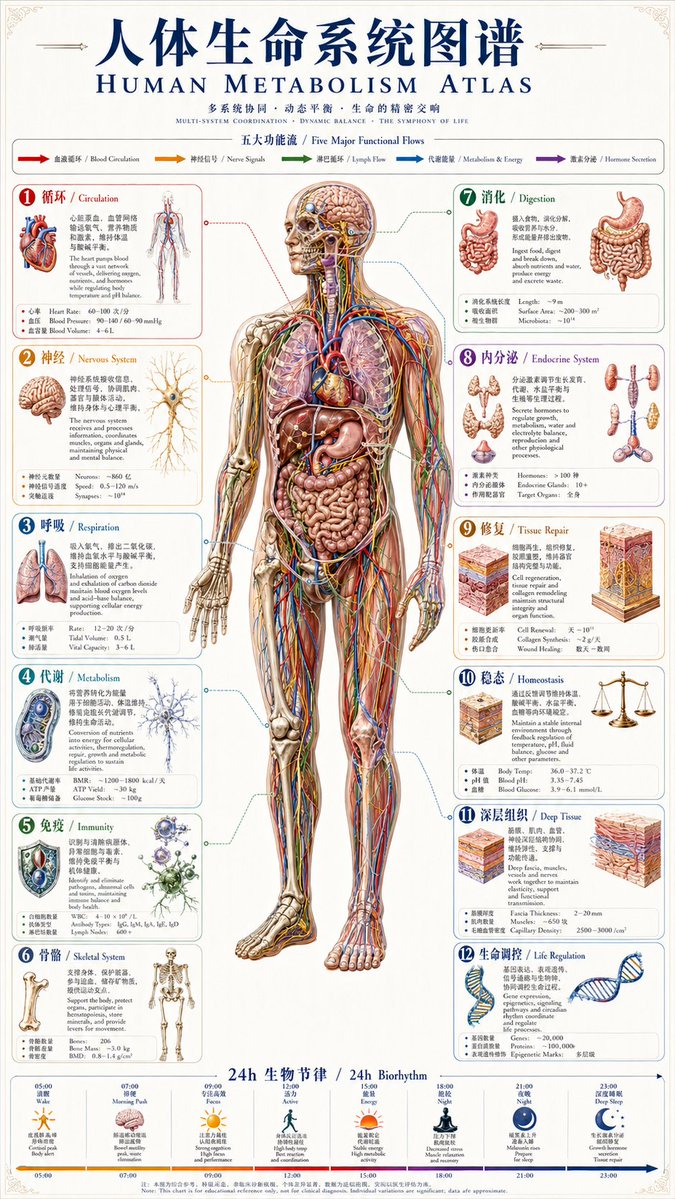
Plakat Atlasu Metabolizmu Człowieka
Gęsty, dwujęzyczny plakat-infografika poświęcony anatomii, przedstawiający centralną część ciała człowieka, 12 opisanych paneli przedstawiających układy życiowe oraz 24-godzinną oś czasu biorytmu, idealny do materiałów edukacyjnych lub medycznych.
To jest przykładowy przykład GPT Image 2 dla Grafika i plakat . Skorzystaj z poniższego przykładu gotowego do skopiowania, aby wygenerować podobne materiały wizualne i sprawdź atrybucję Awesome GPT Image 2 Prompts oraz prawa do użytku komercyjnego przed ponownym wykorzystaniem.
Free 1K preview
Generate one preview image instantly, no sign-up required.
Free text preview doesn’t preserve reference-image consistency.
Opis
Monit o przygotowanie do kopiowania
{
  "type": "bilingual medical infographic poster",
  "topic": "{argument name=\"headline text\" default=\"Human Life System Atlas\"}",
  "subtitle": "HUMAN METABOLISM ATLAS",
  "style": "elegant educational atlas, clean cream background, thin ornamental border, highly detailed scientific illustration mixed with infographic design, Chinese-first bilingual labels with smaller English translations, polished print-poster composition",
  "palette": {
    "background": "warm ivory",
    "accent colors": [
      "deep navy",
      "red",
      "orange",
      "green",
      "blue",
      "purple"
    ],
    "linework": "fine medical-illustration lines"
  },
  "layout": {
    "orientation": "vertical poster",
    "centerpiece": "front-facing full-body anatomical human figure with skin removed, showing muscles, organs, arteries, veins, lymphatic pathways, and nerves, standing upright with arms relaxed slightly away from the body",
    "top_header": {
      "count": 4,
      "items": [
        "main Chinese title",
        "large English subtitle",
        "small Chinese tagline",
        "functional flow legend"
      ]
    },
    "side_sections": {
      "left_column_count": 6,
      "right_column_count": 6,
      "total_count": 12
    },
    "bottom_timeline": {
      "title": "24-Hour Biological Rhythm / 24h Biorhythm",
      "count": 7,
      "labels": [
        "05:00 Wake",
        "07:00 Morning Peak",
        "09:00 Focus",
        "12:00 Active",
        "15:00 Energy",
        "18:00 Relax",
        "21:00 Night"
      ]
    }
  },
  "legend": {
    "title": "Five Major Functional Flows / Five Major Functional Flows",
    "count": 5,
    "items": [
      {
        "label": "Blood Circulation / Blood Circulation",
        "color": "red"
      },
      {
        "label": "Nerve Signal / Nerve Signal",
        "color": "orange"
      },
      {
        "label": "Lymphatic Circulation / Lymph Flow",
        "color": "green"
      },
      {
        "label": "Metabolism & Energy",
        "color": "blue"
      },
      {
        "label": "Hormone Secretion",
        "color": "purple"
      }
    ]
  },
  "sections": [
    {
      "number": 1,
      "title": "Circulation",
      "position": "upper left",
      "count": 3,
      "visuals": [
        "anatomical heart",
        "vascular diagram",
        "small stat callout list"
      ],
      "theme_color": "red"
    },
    {
      "number": 2,
      "title": "Nervous System",
      "position": "left upper-middle",
      "count": 3,
      "visuals": [
        "brain illustration",
        "neuron cell drawing",
        "small stat callout list"
      ],
      "theme_color": "orange"
    },
    {
      "number": 3,
      "title": "Respiration / Respiration",
      "position": "left middle",
      "count": 2,
      "visuals": [
        "lungs illustration",
        "small stat callout list"
      ],
      "theme_color": "blue"
    },
    {
      "number": 4,
      "title": "Metabolism / Metabolism",
      "position": "left lower-middle",
      "count": 3,
      "visuals": [
        "cell cross-section",
        "metabolic pathway style neuron-like graphic",
        "small stat callout list"
      ],
      "theme_color": "teal"
    },
    {
      "number": 5,
      "title": "Immunity / Immunity",
      "position": "left bottom",
      "count": 3,
      "visuals": [
        "shield icon",
        "microbe or immune particle cluster",
        "small stat callout list"
      ],
      "theme_color": "green"
    },
    {
      "number": 6,
      "title": "Skeletal System / Skeletal System",
      "position": "bottom left",
      "count": 3,
      "visuals": [
        "long bone illustration",
        "full skeleton figure",
        "small stat callout list"
      ],
      "theme_color": "olive"
    },
    {
      "number": 7,
      "title": "Digestion / Digestion",
      "position": "upper right",
      "count": 3,
      "visuals": [
        "intestine illustration",
        "stomach and digestive tract illustration",
        "small stat callout list"
      ],
      "theme_color": "green"
    },
    {
      "number": 8,
      "title": "Endocrine / Endocrine System",
      "position": "right upper-middle",
      "count": 3,
      "visuals": [
        "thyroid-like gland cluster",
        "multiple endocrine gland diagrams",
        "small stat callout list"
      ],
      "theme_color": "purple"
    },
    {
      "number": 9,
      "title": "Repair / Tissue Repair",
      "position": "right middle",
      "count": 3,
      "visuals": [
        "skin tissue block",
        "larger tissue cross-section block",
        "small stat callout list"
      ],
      "theme_color": "brown"
    },
    {
      "number": 10,
      "title": "Homeostasis / Homeostasis",
      "position": "right lower-middle",
      "count": 3,
      "visuals": [
        "tissue cube",
        "balance scale icon",
        "small stat callout list"
      ],
      "theme_color": "blue"
    },
    {
      "number": 11,
      "title": "Deep Tissue / Deep Tissue",
      "position": "right bottom",
      "count": 3,
      "visuals": [
        "layered tissue block",
        "muscle-fiber tissue cutaway",
        "small stat callout list"
      ],
      "theme_color": "navy"
    },
    {
      "number": 12,
      "title": "Life Regulation / Life Regulation",
      "position": "bottom right",
      "count": 3,
      "visuals": [
        "DNA double helix",
        "genetic information motif",
        "small stat callout list"
      ],
      "theme_color": "blue"
    }
  ],
  "text_density": "high, magazine-quality infographic text blocks in Chinese with concise English translations beneath headings and key terms",
  "connectors": "each side panel is linked to the corresponding body region with thin dotted colored guide lines",
  "rendering": "ultra-detailed anatomy, realistic organ textures, precise vessels and nerves, refined infographic typography, sharp print-ready composition",
  "quality": "high resolution, poster design, symmetrical and information-dense"
}
Zmienne monitujące
Edytowalne symbole zastępcze argumentów znalezione w monicie, wraz z ich wartościami domyślnymi.
Best for
- - Grafika i plakat visual exploration
- - Image generation and reference-image edits
- - Reusable briefs that keep source attribution visible
Change these parts
- - Subject, product, character, or scene
- - Aspect ratio, camera, lighting, and background
- - Brand, text, color, and output constraints
Recommended model and settings
- - Model: gpt-image-2
- - Input mode: Obraz na obraz
- - Aspect ratio: source
- - Commercial status: review original source
How to use this prompt
- 1. Copy the prompt and preserve its structure for the first test.
- 2. Replace the subject, context, and publishing channel.
- 3. Change one camera, lighting, or style variable per iteration.
- 4. Inspect the output, source, text, and rights before reuse.
Limitations, source, and reuse cautions
- - Generated output is an editable draft, not factual, legal, or rights evidence.
- - Review the linked source, people, brands, logos, text, and third-party media before commercial use.
Więcej przypadków w tej kategorii
Priorytety według kategorii, zgodności trybu wprowadzania, jakości i niższego ryzyka.





Ponowne wykorzystanie i źródło notatek
Użyj tego monitu bezpiecznie po zapoznaniu się ze sprawą.
- 1.Skopiuj monit lub otwórz go bezpośrednio w Dovoo za pomocą przycisku generowania.
- 2.Dostosuj zmienne, proporcje obrazu i obrazy referencyjne do własnego przypadku użycia.
- 3.Przed publikacją lub płatnym wykorzystaniem należy sprawdzić prawa autorskie do źródła, wymogi dotyczące atrybucji oraz ryzyko związane z marką lub podobizną.