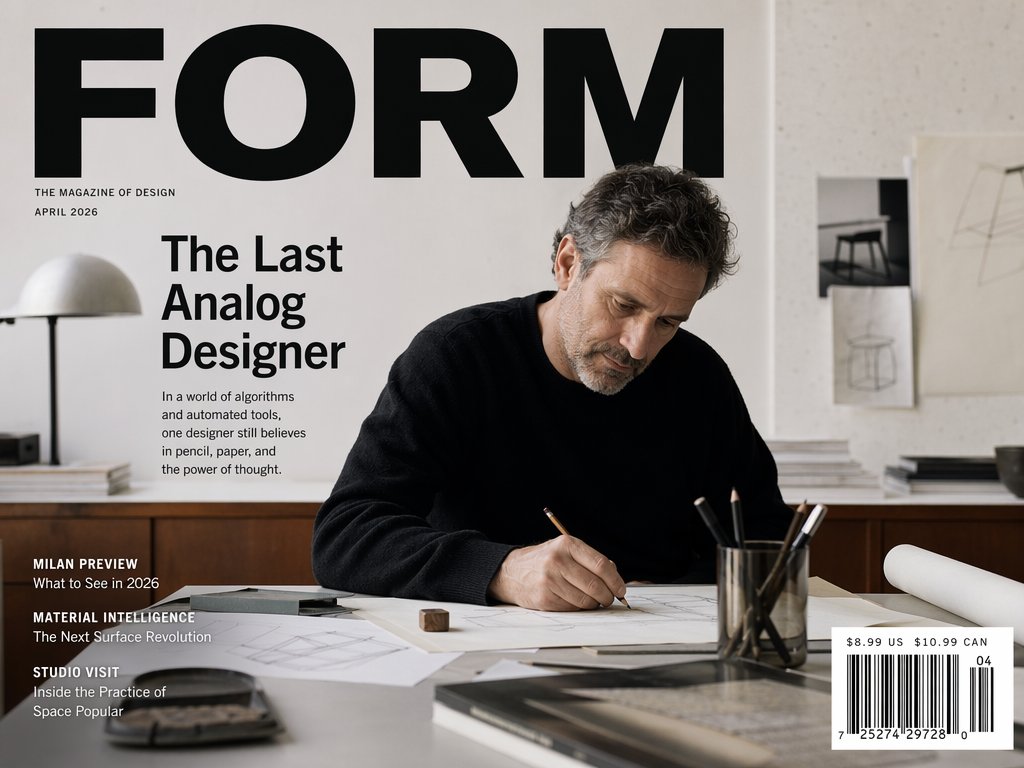
Okładka magazynu Fictional Design
To polecenie pozwala na wygenerowanie realistycznej okładki magazynu, na której anonimowy projektant pracuje w minimalistycznym studiu. Okładka ta idealnie nadaje się do tworzenia koncepcji artystycznych, projektów okładek i wizualnych opowieści o tematyce projektowej.
To jest przykładowy przykład GPT Image 2 dla Grafika i plakat . Skorzystaj z poniższego przykładu gotowego do skopiowania, aby wygenerować podobne materiały wizualne i sprawdź atrybucję Awesome GPT Image 2 Prompts oraz prawa do użytku komercyjnego przed ponownym wykorzystaniem.
Free 1K preview
Generate one preview image instantly, no sign-up required.
Opis
Monit o przygotowanie do kopiowania
A hyper-realistic modern magazine cover for a fictional design magazine titled {argument name="magazine title" default="FORM"}, shot like a premium editorial portrait in a minimalist architect’s studio. The cover uses a clean, restrained European design aesthetic with lots of white space, sharp typography, and warm natural indoor lighting. At the top, place an enormous bold black sans-serif masthead spanning nearly the full width. Beneath the left side of the masthead, add small uppercase text reading “THE MAGAZINE OF DESIGN” and “APRIL 2026”. The main cover line on the left reads {argument name="cover headline" default="The Last Analog Designer"} in large black sans-serif text stacked over multiple lines. Below it, add a smaller teaser paragraph: “In a world of algorithms and automated tools, one designer still believes in pencil, paper, and the power of thought.” In the lower left, include 3 secondary cover lines in small white sans-serif text over the darker desk area: “MILAN PREVIEW” with “What to See in 2026”, “MATERIAL INTELLIGENCE” with “The Next Surface Revolution”, and “STUDIO VISIT” with “Inside the Practice of Space Popular”. In the bottom right, add a realistic white barcode box with small price text above it reading “$8.99 US $10.99 CAN” and the issue number “04”. The scene shows 1 seated middle-aged male designer at a worktable, wearing a dark navy or black knit sweater, with salt-and-pepper curly hair, leaning forward and sketching on white paper with a pencil. Show every face clearly with natural, detailed facial features, creating an anonymous portrait. On the desk are exactly 8 visible object groups: scattered sketch papers with geometric chair drawings, 1 pencil cup holding several pencils, 1 rolled white blueprint on the right, 1 closed dark notebook on the left, 1 small brown eraser near the center, 1 blurred black object in the front-left foreground, 1 large flat book or material sample in the front-right foreground, and the active drawing sheet under his hand. Behind him is a warm wooden credenza with neat stacks of books, 1 white dome desk lamp on the far left, and a white wall displaying exactly 4 pinned design references: 1 small dark photo of a chair, 1 light sketch beneath it, and 2 larger minimal line drawings on the right. Use muted neutral tones, off-white walls, walnut wood, black clothing, and a calm contemplative mood. The composition should feel like a believable high-end magazine cover, straight-on and carefully art-directed, with editorial realism and no visible publisher logos other than the fictional masthead.Zmienne monitujące
Edytowalne symbole zastępcze argumentów znalezione w monicie, wraz z ich wartościami domyślnymi.
Best for
- - Grafika i plakat visual exploration
- - Image generation and reference-image edits
- - Reusable briefs that keep source attribution visible
Change these parts
- - Subject, product, character, or scene
- - Aspect ratio, camera, lighting, and background
- - Brand, text, color, and output constraints
Recommended model and settings
- - Model: gpt-image-2
- - Input mode: Tekst na obraz
- - Aspect ratio: source
- - Commercial status: review original source
How to use this prompt
- 1. Copy the prompt and preserve its structure for the first test.
- 2. Replace the subject, context, and publishing channel.
- 3. Change one camera, lighting, or style variable per iteration.
- 4. Inspect the output, source, text, and rights before reuse.
Limitations, source, and reuse cautions
- - Generated output is an editable draft, not factual, legal, or rights evidence.
- - Review the linked source, people, brands, logos, text, and third-party media before commercial use.
Więcej przypadków w tej kategorii
Priorytety według kategorii, zgodności trybu wprowadzania, jakości i niższego ryzyka.
Ponowne wykorzystanie i źródło notatek
Użyj tego monitu bezpiecznie po zapoznaniu się ze sprawą.
- 1.Skopiuj monit lub otwórz go bezpośrednio w Dovoo za pomocą przycisku generowania.
- 2.Dostosuj zmienne, proporcje obrazu i obrazy referencyjne do własnego przypadku użycia.
- 3.Przed publikacją lub płatnym wykorzystaniem należy sprawdzić prawa autorskie do źródła, wymogi dotyczące atrybucji oraz ryzyko związane z marką lub podobizną.