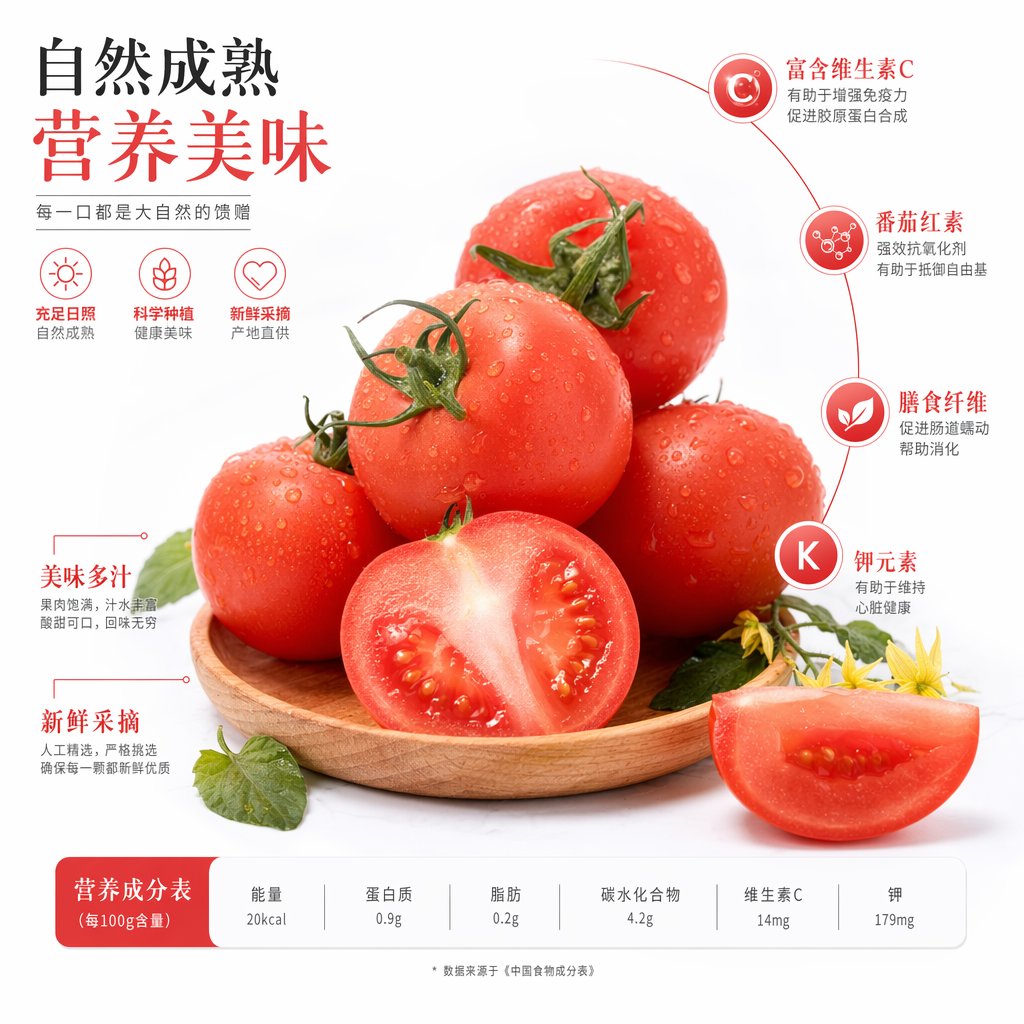
Chiński plakat o wartościach odżywczych pomidorów
Elegancka chińska reklama produktu przedstawiająca świeże pomidory z informacjami o wartościach odżywczych i tabelą wartości odżywczych na spodzie, idealna do reklamy artykułów spożywczych, opakowań lub materiałów wizualnych służących do marketingu żywności.
To jest przykładowy przykład GPT Image 2 dla Jedzenie i napoje . Skorzystaj z poniższego przykładu gotowego do skopiowania, aby wygenerować podobne materiały wizualne i sprawdź atrybucję Awesome GPT Image 2 Prompts oraz prawa do użytku komercyjnego przed ponownym wykorzystaniem.
Free 1K preview
Generate one preview image instantly, no sign-up required.
Opis
Monit o przygotowanie do kopiowania
A simple, high-end food advertisement poster with a light gray-white studio background, featuring {argument name="fruit name" default="tomatoes"} as the main subject. In the center of the image, display 7 tomatoes arranged on a shallow circular wooden plate: 5 ripe red tomatoes stacked in a pyramid shape, 1 tomato cut in half standing upright in the front center with glistening flesh and visible seeds, and another 1 tomato wedge placed in the lower right foreground. The tomatoes are fresh, vividly red, and covered with realistic water droplets, with most whole fruits having green stems. Add a few green leaves and two yellow tomato blossoms along the lower right edge to enhance freshness. Use soft commercial lighting, gentle shadows, sharp focus, and highly realistic textures to create a sophisticated supermarket poster style.

Design the layout as a Chinese-style nutrition and freshness infographic poster. In the upper left corner, place a prominent two-line Chinese title with a strong typographic hierarchy: the first line in black text is {argument name="headline line 1" default="Naturally ripened"}, and the second line in large warm red text is {argument name="headline line 2" default="Nutritious and delicious"}. Below it, add a smaller gray Chinese slogan: {argument name="slogan text" default="Every bite is a gift from nature"}. Below the slogan, arrange 3 simple red line icons horizontally, each with a short Chinese label and gray subtitle: 1) a sun icon, text “Ample Sunlight”, subtitle “Naturally Ripened”; 2) a sprout or leaf icon, text “Scientific Cultivation”, subtitle “Healthy and Delicious”; 3) a heart outline icon, text “Freshly Picked”, subtitle “Direct from Origin”.

On the right side, draw a thin red arc guide line circling the tomatoes, and stack 4 circular nutrition labels vertically. Each label is a red or red-orange gradient circle with a white symbol or letter inside, connected to the guide line. Use the following Chinese labels and descriptions: 1) the top label is “C”, title “Rich in Vitamin C”, description “Helps boost immunity and promote collagen synthesis”; 2) the second label is a molecule icon, title “Lycopene”, description “Powerful antioxidant helps defend against free radicals”; 3) the third label is a leaf icon, title “Dietary Fiber”, description “Promotes intestinal motility and aids digestion”; 4) the bottom label is “K”, title “Potassium”, description “Helps maintain heart health”.

Below the tomatoes on the left, add 2 red text feature labels with red guide lines: the upper title is “Delicious and Juicy”, accompanied by smaller gray text “Full flesh, rich juice, sweet and sour, with a lasting aftertaste”; the lower title is “Freshly Picked”, accompanied by smaller gray text “Manually selected, strictly chosen to ensure each one is fresh and high quality”.

At the bottom, place a white rounded rectangle nutrition facts bar with a light gray separator. Add a solid red rounded corner label block on the left with the Chinese title {argument name="table title" default="Nutrition Facts (per 100g)"}. On the right, display 6 columns of nutritional components, with gray titles above and dark numerical values below: “Energy” “20kcal”; “Protein” “0.9g”; “Fat” “0.2g”; “Carbohydrates” “4.2g”; “Vitamin C” “14mg”; “Potassium” “179mg”. Place a tiny gray footnote centered below the table: “* Data sourced from the ‘Chinese Food Composition Table’”. Overall style: elegant Chinese fresh food marketing poster, balanced whitespace, infographic design with red accents, and a perfect fusion of realistic product photography and simple vector UI elements.
Zmienne monitujące
Edytowalne symbole zastępcze argumentów znalezione w monicie, wraz z ich wartościami domyślnymi.
Best for
- - Jedzenie i napoje visual exploration
- - Image generation and reference-image edits
- - Reusable briefs that keep source attribution visible
Change these parts
- - Subject, product, character, or scene
- - Aspect ratio, camera, lighting, and background
- - Brand, text, color, and output constraints
Recommended model and settings
- - Model: gpt-image-2
- - Input mode: Tekst na obraz
- - Aspect ratio: source
- - Commercial status: review original source
How to use this prompt
- 1. Copy the prompt and preserve its structure for the first test.
- 2. Replace the subject, context, and publishing channel.
- 3. Change one camera, lighting, or style variable per iteration.
- 4. Inspect the output, source, text, and rights before reuse.
Limitations, source, and reuse cautions
- - Generated output is an editable draft, not factual, legal, or rights evidence.
- - Review the linked source, people, brands, logos, text, and third-party media before commercial use.
Więcej przypadków w tej kategorii
Priorytety według kategorii, zgodności trybu wprowadzania, jakości i niższego ryzyka.



Ponowne wykorzystanie i źródło notatek
Użyj tego monitu bezpiecznie po zapoznaniu się ze sprawą.
- 1.Skopiuj monit lub otwórz go bezpośrednio w Dovoo za pomocą przycisku generowania.
- 2.Dostosuj zmienne, proporcje obrazu i obrazy referencyjne do własnego przypadku użycia.
- 3.Przed publikacją lub płatnym wykorzystaniem należy sprawdzić prawa autorskie do źródła, wymogi dotyczące atrybucji oraz ryzyko związane z marką lub podobizną.