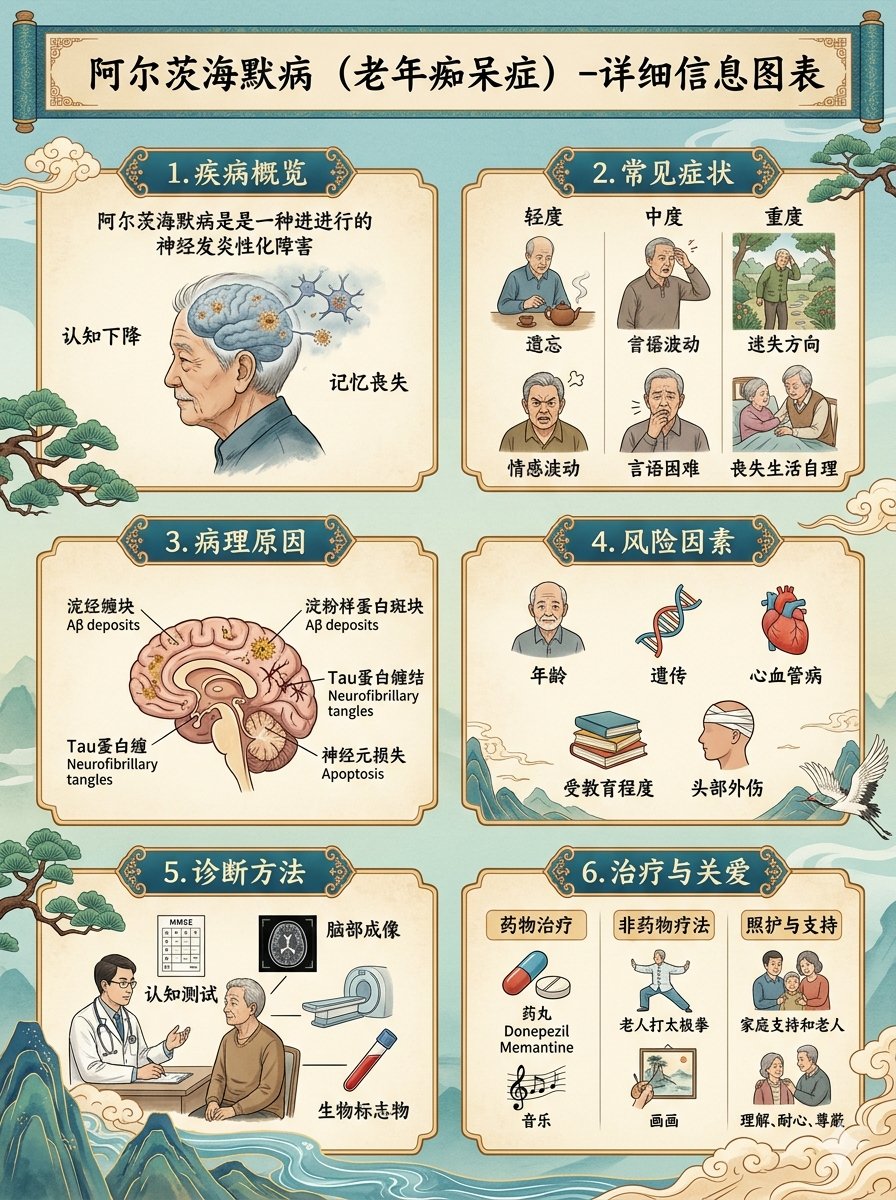
Chiński plakat infograficzny dotyczący choroby Alzheimera
Szczegółowy plakat w stylu chińskiej infografiki medycznej, przedstawiający chorobę Alzheimera, przeznaczony do edukacji zdrowotnej, kampanii uświadamiających i postów naukowych w mediach społecznościowych.
To jest przykładowy przykład GPT Image 2 dla Grafika i plakat . Skorzystaj z poniższego przykładu gotowego do skopiowania, aby wygenerować podobne materiały wizualne i sprawdź atrybucję Awesome GPT Image 2 Prompts oraz prawa do użytku komercyjnego przed ponownym wykorzystaniem.
Free 1K preview
Generate one preview image instantly, no sign-up required.
Opis
Monit o przygotowanie do kopiowania
{
  "type": "traditional Chinese medical infographic poster",
  "topic": "{argument name=\"topic\" default=\"Alzheimer's disease (dementia)\"}",
  "title": "{argument name=\"headline text\" default=\"Alzheimer's Disease (Dementia) - Detailed Infographic\"}",
  "language": "Chinese",
  "style": {
    "overall": "educational health infographic in vintage Chinese poster style",
    "rendering": "clean hand-painted illustration, soft watercolor textures, thin ink outlines, muted pastel colors",
    "palette": "teal, beige, cream, jade green, dusty blue, warm brown, light coral",
    "decorative frame": "ornate scroll-like border with gold trim",
    "background": "pale sky-blue backdrop with traditional Chinese landscape motifs, stylized clouds, pine trees, mountains, cranes, and waves"
  },
  "layout": {
    "format": "vertical poster",
    "sections": [
      {
        "title": "1. Disease Overview",
        "position": "top-left",
        "count": 1,
        "labels": [
          "Cognitive Decline",
          "Memory Loss"
        ],
        "content": "one large panel explaining that Alzheimer disease is a progressive neurodegenerative disorder, featuring an elderly side-profile portrait with a semi-transparent brain illustration showing degeneration and small neuron icons around the brain"
      },
      {
        "title": "2. Common Symptoms",
        "position": "top-right",
        "count": 6,
        "labels": [
          "Mild",
          "Moderate",
          "Severe",
          "Forgetfulness",
          "Emotional fluctuations",
          "Speech difficulties",
          "Disorientation",
          "Loss of ability to care for oneself"
        ],
        "content": "a symptom panel arranged as 3 columns by severity, with 6 vignette illustrations of elderly people: forgetting at a table, emotional fluctuation, headache or confusion, speech difficulty, getting lost outdoors, and losing ability for daily self-care with assistance from another person"
      },
      {
        "title": "3. Pathological causes",
        "position": "middle-left",
        "count": 4,
        "labels": [
          "Amyloid plaques",
          "Aβ deposits",
          "Tau protein tangles",
          "Neurofibrillary tangles",
          "Neuron loss",
          "Apoptosis"
        ],
        "content": "a cross-section anatomical brain diagram with bilingual annotations pointing to amyloid beta deposits, tau protein tangles, neurofibrillary tangles, and neuron loss"
      },
      {
        "title": "4. Risk factors",
        "position": "middle-right",
        "count": 5,
        "labels": [
          "Age",
          "Genetics",
          "Cardiovascular disease",
          "Education level",
          "Head trauma"
        ],
        "content": "five icon-based risk factors shown in a grid: an elderly bust for age, DNA helix for genetics, anatomical heart for cardiovascular disease, stacked books for education level, and a head profile with bandage for head trauma"
      },
      {
        "title": "5. Diagnostic methods",
        "position": "bottom-left",
        "count": 4,
        "labels": [
          "Cognitive testing",
          "MMSE",
          "Brain imaging",
          "Biomarker"
        ],
        "content": "a diagnosis panel with a doctor consulting an elderly patient at a desk, plus three diagnostic visuals: an MMSE test sheet, a brain imaging scan with MRI-like machine, and a test tube representing biomarkers"
      },
      {
        "title": "6. Treatment and Care",
        "position": "bottom-right",
        "count": 7,
        "labels": [
          "Drug therapy",
          "Pills",
          "Donepezil",
          "Memantine",
          "Non-pharmacological therapies",
          "Old man practicing Tai Chi",
          "Music",
          "Painting",
          "Care and support",
          "Family support and elderly care",
          "Understanding, patience, respect"
        ],
        "content": "a care and treatment panel divided into 3 columns: medication with two pills and the words Donepezil and Memantine, non-drug therapy with tai chi, music, and painting, and caregiving support with family companionship plus a smaller scene emphasizing understanding, patience, and respect"
      }
    ],
    "header": {
      "count": 1,
      "text": "large centered Chinese calligraphy title banner at the top"
    },
    "panel_style": "six rounded rectangular cream panels with decorative teal-and-gold title tabs"
  },
  "composition": {
    "symmetry": "balanced two-column arrangement with three rows of paired panels",
    "readability": "clear educational hierarchy with large title, numbered section headers, medium illustrations, and bold labels",
    "density": "information-dense but visually friendly"
  },
  "negative_constraints": [
    "no photorealism",
    "no modern flat UI",
    "no dark horror tone",
    "no clutter outside the six main panels",
    "no extra sections beyond the 6 numbered panels"
  ],
  "quality": "high-resolution, polished infographic suitable for public health education, hospital waiting rooms, science communication posts, or social media comparison graphics"
}
Zmienne monitujące
Edytowalne symbole zastępcze argumentów znalezione w monicie, wraz z ich wartościami domyślnymi.
Best for
- - Grafika i plakat visual exploration
- - Image generation and reference-image edits
- - Reusable briefs that keep source attribution visible
Change these parts
- - Subject, product, character, or scene
- - Aspect ratio, camera, lighting, and background
- - Brand, text, color, and output constraints
Recommended model and settings
- - Model: gpt-image-2
- - Input mode: Tekst na obraz
- - Aspect ratio: source
- - Commercial status: review original source
How to use this prompt
- 1. Copy the prompt and preserve its structure for the first test.
- 2. Replace the subject, context, and publishing channel.
- 3. Change one camera, lighting, or style variable per iteration.
- 4. Inspect the output, source, text, and rights before reuse.
Limitations, source, and reuse cautions
- - Generated output is an editable draft, not factual, legal, or rights evidence.
- - Review the linked source, people, brands, logos, text, and third-party media before commercial use.
Więcej przypadków w tej kategorii
Priorytety według kategorii, zgodności trybu wprowadzania, jakości i niższego ryzyka.





Ponowne wykorzystanie i źródło notatek
Użyj tego monitu bezpiecznie po zapoznaniu się ze sprawą.
- 1.Skopiuj monit lub otwórz go bezpośrednio w Dovoo za pomocą przycisku generowania.
- 2.Dostosuj zmienne, proporcje obrazu i obrazy referencyjne do własnego przypadku użycia.
- 3.Przed publikacją lub płatnym wykorzystaniem należy sprawdzić prawa autorskie do źródła, wymogi dotyczące atrybucji oraz ryzyko związane z marką lub podobizną.