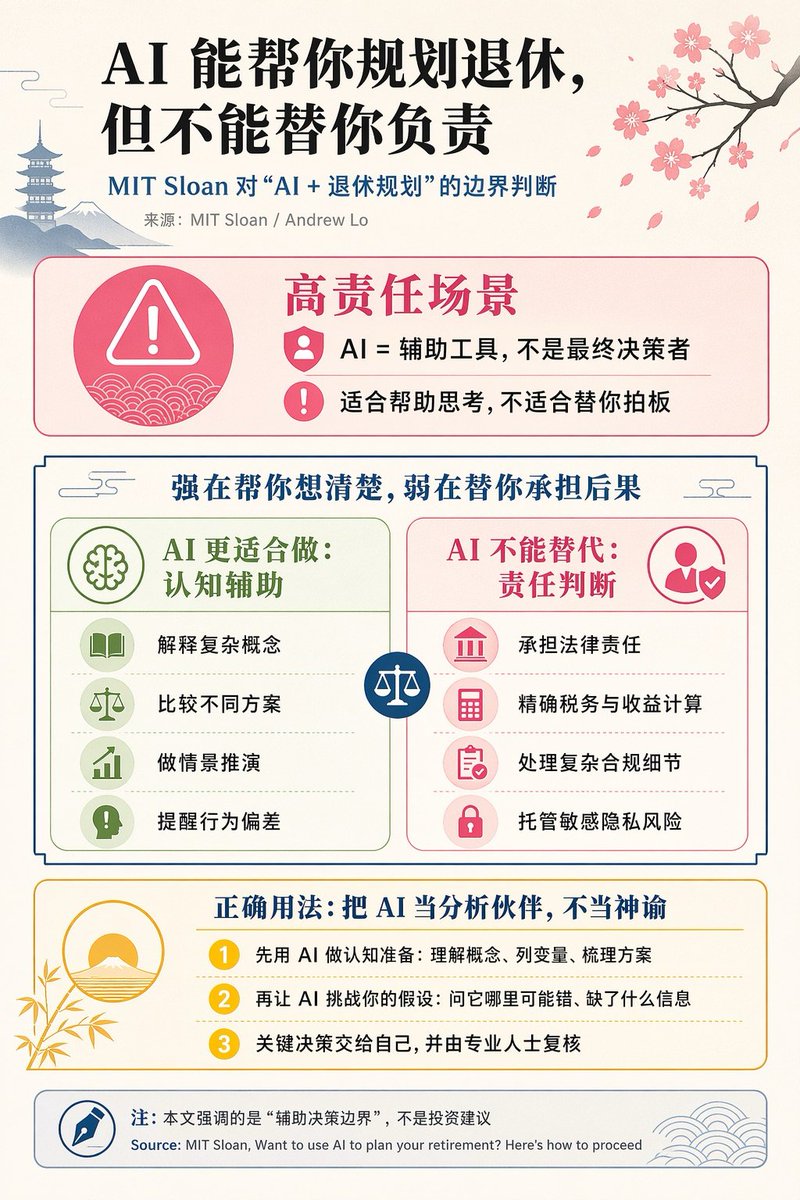
Chińska infografika dotycząca planowania emerytalnego z wykorzystaniem sztucznej inteligencji
To polecenie generuje dopracowaną chińską infografikę redakcyjną na temat ograniczeń sztucznej inteligencji w planowaniu emerytalnym, która nadaje się do publikacji w mediach społecznościowych, edukacji biznesowej lub wizualizacji pomysłów przewodnich.
To jest przykładowy przykład GPT Image 2 dla Grafika i plakat . Skorzystaj z poniższego przykładu gotowego do skopiowania, aby wygenerować podobne materiały wizualne i sprawdź atrybucję Awesome GPT Image 2 Prompts oraz prawa do użytku komercyjnego przed ponownym wykorzystaniem.
Free 1K preview
Generate one preview image instantly, no sign-up required.
Opis
Monit o przygotowanie do kopiowania
{
  "type": "editorial Chinese infographic poster",
  "topic": "AI and retirement planning boundaries",
  "style": "clean academic magazine infographic, flat vector icons, soft textured off-white paper background, balanced Chinese editorial typography, minimal Japanese-inspired decorative motifs",
  "canvas": {
    "orientation": "portrait",
    "aspect_ratio": "3:4"
  },
  "palette": {
    "background": "warm ivory",
    "primary_text": "black",
    "secondary_text": "deep blue",
    "accent_red": "rose pink",
    "accent_green": "muted olive green",
    "accent_yellow": "golden yellow",
    "accent_blue": "navy blue",
    "line_color": "soft gray-blue"
  },
  "headline": {
    "text": "{argument name=\"headline text\" default=\"AI can help you plan for retirement, but it can't take responsibility for you.\"}",
    "position": "top left",
    "font": "bold Chinese serif or Song-style display",
    "large": true
  },
  "subheadline": {
    "text": "MIT Sloan's judgment on the boundaries of \"AI + Retirement Planning\".",
    "position": "below headline",
    "color": "deep blue",
    "font": "bold Chinese sans-serif"
  },
  "source_line": {
    "text": "Source: MIT Sloan / Andrew Lo",
    "position": "below subheadline",
    "color": "gray"
  },
  "layout": {
    "sections": [
      {
        "title": "High-Responsibility Scenarios",
        "position": "upper middle",
        "count": 2,
        "shape": "rounded rectangle with pink border and pale pink fill",
        "icon_count": 3,
        "labels": [
          "AI = Assistive Tool, Not the Final Decision-Maker.",
          "Suitable for helping you think, not for making decisions for you."
        ],
        "left_icon": "large pink warning triangle inside circle over wave pattern",
        "item_icons": [
          "person badge",
          "exclamation mark"
        ]
      },
      {
        "title": "Strong at helping you clarify your thoughts, weak at taking responsibility for the consequences.",
        "position": "center",
        "count": 2,
        "shape": "large framed comparison panel",
        "subsections": [
          {
            "title": "AI is better suited for: cognitive assistance",
            "position": "left",
            "count": 4,
            "color": "green",
            "labels": [
              "Explaining complex concepts",
              "Comparing different options",
              "Conduct scenario simulations",
              "Alert to behavioral deviations"
            ],
            "icons": [
              "book",
              "balance scale",
              "upward chart",
              "exclamation in speech bubble"
            ]
          },
          {
            "title": "AI cannot replace: responsibility judgment",
            "position": "right",
            "count": 4,
            "color": "pink-red",
            "labels": [
              "Bear legal responsibility",
              "Accurate tax and revenue calculation",
              "Handle complex compliance details",
              "Manage sensitive privacy risks"
            ],
            "icons": [
              "courthouse",
              "calculator",
              "clipboard",
              "lock"
            ]
          }
        ],
        "center_icon": "blue circle with white balance scale"
      },
      {
        "title": "Correct usage: Treat AI as an analytical partner, not an oracle",
        "position": "lower middle",
        "count": 3,
        "shape": "rounded rectangle with yellow border and pale cream fill",
        "labels": [
          "First, use AI for cognitive preparation: understand concepts, list variables, and organize solutions",
          "Then, let AI challenge your assumptions: ask it where it might be wrong or what information is missing",
          "Make key decisions yourself, and have them reviewed by professionals."
        ],
        "left_illustration": "yellow rising sun over stylized landscape with bamboo leaves",
        "step_markers": "three yellow numbered circles: 1, 2, 3"
      },
      {
        "title": "Note: This article emphasizes the \"decision-making boundary assistance\", not investment advice.",
        "position": "bottom",
        "count": 1,
        "shape": "rounded rectangle with blue-gray border",
        "labels": [
          "Source: MIT Sloan, Want to use AI to plan your retirement? Here’s how to proceed"
        ],
        "left_icon": "blue fountain pen nib in circle",
        "right_decoration": "gray-blue wave pattern"
      }
    ],
    "decorations": {
      "count": 5,
      "items": [
        "top right cherry blossom branch with pink flowers and falling petals",
        "top left pagoda silhouette",
        "top left distant mountain silhouette",
        "small cloud-line motifs near upper corners of comparison section",
        "subtle wave patterns inside circular icons and lower right footer"
      ]
    }
  },
  "composition": "ample margins, all text in Chinese except the English source line at bottom, strong hierarchy from headline to colored content boxes, symmetrical comparison layout in the middle, polished social-media-ready infographic",
  "rendering": "sharp vector infographic, crisp text, subtle paper grain, no photorealism"
}
Zmienne monitujące
Edytowalne symbole zastępcze argumentów znalezione w monicie, wraz z ich wartościami domyślnymi.
Best for
- - Grafika i plakat visual exploration
- - Image generation and reference-image edits
- - Reusable briefs that keep source attribution visible
Change these parts
- - Subject, product, character, or scene
- - Aspect ratio, camera, lighting, and background
- - Brand, text, color, and output constraints
Recommended model and settings
- - Model: gpt-image-2
- - Input mode: Tekst na obraz
- - Aspect ratio: source
- - Commercial status: review original source
How to use this prompt
- 1. Copy the prompt and preserve its structure for the first test.
- 2. Replace the subject, context, and publishing channel.
- 3. Change one camera, lighting, or style variable per iteration.
- 4. Inspect the output, source, text, and rights before reuse.
Limitations, source, and reuse cautions
- - Generated output is an editable draft, not factual, legal, or rights evidence.
- - Review the linked source, people, brands, logos, text, and third-party media before commercial use.
Więcej przypadków w tej kategorii
Priorytety według kategorii, zgodności trybu wprowadzania, jakości i niższego ryzyka.



Ponowne wykorzystanie i źródło notatek
Użyj tego monitu bezpiecznie po zapoznaniu się ze sprawą.
- 1.Skopiuj monit lub otwórz go bezpośrednio w Dovoo za pomocą przycisku generowania.
- 2.Dostosuj zmienne, proporcje obrazu i obrazy referencyjne do własnego przypadku użycia.
- 3.Przed publikacją lub płatnym wykorzystaniem należy sprawdzić prawa autorskie do źródła, wymogi dotyczące atrybucji oraz ryzyko związane z marką lub podobizną.