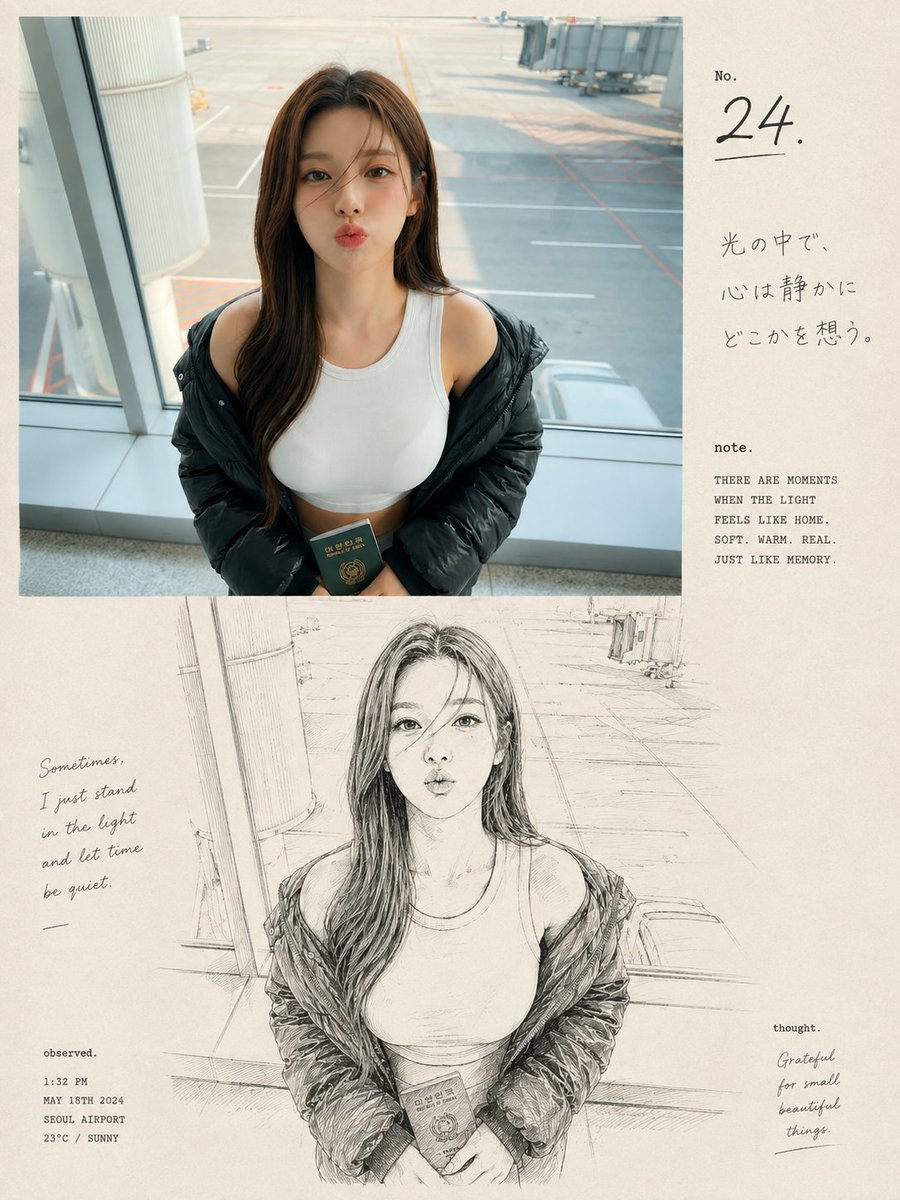
Airport Passport Artbook Page
A complex prompt for a dual-section artbook page that mixes a realistic airport photograph with a Japanese-inspired ink sketch of a woman holding a passport.
To jest przykładowy przykład GPT Image 2 dla Ilustracja i sztuka . Skorzystaj z poniższego przykładu gotowego do skopiowania, aby wygenerować podobne materiały wizualne i sprawdź atrybucję Awesome GPT Image 2 Prompts oraz prawa do użytku komercyjnego przed ponownym wykorzystaniem.
Potrzebujesz pełnego zestawu podpowiedzi? Użyj Ilustracja i sztuka aby uzyskać więcej powiązanych przykładów, odwiedź centrum tematyczne lub otwórz GPT Image 2 szybki katalog aby zobaczyć pełny przykładowy indeks, struktury wielokrotnego użytku i informacje o źródle.
Free 1K preview
Generate one preview image instantly, no sign-up required.
2218/4000
Opis
Monit o przygotowanie do kopiowania
A premium nostalgic editorial photo-and-sketch artbook page featuring a {argument name="subject" default="young East Asian woman at an airport terminal"}, arranged in a clean vertical 3:4 composition. The upper section shows an ultra-realistic candid photograph of the woman standing beside a large airport window, wearing a fitted white sleeveless top with a black puffer jacket casually slipping off her shoulders. She has long dark-brown hair falling naturally over one shoulder and holds a dark green Korean passport gently with both hands near her waist. Her pose is relaxed and natural, with her head turned to the side as she gazes thoughtfully toward the airport runway.

Behind her, realistic airport architecture, glass windows, the runway, painted ground lines, and a boarding gate create an authentic travel atmosphere. Soft natural daylight enters through the window, with subtle film grain, realistic skin texture, authentic colors, shallow depth of field, and an intimate candid photography feeling.

The lower section transforms the exact same woman, clothing, pose, airport environment, and composition into a detailed loose black-and-white hand-drawn ink illustration on warm cream-colored textured paper. Use expressive imperfect lines, delicate cross-hatching, subtle sketch shading, realistic anatomy, and a handmade Japanese-inspired visual diary aesthetic.

Add elegant minimalist editorial typography in the surrounding cream negative space: a small “No. 24.” title, subtle Japanese handwritten-style text, a short poetic caption reading “{argument name="caption" default="Sometimes, I just stand in the light and let time be quiet."}”, and tiny documentary-style notes such as time, date, location, and weather. Include understated words like “note.”, “observed.”, and “thought.” around the layout.

Warm off-white paper texture, slightly imperfect ink printing, sophisticated contemporary photography journal design, nostalgic analog mood, generous negative space, cohesive transition between realistic photograph and sketch illustration, emotionally warm, highly detailed, premium artbook aesthetic, no watermark, no logos, vertical {argument name="aspect ratio" default="3:4"} aspect ratio.
Zmienne monitujące
Edytowalne symbole zastępcze argumentów znalezione w monicie, wraz z ich wartościami domyślnymi.
Zmienny
subject
Domyślny
young East Asian woman at an airport terminal
Zmienny
caption
Domyślny
Sometimes, I just stand in the light and let time be quiet.
Zmienny
aspect ratio
Domyślny
3:4
Best for
- - Ilustracja i sztuka visual exploration
- - Image generation and reference-image edits
- - Reusable briefs that keep source attribution visible
Change these parts
- - Subject, product, character, or scene
- - Aspect ratio, camera, lighting, and background
- - Brand, text, color, and output constraints
Recommended model and settings
- - Model: gpt-image-2
- - Input mode: Tekst na obraz
- - Aspect ratio: source
- - Commercial status: review original source
How to use this prompt
- 1. Copy the prompt and preserve its structure for the first test.
- 2. Replace the subject, context, and publishing channel.
- 3. Change one camera, lighting, or style variable per iteration.
- 4. Inspect the output, source, text, and rights before reuse.
Limitations, source, and reuse cautions
- - Generated output is an editable draft, not factual, legal, or rights evidence.
- - Review the linked source, people, brands, logos, text, and third-party media before commercial use.
Zaimportowano z Awesome GPT Image 2 Prompts . Wymagane jest podanie źródła. Status do użytku komercyjnego to allowed ; przed płatnym użyciem sprawdź prawa autorskie do źródła.
Więcej przypadków w tej kategorii
Priorytety według kategorii, zgodności trybu wprowadzania, jakości i niższego ryzyka.
Ponowne wykorzystanie i źródło notatek
Użyj tego monitu bezpiecznie po zapoznaniu się ze sprawą.
- 1.Skopiuj monit lub otwórz go bezpośrednio w Dovoo za pomocą przycisku generowania.
- 2.Dostosuj zmienne, proporcje obrazu i obrazy referencyjne do własnego przypadku użycia.
- 3.Przed publikacją lub płatnym wykorzystaniem należy sprawdzić prawa autorskie do źródła, wymogi dotyczące atrybucji oraz ryzyko związane z marką lub podobizną.