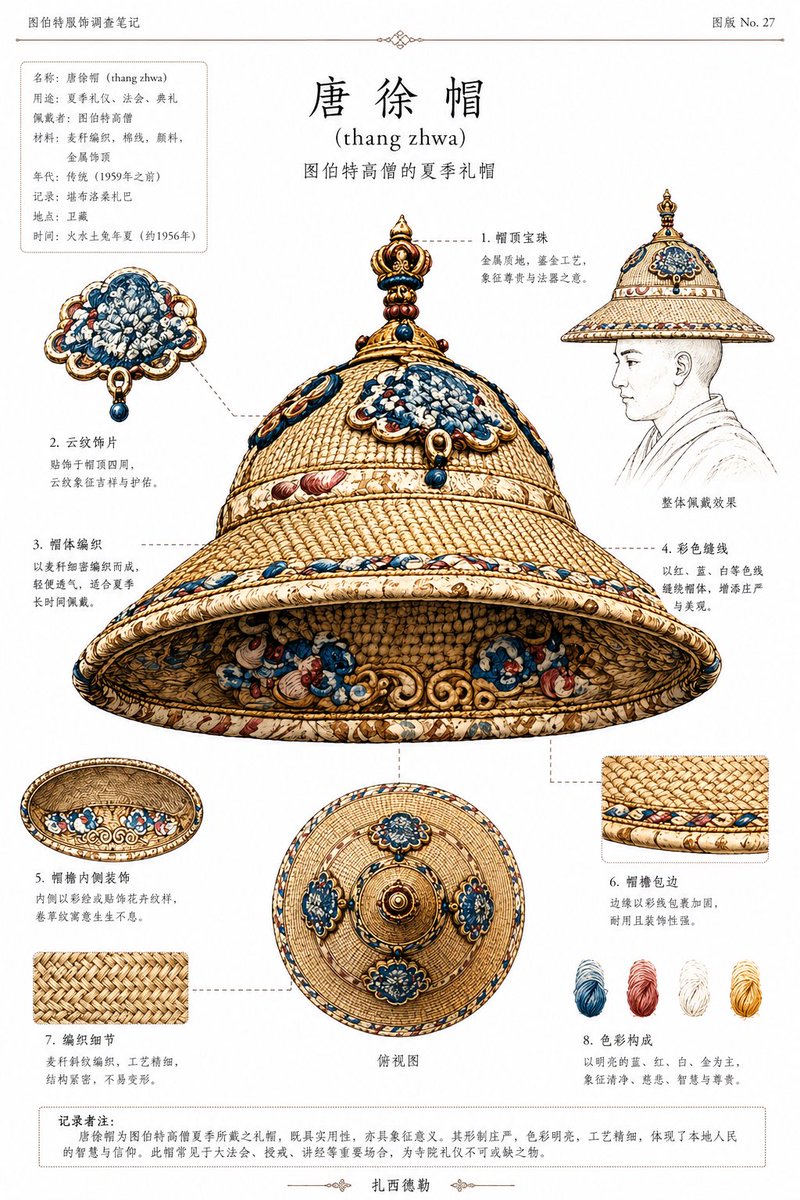
Etnografische plaat voor een Tibetaanse ceremoniële hoed
Deze opdracht zet historische referentiefoto's om in een Chinees archiefdiagram in museumstijl, dat een Tibetaanse ceremoniële hoed documenteert voor gebruik in catalogi, onderzoek of tentoonstellingen.
Dit is een voorbeeld van een GPT Image 2 prompt voor Illustratie & Kunst . Gebruik de onderstaande kant-en-klare prompt om vergelijkbare afbeeldingen te genereren en controleer de Awesome GPT Image 2 Prompts en de rechten voor commercieel gebruik voordat u de afbeeldingen hergebruikt.
Free 1K preview
Generate one preview image instantly, no sign-up required.
Snel
Schrijfklare prompt
Using REFERENCE_0 and REFERENCE_1, create a clean ethnographic archive plate focused on the ceremonial hat. Use REFERENCE_0 as the historical Tibetan context and silhouette reference, and REFERENCE_1 as the color, material, and ornament reference for the hat. Isolate and reconstruct the hat as a museum-style object study, removing the seated body as the main subject. Present the hat on an off-white document page as a scholarly catalog sheet in Chinese with small romanization. Add 8 numbered callouts around the object with fine dashed leader lines, each pointing to a specific structural detail. The centerpiece should be one large three-quarter underside view of the hat. Also include exactly 4 supplementary views/details: 1 side-profile wearing sketch with a faint line-drawn bust, 1 underside interior view, 1 top-down view, and 2 square close-up material swatches. Add exactly 4 thread-color samples near the lower right: blue, red, white, and yellow. At the top center, add the large title {argument name="headline text" default="Tang Xu hat"} with the romanization {argument name="romanization" default="(thang zhwa)"} beneath it, plus a smaller subtitle describing it as a summer ceremonial hat of high-ranking Tibetan monks. In the upper left, add a boxed metadata panel with multiple short Chinese fields, and in the upper right add a plate number reading {argument name="plate number" default="Plate No. 27"}. At the bottom, add one bordered note paragraph in Chinese. Overall style: meticulous archival infographic, anthropological catalog illustration, historically informed, precise woven texture, ivory-gold base with blue and red ornament, elegant print layout, thin rules and decorative divider marks, high-detail object rendering on a plain paper background.Vraagvariabelen
Bewerkbare argumentplaceholders in de prompt, met hun standaardwaarden.
Best for
- - Illustratie & Kunst visual exploration
- - Image generation and reference-image edits
- - Reusable briefs that keep source attribution visible
Change these parts
- - Subject, product, character, or scene
- - Aspect ratio, camera, lighting, and background
- - Brand, text, color, and output constraints
Recommended model and settings
- - Model: gpt-image-2
- - Input mode: Tekst naar afbeelding
- - Aspect ratio: source
- - Commercial status: review original source
How to use this prompt
- 1. Copy the prompt and preserve its structure for the first test.
- 2. Replace the subject, context, and publishing channel.
- 3. Change one camera, lighting, or style variable per iteration.
- 4. Inspect the output, source, text, and rights before reuse.
Limitations, source, and reuse cautions
- - Generated output is an editable draft, not factual, legal, or rights evidence.
- - Review the linked source, people, brands, logos, text, and third-party media before commercial use.
Meer gevallen in deze categorie
Geprioriteerd op basis van categorie, compatibiliteit met invoermodus, kwaliteit en lager risico.


Hergebruik en bronvermeldingen
Gebruik deze prompt veilig nadat u de casus hebt bekeken.
- 1.Kopieer de prompt of open deze direct in Dovoo met de knop 'Genereren'.
- 2.Pas de variabelen, beeldverhouding en referentieafbeeldingen aan uw eigen toepassing aan.
- 3.Controleer vóór publicatie of betaald gebruik de auteursrechten, de vereisten voor naamsvermelding en de risico's met betrekking tot merk of beeltenis.