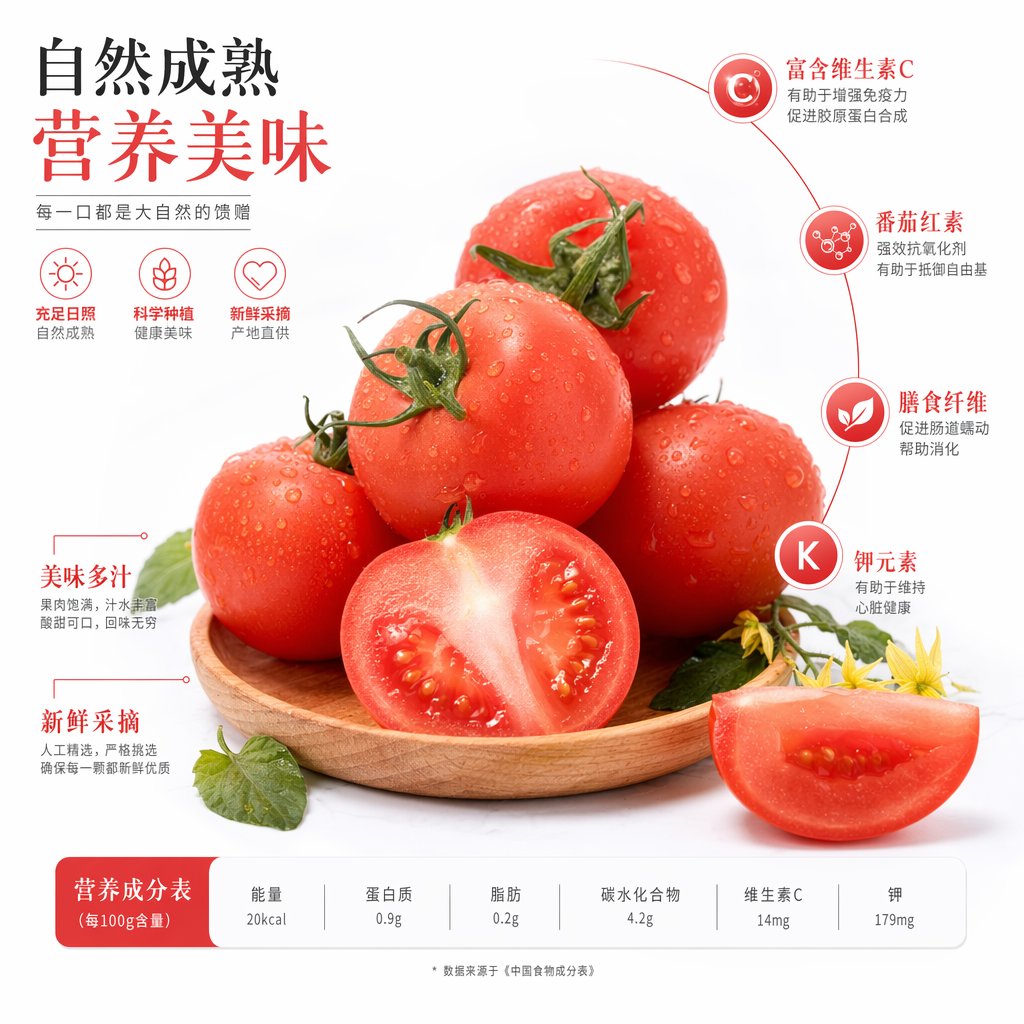
Voedingsposter van Chinese tomaten
Een professionele Chinese reclame voor verse groenten en fruit, met afbeeldingen van verse tomaten, voedingsinformatie en een voedingswaardetabel onderaan. Ideaal voor gebruik in supermarkten, op verpakkingen of in marketingmateriaal voor voedingsproducten.
Dit is een voorbeeld van een GPT Image 2 prompt voor Eten en drinken . Gebruik de onderstaande kant-en-klare prompt om vergelijkbare afbeeldingen te genereren en controleer de Awesome GPT Image 2 Prompts en de rechten voor commercieel gebruik voordat u de afbeeldingen hergebruikt.
Free 1K preview
Generate one preview image instantly, no sign-up required.
Snel
Schrijfklare prompt
A simple, high-end food advertisement poster with a light gray-white studio background, featuring {argument name="fruit name" default="tomatoes"} as the main subject. In the center of the image, display 7 tomatoes arranged on a shallow circular wooden plate: 5 ripe red tomatoes stacked in a pyramid shape, 1 tomato cut in half standing upright in the front center with glistening flesh and visible seeds, and another 1 tomato wedge placed in the lower right foreground. The tomatoes are fresh, vividly red, and covered with realistic water droplets, with most whole fruits having green stems. Add a few green leaves and two yellow tomato blossoms along the lower right edge to enhance freshness. Use soft commercial lighting, gentle shadows, sharp focus, and highly realistic textures to create a sophisticated supermarket poster style.

Design the layout as a Chinese-style nutrition and freshness infographic poster. In the upper left corner, place a prominent two-line Chinese title with a strong typographic hierarchy: the first line in black text is {argument name="headline line 1" default="Naturally ripened"}, and the second line in large warm red text is {argument name="headline line 2" default="Nutritious and delicious"}. Below it, add a smaller gray Chinese slogan: {argument name="slogan text" default="Every bite is a gift from nature"}. Below the slogan, arrange 3 simple red line icons horizontally, each with a short Chinese label and gray subtitle: 1) a sun icon, text “Ample Sunlight”, subtitle “Naturally Ripened”; 2) a sprout or leaf icon, text “Scientific Cultivation”, subtitle “Healthy and Delicious”; 3) a heart outline icon, text “Freshly Picked”, subtitle “Direct from Origin”.

On the right side, draw a thin red arc guide line circling the tomatoes, and stack 4 circular nutrition labels vertically. Each label is a red or red-orange gradient circle with a white symbol or letter inside, connected to the guide line. Use the following Chinese labels and descriptions: 1) the top label is “C”, title “Rich in Vitamin C”, description “Helps boost immunity and promote collagen synthesis”; 2) the second label is a molecule icon, title “Lycopene”, description “Powerful antioxidant helps defend against free radicals”; 3) the third label is a leaf icon, title “Dietary Fiber”, description “Promotes intestinal motility and aids digestion”; 4) the bottom label is “K”, title “Potassium”, description “Helps maintain heart health”.

Below the tomatoes on the left, add 2 red text feature labels with red guide lines: the upper title is “Delicious and Juicy”, accompanied by smaller gray text “Full flesh, rich juice, sweet and sour, with a lasting aftertaste”; the lower title is “Freshly Picked”, accompanied by smaller gray text “Manually selected, strictly chosen to ensure each one is fresh and high quality”.

At the bottom, place a white rounded rectangle nutrition facts bar with a light gray separator. Add a solid red rounded corner label block on the left with the Chinese title {argument name="table title" default="Nutrition Facts (per 100g)"}. On the right, display 6 columns of nutritional components, with gray titles above and dark numerical values below: “Energy” “20kcal”; “Protein” “0.9g”; “Fat” “0.2g”; “Carbohydrates” “4.2g”; “Vitamin C” “14mg”; “Potassium” “179mg”. Place a tiny gray footnote centered below the table: “* Data sourced from the ‘Chinese Food Composition Table’”. Overall style: elegant Chinese fresh food marketing poster, balanced whitespace, infographic design with red accents, and a perfect fusion of realistic product photography and simple vector UI elements.
Vraagvariabelen
Bewerkbare argumentplaceholders in de prompt, met hun standaardwaarden.
Best for
- - Eten en drinken visual exploration
- - Image generation and reference-image edits
- - Reusable briefs that keep source attribution visible
Change these parts
- - Subject, product, character, or scene
- - Aspect ratio, camera, lighting, and background
- - Brand, text, color, and output constraints
Recommended model and settings
- - Model: gpt-image-2
- - Input mode: Tekst naar afbeelding
- - Aspect ratio: source
- - Commercial status: review original source
How to use this prompt
- 1. Copy the prompt and preserve its structure for the first test.
- 2. Replace the subject, context, and publishing channel.
- 3. Change one camera, lighting, or style variable per iteration.
- 4. Inspect the output, source, text, and rights before reuse.
Limitations, source, and reuse cautions
- - Generated output is an editable draft, not factual, legal, or rights evidence.
- - Review the linked source, people, brands, logos, text, and third-party media before commercial use.
Meer gevallen in deze categorie
Geprioriteerd op basis van categorie, compatibiliteit met invoermodus, kwaliteit en lager risico.
Hergebruik en bronvermeldingen
Gebruik deze prompt veilig nadat u de casus hebt bekeken.
- 1.Kopieer de prompt of open deze direct in Dovoo met de knop 'Genereren'.
- 2.Pas de variabelen, beeldverhouding en referentieafbeeldingen aan uw eigen toepassing aan.
- 3.Controleer vóór publicatie of betaald gebruik de auteursrechten, de vereisten voor naamsvermelding en de risico's met betrekking tot merk of beeltenis.