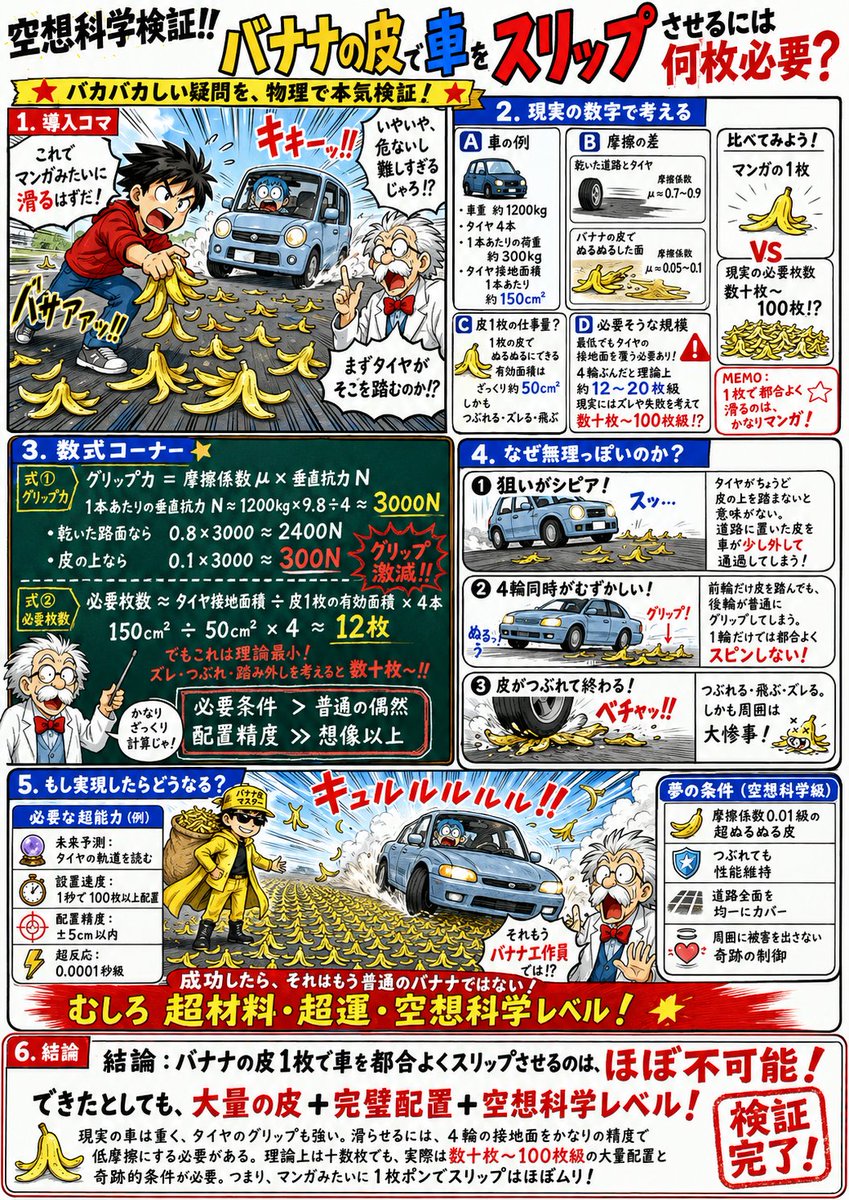
Fictieve wetenschappelijke infographicgenerator
Een zeer gedetailleerde, gestructureerde opdracht voor het maken van infographics in retrostijl die absurde fictieve scenario's verifiëren met serieuze wetenschappelijke berekeningen en diagrammen.
Dit is een voorbeeld van een GPT Image 2 prompt voor Illustratie & Kunst . Gebruik de onderstaande kant-en-klare prompt om vergelijkbare afbeeldingen te genereren en controleer de Awesome GPT Image 2 Prompts en de rechten voor commercieel gebruik voordat u de afbeeldingen hergebruikt.
Free 1K preview
Generate one preview image instantly, no sign-up required.
Snel
Schrijfklare prompt
Create a comical scientific explanation illustration. The verification theme is "{argument name="validation theme" default="How many banana peels are needed to make a car slip?"}"

A vertical A4 manga-style infographic that seriously verifies absurd questions with science and calculations. White background, thick black lines, and emphasis colors of red, blue, and yellow. A design reminiscent of retro educational manga, science reference books, or scientific columns. Use a professor character, surprised people, speech bubbles, hand-drawn arrows, red pen annotations, and chalkboard-style formula boxes. The overall atmosphere should be 'using physics to verify a silly question with full effort,' making it fun, energetic, and not too serious.

Structure:

1.
Depict the theme's situation in an exaggerated and ridiculous way that is understood at a glance. The characters are trying their best, but the appearance is quite reckless. The professor interjects with a comment from the side.

2. Thinking with Real Numbers
Display 3 to 4 boxes of important values related to the theme, such as speed, time, distance, weight, force, temperature, or energy. Include comparison charts or timelines to clearly show the gap between 'human senses' and the 'scale of the phenomenon.'

3. Formula Corner
Draw necessary conditions or comparison formulas largely in chalkboard-style frames. Example: 'Required Ability > Human Limit' 'Reaction Time < Time Phenomenon Occurs' 'Required Force/Speed/Durability ≫ Normal Human.' Formulas don't need to be strictly accurate; keep them intuitive and easy to understand.

4. Is Realization Impossible?
Explain problem points using three small panels. Example: ① Too fast / Too heavy / Too hot ② Precision is too severe ③ Even if successful, the body won't hold out / Surroundings will be in trouble. Include comical failure illustrations, onomatopoeia, and speech bubbles.

5. What If It Was Realized?
Make this part important. Illustrate what superhuman or speculative scientific abilities would be needed to actually succeed. For example, super reflexes, future prediction, abnormal grip strength, ultra-high-speed vision, physical ability to ignore air resistance, or a skeleton that can withstand impact. If necessary, use scientifically impossible numbers like 'reaction speed 0.0001s,' 'grip strength 3000kg,' or 'dynamic vision dozens of times that of a fighter pilot.' Furthermore, depict what happens the moment it is realized. Example: an impact that blows an arm off, sinking into the ground, shockwaves in the surroundings, while the person themselves remains calm. Bring out the 'if successful, they are no longer human' feeling in a fun way.

6. Conclusion
Write the conclusion largely in a red highlighted frame. 'Conclusion: XX is almost impossible for a normal human!' or 'Even if realized, it would be at a superhuman, cyborg, or speculative science level!' Summarize it in a way that states it's impossible for real humans but achievable with speculative scientific abilities.

Design Specifications: Manga paneling + science illustrations + professor's commentary. Use thick headings, red circles, emphasis lines, hand-drawn notes, and speech bubbles frequently. Formulas and numerical values should be large and easy to read, conveying the message intuitively even to children. Finish it like a page from an interesting science reading that is absurd yet strangely convincing.
Vraagvariabelen
Bewerkbare argumentplaceholders in de prompt, met hun standaardwaarden.
Best for
- - Illustratie & Kunst visual exploration
- - Image generation and reference-image edits
- - Reusable briefs that keep source attribution visible
Change these parts
- - Subject, product, character, or scene
- - Aspect ratio, camera, lighting, and background
- - Brand, text, color, and output constraints
Recommended model and settings
- - Model: gpt-image-2
- - Input mode: Tekst naar afbeelding
- - Aspect ratio: source
- - Commercial status: review original source
How to use this prompt
- 1. Copy the prompt and preserve its structure for the first test.
- 2. Replace the subject, context, and publishing channel.
- 3. Change one camera, lighting, or style variable per iteration.
- 4. Inspect the output, source, text, and rights before reuse.
Limitations, source, and reuse cautions
- - Generated output is an editable draft, not factual, legal, or rights evidence.
- - Review the linked source, people, brands, logos, text, and third-party media before commercial use.
Meer gevallen in deze categorie
Geprioriteerd op basis van categorie, compatibiliteit met invoermodus, kwaliteit en lager risico.
Hergebruik en bronvermeldingen
Gebruik deze prompt veilig nadat u de casus hebt bekeken.
- 1.Kopieer de prompt of open deze direct in Dovoo met de knop 'Genereren'.
- 2.Pas de variabelen, beeldverhouding en referentieafbeeldingen aan uw eigen toepassing aan.
- 3.Controleer vóór publicatie of betaald gebruik de auteursrechten, de vereisten voor naamsvermelding en de risico's met betrekking tot merk of beeltenis.