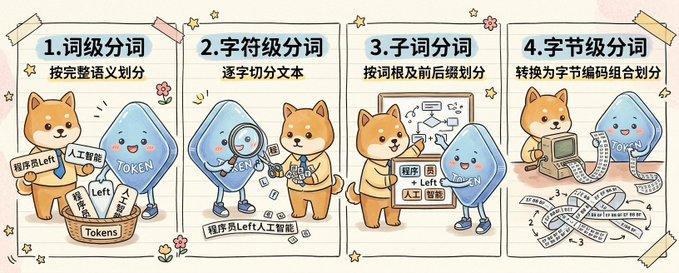
Søt infografikk for tokenisering med fire paneler
Denne ledeteksten genererer en bred håndtegnet infografikk med to maskotfigurer som forklarer fire tokeniseringsmetoder, ideelt for pedagogiske innlegg på sosiale medier om AI og NLP.
Dette er et tilfelle av en GPT Image 2 -ledetekst for Grafikk og plakat . Bruk den kopieringsklare ledeteksten nedenfor for å generere lignende visuelle elementer, og gjennomgå Awesome GPT Image 2 Prompts -attribusjonen pluss kommersielle bruksrettigheter før gjenbruk.
Free 1K preview
Generate one preview image instantly, no sign-up required.
Free text preview doesn’t preserve reference-image consistency.
Spørsmål
Klar til kopiering
{
  "type": "hand-drawn educational infographic illustration",
  "style": "cute notebook doodle style, hand-painted handbook aesthetic, warm beige paper background with faint texture, playful sketchy outlines, soft pastel colors, small flower and star doodles, taped paper-card layout",
  "aspect_ratio": "wide horizontal",
  "subject": {
    "characters": [
      {
        "name": "{argument name=\"dog character name\" default=\"Chai Xiaoqi\"}",
        "species": "Shiba Inu mascot",
        "appearance": "cute orange-brown Shiba Inu with cream muzzle and belly, round face, upright ears, friendly expression, simplified cartoon anatomy"
      },
      {
        "name": "{argument name=\"blue character name\" default=\"Token\"}",
        "species": "blue token mascot",
        "appearance": "rounded triangular blue droplet-shaped character with glossy gradient body, tiny arms and legs, rosy cheeks, smiling face, the word \"{argument name=\"token label\" default=\"TOKEN\"}\" written across the body in white"
      }
    ],
    "theme": "compare four levels of text segmentation in a friendly science-explainer format"
  },
  "layout": {
    "sections": [
      {
        "title": "1. Word-level Segmentation",
        "position": "far left panel",
        "count": 1,
        "subtitle": "Divided according to complete semantics",
        "scene": "A Shiba Inu and a blue Token character stand next to a basket labeled \"Tokens\", which is filled with slips of paper. Visible slips and labels are written with \"Programmer\", \"Left\", \"Artificial Intelligence\", and a small sign next to it reads \"ProgrammerLeft\". The Token character points to the basket, while the Shiba Inu displays sorted fragments."
      },
      {
        "title": "2. Character-level tokenization",
        "position": "left-center panel",
        "count": 1,
        "subtitle": "Splitting the text character by character",
        "scene": "A blue Token character uses a magnifying glass to examine small character blocks scattered on the floor, while a Shiba Inu organizes them nearby. A label strip at the bottom reads \"ProgrammerLeftArtificialIntelligence\", serving as a continuous text sample broken down into individual characters."
      },
      {
        "title": "3. Subword tokenization",
        "position": "right-center panel",
        "count": 1,
        "subtitle": "Divide by root words and prefixes",
        "scene": "The Shiba Inu points to a project demonstrating root word splitting and arrows, with a blue Token mascot standing next to it. Small paper labels contain mixed fragments such as \"program\", \"member\", \"Left\", \"artificial\", \"intelligence\", emphasizing morpheme or subword groupings."
      },
      {
        "title": "4. Byte-level tokenization",
        "position": "far right panel",
        "count": 1,
        "subtitle": "Convert to byte encoding combinations for division",
        "scene": "the Shiba Inu uses a retro computer with a long printed strip emerging from it, and the blue token character stands to the side. Across the lower half are ribbon-like strips filled with repeated byte numbers and symbols, especially \"1\", \"2\", \"3\", \"4\", and \"-3\", illustrating byte encoding combinations."
      }
    ],
    "decorations": {
      "count": 10,
      "items": [
        "4 pieces of taped corners in pale yellow and pink",
        "small five-point stars scattered around panels",
        "tiny flower doodles between panels",
        "curved motion lines near character gestures",
        "notebook-style vertical panel dividers",
        "rounded rectangular panel frames",
        "light shadows behind paper panels",
        "faint horizontal paper grain",
        "small spark icons",
        "hand-drawn accent marks"
      ]
    }
  },
  "composition": "four equal vertical panels arranged left to right across one canvas, each panel with a bold numbered Chinese heading and a smaller subtitle beneath it, each panel showing the two mascots acting out a different tokenization concept",
  "text": {
    "headings": [
      "1. Word-level Segmentation",
      "2. Character-level tokenization",
      "3. Subword tokenization",
      "4. Byte-level tokenization"
    ],
    "subtitles": [
      "Divided according to complete semantics",
      "Splitting the text character by character",
      "Divide by root words and prefixes",
      "Convert to byte encoding combinations for division"
    ]
  },
  "quality": "clean, polished, adorable, presentation-ready educational visual",
  "use_case": "social media science explainer comparing tokenization methods for AI and NLP"
}
Promptvariabler
Redigerbare argumentplassholdere funnet i ledeteksten, med standardverdiene.
Best for
- - Grafikk og plakat visual exploration
- - Image generation and reference-image edits
- - Reusable briefs that keep source attribution visible
Change these parts
- - Subject, product, character, or scene
- - Aspect ratio, camera, lighting, and background
- - Brand, text, color, and output constraints
Recommended model and settings
- - Model: gpt-image-2
- - Input mode: Bilde til bilde
- - Aspect ratio: source
- - Commercial status: review original source
How to use this prompt
- 1. Copy the prompt and preserve its structure for the first test.
- 2. Replace the subject, context, and publishing channel.
- 3. Change one camera, lighting, or style variable per iteration.
- 4. Inspect the output, source, text, and rights before reuse.
Limitations, source, and reuse cautions
- - Generated output is an editable draft, not factual, legal, or rights evidence.
- - Review the linked source, people, brands, logos, text, and third-party media before commercial use.
Flere saker i denne kategorien
Prioritert etter kategori, kompatibilitet med inndatamodus, kvalitet og lavere risiko.


Gjenbruk og kildenotater
Bruk denne ledeteksten på en trygg måte etter at du har forhåndsvist saken.
- 1.Kopier ledeteksten eller åpne den direkte i Dovoo med genereringsknappen.
- 2.Juster variabler, sideforhold og referansebilder for ditt eget brukstilfelle.
- 3.Før publisering eller betalt bruk, kontroller kilderettigheter, krav til kreditering og risikoer knyttet til merkevare eller likhet.